Sunday, 19 November 2006

Ireland burn bright in gloomy Dublin

Irish cohesion trumps Wallabies

Ireland allowed their fans to dream of world domination after conquering not only Australia but tempestuous conditions in Dublin on Sunday, recording a remarkable 21-6 victory over the touring Wallabies.
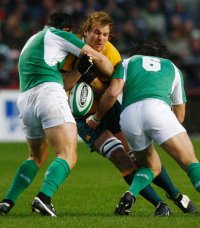
Like England's progression towards Rugby World Cup 2003, Ireland are beginning to collect scalps from the Southern Hemisphere and the benefits of Ireland's policy of keeping faith in an established core of players is now evident for all to see.

Australia won't be the first side to put a loss down to that tired old excuse of "RWC development" -- and, indeed, some of their new combinations looked decidedly undercooked -- but the inescapable truth is that they were second-best to Ireland in every facet of play.

The locals were simply outstanding, earning a standing ovation from a soaked but satisfied crowd not only at full-time but also as they trooped off for the interval.  A rare honour indeed, but thoroughly deserved.

Both sides had beseeched the heavens to supply a dry canvas for their respective artists, but the gods failed to deliver the goods:  the weather was worse than filthy.  The rain lashed Lansdowne Road, coming down at all angles as a swirling wind took on the appearance of a nascent hurricane.  Perhaps they won't have to demolish this old pile after all, it will just be carried off across Ireland before disappearing into the mutinous Shannon waves.

Somehow the conditions failed to dampen the spectacle.  Modern rugby jerseys are not designed for the old up-the-jumper tactic, but credit goes to both sides for shunning all notions of safety-first, the handling was simply outstanding -- this was bare-foot rugby on Bondi Beach rather a wrestle in an Irish bog.

The official statistics tell us that the Irish completed 119 passes and only committed 16 errors.  It's hard to believe but it's near enough to the truth.  Where are the All Blacks when you need them?

Wallaby skipper Stirling Mortlock landed two penalties but Australia never threatened to score a try and were not helped by having Phil Waugh and replacement Mat Rogers sin-binned simultaneously for fighting;  Denis Leamy joined them for his role in the same sorry skirmish.

Ireland, who beat South Africa 32-15 last Saturday, pulverised the Australia pack with the maniacal Neil Best spearheading a dominant forward display that snuffed out a promising start from the visitors that bore an early penalty goal.

Ireland then staged a series of attacks which saw Australia's defensive line stretched to the limit.  One raid produced 21 phases of play before Matt Giteau knocked Shane Horgan off course with a try-saving tackle.

Despite failing to secure the five points, the Irish began to believe in their own dexterity and continued to press.  Geordan Murphy was the next man to come close, but the television match official ruled that a double-tackle by Chris Latham and Wycliff Palu had forced the Irishman to knock-on in the act of scoring.

But all was not lost, referee Marius Jonker went back to a penalty for off-side and Ronan O'Gara landed the shot at goal via a kind deflection off the uprights.

Australia were now under heavy pressure, turning over possession on their own line-out and relying on a last-ditch tackle from Mark Gerrard to keep out O'Driscoll.

Palu was penalised for holding onto the ball after going to ground and Ireland opted for the line-out after assessing the wind conditions.

Their decision paid dividends as the ensuing move led to a fine score in the left corner -- following a juggling display from O'Gara.

The Munster fly-half attempted to offload but fumbled the ball and recovered as he went about running out of support.

He spotted Hickie unmarked on the left touchline and fired a crossfield kick which the Leinster wing gathered before jinking between three Wallaby defenders to score.

It was a magnificent finish from Hickie and Australia's problems deepened when Larkham limped off and was replaced by Rogers.

Gerrard kicked the ball out of play, allowing Ireland to stage a fresh assault which Horgan used to offload in the tackle to Leamy -- and it took more desperate defending to keep the Munster back row out.

They could not be denied a minute into first-half injury-time, however, as they pinched a line-out and ran in a stunning try.

Superb handling from O'Gara released Gordon D'Arcy who dashed forward before feeding the outstanding Shane Horgan and the big Leinster winger drew Gerrard and supplied the scoring pass to Murphy.  O'Gara converted to bring the curtain down on an inspired first half.

Australia drew first blood in the second period with a Mortlock penalty but Ireland were still in control thanks to the reams of possession secured by their pack.

O'Gara sent a penalty between the uprights to give Ireland an 18-6 lead and tempers boiled over in the 52nd minute when an exchange of punches between Leamy and Waugh resulted in a large meeting between minds and fists.

Both players were yellow carded and Rogers joined them in the sin-bin for involving himself in the fight.

Australia's discipline was in danger of disintegrating as Jonker penalised them 10 yards for back-chatting.

The Wallabies were seeing more possession but when Ireland came up with the ball in the 58th minute O'Gara sent them deep into opposition territory with a sublime touch-finder and then booted his third penalty.

O'Gara missed a penalty in the 66th minute but Australia looked dead on their feet and seemed incapable of staging a comeback.

Little more headway could be made as the conditions grew increasingly worse and the influx of late replacements disturbed the rhythm of the game -- a common and highly frustrating aspect of modern rugby.

But it mattered not one wit, Ireland were already out of sight.

Man of the match:  Rocky Elsom and Chris Latham kept the Australian flag flying, albeit at half-mast, but the Irish were so dominant that one feels compelled to hand out a joint 22-man award.  The glories of Ireland's backline are well documented, but it was the Irish forwards who impressed on Saturday.  Denis Leamy, bar some indiscipline, swatted the Wallabies off like flies and John Hayes got through a mountain of work in the tight, but our award goes to the marauding Neil Best who got himself absolutely everywhere, not least up the noses of the opposition.

Moment of the match:  Ireland's second try was an absolute corker.  Stolen line-out ball turned into points by the cunning of the backline spells "teamwork".  But we'll opt for the crowd's standing ovation at the break which sums up Ireland's magnificent first 40 minutes.

Villain of the match:  Denis Leamy and Phil Waugh deserve slapped wrists for their disagreement in the second half, but Mat Rogers deserves more for steaming into other people's business from 20 yards away.  This one's for you, Mat.

The scorers:

For Ireland:
Tries:  Hickie, Murphy
Con:  O'Gara
Pens:  O'Gara 3

For Australia:
Pens:  Mortlock 2

Yellow card(s):  Waugh (Australia) -- fighting, 52; Rogers (Australia) -- fighting, 52; Leamy (Ireland) -- fighting, 52.

Teams:

Ireland:  15 Geordan Murphy, 14 Shane Horgan, 13 Brian O'Driscoll (captain), 12 Gordon D'Arcy, 11 Denis Hickie, 10 Ronan O'Gara, 9 Isaac Boss, 8 Denis Leamy, 7 David Wallace, 6 Neil Best, 5 Paul O'Connell, 4 Donncha O'Callaghan, 3 John Hayes, 2 Rory Best, 1 Bryan Young.
Replacements:  16 Frank Sheahan, 17 Marcus Horan, 18 Malcolm O'Kelly, 19 Simon Easterby, 20 Peter Stringer, 21 Paddy Wallace, 22 Girvan Dempsey.

Australia:  15 Chris Latham (vice-captain), 14 Clyde Rathbone, 13 Lote Tuqiri, 12 Stirling Mortlock (captain), 11 Mark Gerrard, 10 Stephen Larkham (vice-captain), 9 Matt Giteau, 8 Wycliff Palu, 7 Phil Waugh (vice-captain), 6 Rocky Elsom, 5 Mark Chisholm, 4 Nathan Sharpe, 3 Guy Shepherdson, 2 Brendan Cannon, 1 Al Baxter.
Replacements:  16 Tai McIsaac, 17 Benn Robinson, 18 Al Campbell, 19 George Smith, 20 Josh Valentine, 21 Mat Rogers, 22 Scott Staniforth

Referee:  Marius Jonker (South Africa)
Touch judges:  Nigel Owens (Wales), Malcolm Changleng (Scotland)
Television match official:  Mark Lawrence (South Africa)
Assessor:  Brian Smith (Ireland)

Saturday, 18 November 2006

Injuries sour Scotland's glory

Beattie and Cusiter carried off

Scotland underlined their burgeoning stature with a well-taken 34-22 victory over a game Pacific Islanders side at Murrayfield on Saturday.  But the win, in which the hosts had led 31-5, was marred by injuries to Johnnie Beattie and Chris Cusiter, both of whom now look doubtful for Scotland's match against Australia next week.

Whether the Scots have returned to the path that they slide off in the late nineties is still a matter of debate, but Frank Hadden's men have produced enough evidence to suggest that this revival could blossom into a bright new era.

True, the Pacific Islanders are not quite the All Blacks, but they put up a decent if disjointed fight.  What was impressive about Scotland was their ability to dictate terms.

The Islanders did excel in one area of play and that was their intuition on the counterattack, but rugby depends on a lot more than pure god-given ability.

The Islanders' lack of together-time was evident for long passages of play, passes checked their receivers and defensive patterns lacked cohesion.  But these guys can put passes together and threatened the comeback of all comebacks before the Scots managed to put a lid on the gathering storm.

Plenty of column inches had been dedicated to the Islanders' love of running but it was Scotland who made the more enterprising start even though that adventure came at quite a price.

Johnnie Beattie was forced to exit the stage in the eighth minute of the game with an ankle injury and the gloom grew deeper as Chris Cusiter followed the No.8 to the medical tent just seconds later -- a sad moment for a man keen to reassert himself on the Test stage after a long injury-enforced absence.

But Marcus Di Rollo soon lifted Scottish spirits by punctuating good approach work from his forwards with an easy try born of lackadaisical defending.  Chris Paterson converted in the shadow of the uprights.

The forwards spied a chink in the Islanders' armoury and began to turn the screw with a series of handsome driving mauls.

With the Islanders in reverse, Mike Blair -- on for the luckless Cusiter -- decided to ship the ball wide, and a brilliant miss-three pass from Dan Parks found Dave Callam -- on for the luckless Beattie -- who slid into the corner for Scotland's second try; Paterson added the extras with a fine conversion.

Scotland had their tails up now and began to play wide rugby, with Simon Webster to the fore.

The Islanders did what they could with limited possession, but their efforts lacked cohesion.  Frustration got the better of the tourists and Epi Taione was soon trudging off to the sin-bin for killing the ball.

Scotland made good use of their numerical advantage; Kelly Brown broke off the back of a driving maul to score and he was soon followed by Andrew Henderson who snaffled a try on the back of another fine break from Webster.

Paterson converted both tries to leave Scotland 28-0 up after just 28 minutes.  It seemed Christmas had come early.

But the locals were unable to maintain the momentum and a poor clearance from Parks gifted the visitors a line-out on the blue 10-metre line.

With a sniff of a score, island intuition kicked into gear and fine handling across the backline allowed Rupeni Caucaunibuca to stroll in for a try on his opposite wing.

Tusi Pisi missed the difficult conversion and Paterson drew the first half to a close by slotting a 42-metre penalty.  At 31-5 up at the break, Scotland's half-time oranges must have tasted very sweet indeed.

Credit to the Islanders, they could have easily thrown in the towel but they exploded into the second period, scoring two tries in the first five minutes.

Kameli Ratuvou was the first man over the whitewash after he scooped up spilt Scottish possession to poach an unconverted try.

Then Caucaunibuca gave birth to a length-of-the-field try, scored by Daniel Leo, that owed its metamorphosis to the natural dexterity and vision of the tourists.

But Pisi failed to land his conversion yet again, with Parks doing well to charge down his kick at goal.

Scotland tried to lure their increasingly confident guests into a pitched battle, but the Islanders were having none of it.  Great handling and Caucaunibuca's phenomenal strength almost produced another long-distance try, but Sean Lamont performed miracles in defence.

Scotland put their thinking caps on and Parks began to play for territory, but quick throw-in after quick throw-in kept island fires burning.  They were beginning to click.

Then, in the manner of stern parents, Scotland stamped order on the raucous proceedings, confining their rowdy guests to their own half via boot and brawn.

Lome Fa'atau almost got over the line at the end of one of a handful of jail-breaks, but good cover defence took him into touch.

Di Rollo added a drop-goal in the closing stages of the game, but it was the Islanders who had the last word as Ratuvou picked up his second try of the day after collecting his own grubber.

Pisi finally found his range with the conversion, but it was too little too late.

Man of the match:  Plenty of fine individual performances from the Islanders, but this award must go to a Scot.  Kelly Brown had an industrious day on the openside, Sean Lamont was a rock in defence and Marcus Di Rollo held the backline together.  But our man of the match is Simon Webster whose adventurous running lines out-islanded the Islanders.

Moment of the match:  Could it be Rupeni Caucaunibuca's first touch?  Or Seru Rabeni's pile-driving tackle on Simon Taylor?  We'll opt for the free-flowing build up to Leo's try.

Villain of the match:  Epi Taione earned a yellow-card, but it wasn't evil incarnate.  No award.

The scorers:

For Scotland:
Tries:  Di Rollo, Callam, Brown, Henderson
Cons:  Parks, Paterson 3
Pen:  PatersonDrop goal:  Di Rollo

For the Pacific Islanders:
Tries:  Caucaunibuca, Ratuvou 2, Leo
Con:  Pisi

Yellow card(s):  Taione (Pacific Islanders) -- killing the ball, 25

The teams:

Scotland:  15 Chris Paterson (captain), 14 Simon Webster, 13 Marcus Di Rollo, 12 Andrew Henderson, 11 Sean Lamont, 10 Dan Parks, 9 Chris Cusiter, 8 Johnnie Beattie, 7 Kelly Brown, 6 Simon Taylor, 5 Scott Murray, 4 Nathan Hines, 3 Euan Murray, 2 Dougie Hall, 1 Gavin Kerr.
Replacements:  16 Ross Ford, 17 Allan Jacobsen, 18 Alastair Kellock, 19 Dave Callam, 20 Mike Blair, 21 Phil Godman, 22 Hugo Southwell.

Pacific Islanders:  15 Norman Ligairi, 14 Lome Fa'atau, 13 Kameli Ratuvou, 12 Elvis Seveali'i, 11 Rupeni Caucaunibuca, 10 Tusi Pisi, 9 Moses Rauluni, 8 Epi Taione, 7 Nili Latu, 6 Viliami Vaki, 5 Daniel Leo, 4 Simon Raiwalui (captain), 3 Tevita Taumoepeau, 2 Mahonri Schwalger, 1 Taufa'ao Felise.
Replacements:  16 Aleki Lutui, 17 Justin Va'a, 18 Ma'ama Molitika, 19 Semo Sititi, 20 Junior Poluleuligaga, 21 Seremaia Bai, 22 Seru Rabeni.

Referee:  Bryce Lawrence (New Zealand)
Touch judges:  Alan Lewis and George Clancy (both Ireland)
TMO:  Hugh Watkins (Wales)

Pumas race back to win in Rome

Todeschini sparks another Argentine comeback

Argentina staged a superb second-half comeback to claim a 23-16 victory over Italy in Rome on Saturday.

Have you heard of a monkeys' wedding?  When the sun shines and the rain falls at the same time, that's a monkey's wedding.  That's what we had in Rome on Saturday afternoon, but there was certainly not a bagful of tricks on the field in that tryless first half.

Oh there could have been a try but prop Marcos Ayerza knocked on, which was the only way that there would not be a try.  Ayerza had a prodigal half as he gave away three penalties, one of which gave David Bortolussi a long goal-kick from his own half, which he goaled to give the Azzurri the lead.

In fact the Pumas were prodigal for they gave away ten penalties (to three) in that half.

It was a half of much kicking, a lot of it desultory.

When Alessandro Zanni was penalised at a tackle/tuck, Federico Todeschini, a hero at Twickenham the week before, goaled a penalty to open the scoring.

A bit of unsubtle barging in the line-out by young Estaban Lozada enabled Bortolussi to level the scores.  penalised at a scrum -- he was penalised twice at collapsed scrums -- Ayerza enabled Bortolussi to put Italy ahead and then just on half time he gave his side a 9-3 lead with a 45-metre penalty when the Pumas captain of the day, Gonzalo Longo, tackled late.

Sin novedad!  There was nothing notable to report, sir.

The second half was a bit better.  After all, there were three tries -- two long-range affairs by Argentina and a well-worked try by Italy.

Todeschini scored first in the second half when the Italian hooker Carlo Festuccia went off-side.

After that Italy looked promising, despite their erratic flyhalf Ramiro Pez who served Argentina well.  (The little man comes from Córdoba in Argentina.  (Isn't Fifth Columnist a Spanish concept?)  There were promising breaks by Pablo Canavosio, Gonzalo Canale and Mirco Bergamasco.  (The first two are also Argentinians which suggests that they really were trying to serve their adopted country well.)

But it was the Pumas who scored first.  Their handling just inside their own half broke down but big Ignacio Corleto, playing on the right wing, grabbed the ball and raced down the touch-line, bursting inside through Marco Bortolami's tackle to feed Todeschini on his insiode, and the flyhalf scored a try which he converted.

The second try was also a break out as the ball went from industrious Horacio Agulla on the left wing to Miguel Avramovic and then to Martín Durand and back to Avramovic who was delighted to score.  Again Todeschini converted.  20-9 to Argentina after 62 minutes.

Lots of substitutions happened about this time.  One of them was flank Juan Manuel Leguizamon who went straight into action and straight out of it again.  He was involved in a scuffle and seemed to be complaining about a finger in the eye but the referee had seen him interfering with the ball in the tackle and sent him, holding his right eye, to the sin bin.

From the second of two attacking line-outs, the Italians went rapidly right and replacement flyhalf Andrea Scanavacca played back inside to left wing Marko Stanojevic who cut clean through to score.

The appearance of Scanavacca at flyhalf made a vast difference to Italy's ability to run the ball.

Italy were running the ball because they were within a try of possible victory but Scanavacca was penalised for holding on in a tackle and Todeschini, ineluctably, lobbed the long kick over, and the final whistle went.

Man of the Match:  It was not a match for heroes at all but Mirco Bergamasco and Paul Griffen did well for Italy while Horacio Agulla was busy for Argentina but our Man of the Match, despite two lost line-outs, was hooker Mario Ledesma.

Moment of the Match:  There were three tries, but the breath-catching clean finish of Marko Stanojevic gets our nod.

Villain of the Match:  Juan Manuel Leguizamon got the yellow card but if somebody really did set out to poke him in the eye, that would be the villain.

The scorers:

For Italy:
Try:  Stanojevic
Con:  Bortolussi
Pens:  Bortolussi 3

For Argentina:
Tries:  Todeschini, Avramovic
Cons:  Todeschini
Pens:  Todeschini 3

The teams:

Italy:  15 David Bortolussi, 14 Pablo Canavosio, 13 Gonzalo Canale, 12 Mirco Bergamasco, 11 Marko Stanojevic, 10 Ramiro Pez, 9 Paul Griffen, 8 Sergio Parisse, 7 Mauro Bergamasco, 6 Alessandro Zanni, 5 Marco Bortolami (captain), 4 Santiago Dellape, 3 Martin Castrogiovanni, 2 Carlo Festuccia, 1 Andrea Lo Cicero.
Replacements:  16 Fabio Ongaro, 17 Carlos Nieto, 18 Carlo Antonio Del Fava, 19 Josh Sole, 20 Simon Picone, 21 Andrea Scanavacca, 22 Walter Pozzebon.

Argentina:  15 Juan Martin Hernández, 14 Ignacio Corleto, 13 Miguel Avramovic, 12 Manuel Contepomi, 11 Horacio Agulla, 10 Federico Todeschini, 9 Nicolas Fernandez Miranda, 8 Gonzalo Longo (captain), 7 Juan Fernandez Lobbe, 6 Martín Durand.  5 Patricio Albacete, 4 Esteban Lozada, 3 Martín Scelzo, 2 Mario Ledesma, 1 Marcos Ayerza.
Replacements:  16 Alberto Vernet Basualdo, 17 Juan Gómez, 18 Jaime Arocena, 19 Juan Manuel Leguizamon, 20 Nicolás Vergallo, 21 Hernán Senillosa, 22 Pablo Gómez Cora

Referee:  Craig Joubert (South Africa)
Touch judges:  Joël Jutge, Romain Poite (both France)
Television match official:  Tim Hayes (Wales)

France flicker but ABs still too good

Paris falls to Carter's charms

New Zealand completed a series whitewash over France courtesy of a hard-fought 23-11 victory at Stade de France in Paris on Saturday evening.  The locals put in a hugely improved performance, even notching up the day's first try, but the All Blacks warmed to the task and order was soon restored via the impeccable orchestration of Daniel Carter.

Vive la difference!  Well, they did for a while anyway.  When Cédric Heymans took Florian Fritz's pass and scored the opening try after eight minutes it looked as though the new joie de vivre running through the French team's veins might be enough to cause a surprise.

Sadly, the ensuing 32 first-half minutes were more than enough of a reminder that this New Zealand has far too much of the je ne sais quoi up top to be ruffled by such a tiny faux pas as the drop of a high ball by Leon MacDonald which led to Heymans' try.

Right on the half-time whistle the Kiwis produced their most exquisite moment of le jeu beau yet to send Rokocoko in at the corner, and the game settled into an all-too-familiar pattern thereafter.

Quelle dommage (and here the awful bon mots cease) for France's rather dour tactics -- the same pattern of kicks and line-out forward drives as last week -- were more effective because of the added zeal which with the French went about their tasks, and briefly threatened an upset.

There were a lot of aspects different about this night from the nightmare of Lyon seven days ago.  The glittering Stade de France and its space-age light and roof provided an altogether grander platform for one.

Then there was the preparation of the French team.  Run into the ground by their heavy club workload and by a gruelling Bernard Laporte schedule last week, the French squad apparently enjoyed a large proportion of this week relaxing.  It paid off, there were far more beans filling the French frames.

It was appropriate that this should be the training schedule before the night that celebrated the 100th anniversary of France's first-ever Test against New Zealand -- it was probably a similar schedule in those days, although with different pre-match diets.  The French jerseys were the same as 100 years ago and different from last week, and the spirit of the players was too.

Right from the first minute, when New Zealand claimed their own kick-off but were driven back some ten metres in the tackle, you sensed that France were more up for it.  Unfortunately, right from the second minute, when Dan Carter charged down Damien Traille's kick and nearly scored, you sensed that just being more up for it might not be enough.

Traille is not the answer at fly-half for France.  His kicking boot may be powerful, but comparing his boot to Carter's in terms of balancing power and precision is like comparing a sawn-off shotgun to a expertly-crafted, telescopically-sighted, high calibre hunting rifle.  In the fourth minute, Traille fired a kick down the field vaguely to the left and to the waiting Carter, whose return swept over the pitch and bounced flawlessly into touch in the French 22.

Carter is a better runner, but fly-halves are not always selected for running.  However Traille offered very little beyond static passes and meat-and-veg kicks to the New Zealand cover.  There was not a shred of invention to be seen, and when you are facing Collins, So'oialo, and Nonu, you have to have something extra that will make them cautious about burying you into the turf.  Otherwise ...

Carter put New Zealand ahead after three minutes with a penalty, but five minutes later MacDonald's howler -- quite where he thought the ball would land is a mystery but it could have been Lyon, so far was he away from it -- let Heymans in for France's try.

It was, on the basis of enthusiasm, deserved.  Where last week the French had slithered off the All Blacks as though they were covered in linseed oil, the tackles this week were square-shouldered, head-on, high-speed, and aimed at the thighs.  Traille's kick that led to the try was from turnover ball, something the French managed six times altogether, and the All Blacks looked unsettled.

Soon enough though, in the manner that sets them apart from other mortals, the visitors found their rhythm.  Carter made the score 5-6 with his second penalty after Jean-Baptiste Elissalde was accused of collapsing a maul which the All Blacks had driven 25m.  Then, Sitiveni Sivivatu launched a counter-attack which ought to have culminated in a try but Nonu ignored three support runners.

The forward battle was intriguing.  France were once again capable in the mauls, but in the scrum they looked alarmingly weak.  In the 23rd minute, they were comprehensively shoved off their own ball, and Carter was only foiled on the turnover by an excellent cover tackle from Elissalde and full-back Pepito Elhorga.  All of New Zealand's other scrums bar one had to be reset at least twice, a sure sign that the other team is struggling.

That tackle ended Elissalde's involvement in the game, and Yachvili was never in the same class against the bustling Kelleher.  Kelleher's break led to Carter's third penalty on the half-hour after a hand in the ruck, and finally on half-time came the inevitable try.

It was worth waiting for.  MacDonald, who had had a miserable first half, dropping two easy passes as well as the early high ball, made amends by searing past Fritz.  So'oialo and McCaw did the link work and drew in the defenders, and then wide it went to Sivivatu, Carter, and finally to Joe Rokocoko, who got past Rougerie at the second time of asking for another classy All Black score.  Carter converted for a 5-16 half-time scoreline.

The ten minutes after the break were one-way traffic.  Wave after wave of All Black pressure hit the French wall, budging it back metre by hard-earned metre, until finally Carter switched sublimely (it could have been King Carlos himself) with Nonu to send the latter under the posts and to take the score to 5-23 with half an hour still to play.

Then we saw just how complete this New Zealand team is.  France battled their way back, and enjoyed some 70 per cent of the possession thereafter.  But not once did they ever look like scoring, even when the silly kicks were abandoned for more direct line-busting methods.  Collins, So'oialo, and Nonu stood out for the tackle rate, but every All Black player did his bit, in a defensive display that impressed far more than the clever tries.  The two penalties conceded were bare irritations to the scoreline, nothing to the result.

Only once, in the final minute, was the defence genuinely pierced, and even then four cover tacklers herded Rougerie into a blind corner.  That was one of the very very rare occasions that France even made it into the All Black 22.

Over two Tests, New Zealand have beaten France in France by nine tries to one and 70 points to 14.  In both matches they gave the appearance of being in second gear for half the time.  Is there anything that can be done?

Man of the match:  For France, Jean-Baptiste Elissalde was having a stormer before his injury, Cedric Heymans was everywhere, and Julien Bonnaire was a real nuisance at the breakdown.  In the black shirts, Dan Carter was on song, Ma'a Nonu was threatening, and Richie McCaw a mirror of Bonnaire.  But for the work in the final half hour, Jerry Collins get the award for a magnificent physical tackling and defending performance.

Moment of the match:  Joe Rokocoko's try.  50 metres and six passes of champagne in crystal glasses.

Villain of the match:  Not a whiff of trouble.

The scorers:

For France:
Try:  Heymans
Pens:  Yachvilli 2

New Zealand:
Tries:  Rococoko, Nonu
Cons:  Carter 2
Pens:  Carter 3

Teams:

France:  15 Pépito Elhorga, 14 Aurélien Rougerie, 13 Florian Fritz, 12 Yannick Jauzion, 11 Cédric Heymans; 10 Damien Traille, 9 Jean-Baptiste Elissalde, 8 Elvis Vermeulen, 7 Rémy Martin, 6 Julien Bonnaire, 5 Pascal Papé, 4 Lionel Nallet, 3 Pieter de Villiers, 2 Raphael Ibañez (captain), 1 Olivier Milloud.
Replacements:  16 Dimitri Szarzewski, 17 Sylvain Marconnet, 18 Loïc Jacquet, 19 Serge Betsen, 20 Dimitri Yachvili, 21 David Marty, 22 Christophe Dominici.

New Zealand:  15 Leon MacDonald, 14 Joe Rokocoko, 13 Mils Muliaina, 12 Ma'a Nonu, 11 Sitiveni Sivivatu, 10 Dan Carter, 9 Byron Kelleher, 8 Rodney So'oialo, 7 Richie McCaw (captain), 6 Jerry Collins, 5 Ali Williams, 4 Chris Jack, 3 Carl Hayman, 2 Keven Mealamu, 1 Tony Woodcock.
Replacements:  16 Andrew Ho re, 17 Neemia Tialata, 18 Jason Eaton, 19 Chris Masoe, 20 Andy Ellis, 21 Nick Evans, 22 Luke McAlister.

Referee:  Chris White (England)
Touch judges:  Donal Courtney, Simon McDowell (both Ireland)
Television match official:  Carlo Damasco (Italy)

England steal a precious victory

Last half-hour fightback earns Robinson his prize

England fought back from 6-18 down to beat South Africa 23-21 at Twickenham on Saturday, bringing to an end the worst run of defeats for over thirty years, but increasing the clouds above Jake White's office.

The prologue of this fascinating encounter tells of two coaches feeling the strains and pressures of underachieving at the top end of professional sport.  But the game itself was a stark contrast as both sides looked to attack with intent and play a brand of rugby not befitting of their relative situations.

For England there was the looming tag of "worst ever England team" as they starred down the barrel of a record eighth straight defeat.  They almost met that bullet head on but for a rousing display in the final twenty minutes where they turned an eight point deficit into a two point victory.

The Springboks were left in tatters last week after Ireland's historic performance in Dublin, not that you would have even recognised some of those players this week such was the transformation.  The defence went from virtually non-existent last week to virtually perfect this week, led by Jean de Villiers who tackled England to a standstill at times.

For all but one passage of the game it looked as if South Africa would repel anything the English threw at them, that was until Phil Vickery squeezed over after an his fellow forwards delivered an intense battering of the Springboks tight defence for fourteen phases.

England's first try only came about due to a sheer weight of numbers, with Jean de Villiers kicking his heels in the sin bin.  Even then Butch James did his best to prevent it with a thunderous hit on Peter Richards, and Andy Goode did his best to butcher it as he dropped the ball backwards diving for the line.

Jake White will surely come in for yet further criticism for his tactical change going into the final quarter -- the outstanding Butch James off and André Pretorius on.  The replacement lacked the all-round game James possessed and used masterly.

James's reputation revolves around his huge hits and physical presence in defence, a rare commodity for a fly-half these days.  However it was his deft touches, astute kicking and clever support play that he will be remembered for today.  Although there was a healthy smattering of bone-crunching hits that rocked England players to their core throughout the sixty minutes he was on for.

The question every South African, and come to think of it most neutral spectators, will be asking then is why did White take him off at such a critical stage in the game.  South Africa had just stretched their lead to eight points thanks to a James penalty with twenty minutes to go and England looked on the ropes.

Pretorius kicked well to his credit but it ensured South Africa gradually slipped into a defensive mind set, not the smartest thing to do against an England team with nothing to lose.

Sensing the shift Robinson made a triple substitution, maybe the best thing he has done in the last three weeks and it just may save his job.  That is if his fate has not already been decided.

It was the injection of life that Chris Jones, Lewis Moody and Lee Mears injected into the game that sparked England into life.  Moody showed his usual disregard for his own body and wellbeing as he flung himself at anything and everything, Jones offered an extra dimension in the loose and Mears was tireless in attack and defence.

So to the rugby, and what rugby it was at times, epitomised by two stunning tries from the Springboks.  England played their part as well albeit through a more traditional approach of forward muscle and power but boy was it effective.

England took the lead as early as the opening minute when Charlie Hodgson, booed off last week and stretchered off this week, slotted a superb touchline penalty.  Corry, under pressure and seeking to inspire his troops, then gifted South Africa three points back for a late and dangerous tackle on Butch James, an offence he was extremely lucky not to be sin-binned for.

Having retaken the lead again through another superb Hodgson penalty England could only stand in awe as Francois Steyn sent over a monstrous fifty-metre drop-goal.  Steyn, the youngest Springbok in seventy-three years has already earned a reputation for his ability with the boot, so it was somewhat of a mystery that Ben Cohen kicked the ball straight down his throat.

Then came one of the those defining moments that seemed to change the course of the game for a long period.  Having been on the end of a try-saving tackle from Lewsey earlier in the half, and with the line at his mercy, Jean de Villiers smashed Lewsey backwards at a rate of knots.

The tackle came at a time when England seemed to be taking an upper hand and were looking dangerous.  Not only did De Villiers's tackle halt a promising England move it also took away their self-belief and field position quite literally.  The rest of the half was played on South African terms and in England's half.

The pressure told on England and South Africa struck a hammer blow as half-time approached.  Another wayward kick from England left them in disarray and again it was de Villiers who summed up a magic moment.  Having surged down the touchline deep into England's twenty-two it seemed as if Lewsey would hit him into touch, which is precisely what he did.  But at the moment of impact De Villiers slipped a sublime inside pass to Butch James to dive over in the corner.

James brushed himself down before stepping up to send over a peachy conversion, sending England trooping off the pitch at half time looking like a desperate side.

Matters only worsened after the break as James, seeing Lewsey was out of position, slid a clever grubber in behind the England defence.  The ball bounced up perfectly for the on-rushing Akona Ndungane who sailed over for his first international try.  The lasting memory of this try will not be the celebrations from the Springboks rather the deject figure of Corry who stood on his own with a look of resignation on his face.

Then came England's first try, the one that gave them the belief they could claw they way back into the game a salvage a desperately needed victory.  With De Villiers in the sin-bin, England exploited the superior numbers, despite Andy Goode's best efforts, for Mark Cueto to score the easiest try of his career.

James added a further three points for South Africa, his last act and South Africa's last scoring act.  After that England took control of the game inspired by their replacements and the rampaging Phil Vickery and slowly South Africa faded away.

England spoke of finding a performance in the build up to the game, and from that would stem the result.  The performance was not always there, as for large parts they were outplayed, but there was a dogged determination to England and they clung on for dear life and when the performance did come late on they were able to strike.

The result, you could argue, stemmed from two tactical changes, one from White which was mystifying and one from Robinson that was a last effort to change the pattern of play.  Those two decisions could ultimately decide the fate of both coaches, only time will tell now.

If Andy Robinson does remain in charge of England he will have one man to thank more than any other:  Josh Lewsey.  It was Lewsey's last ditch defence in the first half that kept England in touch as South Africa ripped the soft underbelly of England's midfield open time and again only to find a rock solid back bone at full back.

There were so many intriguing chapters to this encounter, and each played its part in the story that unfolded before us.  Take the game as it was, without all the subplots concerning coaches and politics, and it was a classic hard-fought encounter.  It just so happens that those subplots make the result that bit more significant and vital to England.

Depending what happens next week the epilogue could well tell of how Jake White ultimately cost himself his job with a strange substitution just as South Africa seemed to be heading for victory.  The pressure is mounting and this may just be one defeat too many for White.

Man of the Match:  Where does one start after such a game?  For England Josh Lewsey was back to his best and back in his best position.  Tom Palmer was a beacon in the pack and started with a bang but did fade slightly.  Phil Vickery added the much-needed leadership and power England lacked without him on the field and Peter Richards ensured England kept ticking over.  For South Africa, Butch James was outstanding, mixing his game superbly without forgetting his defensive duties he loves so much.  Francois Steyn showed moments of class that defied his tender age of just nineteen.  But for us the standout player on the field was Jean de Villiers, a man who didn't deserve to lose.  He tackled with aggression and force, constantly sending England backwards, and then there was that sublime pass that created the try for Butch James.

Moment of the Match:  There were many moments that you can look at and say that was the key factor, but we have settled on two.  Firstly that Jean de Villiers tackle on Lewsey and perhaps the most significant, the two tactical changes, one from White and the triple substitution by Andy Robinson.

Villain of the Match:  The only ugly moment in an otherwise clean game was Martin Corry's late forearm smash to Butch James that went unnoticed but the officials.  It is ironic that a similar offence by Jannes Labuschagne three years ago cost him a red card where as Corry walked free.

The scorers:

For England:
Tries:  Cueto, Vickery
Cons:  Goode 2
Pens:  Hodgson 2, Goode

For South Africa:
Tries:  James, Ndungane
Con:  James
Pens:  James 2
Drop goal:  Steyn

Teams:

England:  15 Josh Lewsey, 14 Mark Cueto, 13 Matthew Tait, 12 Jamie Noon, 11 Ben Cohen, 10 Charlie Hodgson, 9 Peter Richards, 8 Martin Corry (captain), 7 Pat Sanderson, 6 Joe Worsley, 5 Ben Kay, 4 Tom Palmer, 3 Julian White, 2 George Chuter, 1 Andrew Sheridan
Replacements:  16 Lee Mears, 17 Phil Vickery, 18 Chris Jones, 19 Lewis Moody, 20 Shaun Perry, 21 Andy Goode, 22 Toby Flood.

South Africa:  15 Francois Steyn, 14 Akona Ndungane, 13 Wynand Olivier, 12 Jean de Villiers, 11 Bryan Habana, 10 Butch James, 9 Enrico Januarie, 8 Jacques Cronjé, 7 Pierre Spies, 6 Danie Rossouw, 5 Johann Muller, 4 Johan Ackermann, 3 BJ Botha, 2 John Smit (captain), 1 CJ van der Linde.
Replacements:  16 Chiliboy Ralepelle, 17 Deon Carstens, 18 Albert van den Berg, 19 Hilton Lobberts, 20 Ruan Pienaar, 21 André Pretorius, 22 Bevin Fortuin.

Referee:  Steve Walsh (New Zealand)
Touch judges:  Nigel Whitehouse (Wales), Taizo Hirabayashi (Japan)
Television match official:  David Changleng (Scotland)
Assessor:  Patrick Robin (France)

Friday, 17 November 2006

Wales warm up in style

All Blacks await simmering Welsh

Wales look in fine form for their match against New Zealand next week, after they beat Canada 61-26 at the Millennium Stadium on Friday, scoring nine tries.

It suffered from being a foregone conclusion and yet there was still fun as both sides adopted a positive approach to the game and ran with the ball.  The Canadians were earnest, the Welsh striving to give the impression that they were hanging onto their structures.

But at anthem time when you looked down the Canadian line they looked so boyish compared to the rugged Welsh -- made more boyish because Mike James and Jamie Cudmore were playing club rugby in France.  They could have done with them.

When you looked down the lines during the Welsh anthem you saw Sonny Parker.  Gavin Henson was a last-minute withdrawal -- for "injury".  It was not a manly injury like a hamstring or ligaments somewhere.  Henson could not be that ordinary.  It was an ingrown toenail, proving the fragility of his humanity.

Rain threatened Cardiff and so the roof was closed.  The Canadians wore red and so Wales played in a jersey that was not quite white, perhaps ivory, perhaps steel, as the sponsors insisted on calling it, but their numbers were red.

Bless Wales's rugby folk!  Last week when Romania played Scotland there were 12 128 spectators at Murrayfield.  This week at Millennium Stadium there were 74 022 spectators to watch Canada and Wales.

Canada scored first when Australian James Pritchard, sometimes a fly-half but today on the wing, goaled a penalty when Ian Evans was penalised for coming in the side.  He goaled another two penalties in the first half and flyhalf Derek Daypuck slotted a left-footed drop when a penalty set Canada attacking.

Wales did not kick at goal once.  They tapped, they kicked for touch and they took a scrum as they went in search of inevitable tries.

The first came after six minutes as they attacked following a tapped penalty.  Ryan Jones got to the posts but Canada won a great turn-over only to have the clearing kickpartially  charged down by Dwayne Peel.  Wales attacked on the left and James Hook dropped the pass straight onto his boot to thread a perfect grubber through the defence for a try for captain, Gareth Thomas who was celebrating his 90th cap for Wales.

Shane Williams got the next when Wales went through many phases and the left wing danced between two props and then clean past two defenders on a run of some 30 metres to score at the posts.

Canada had a good opportunity to score when Pritchard, wearing 11 but playing on the right wing, ran and chipped.  Dwayne Peel was tackled out at the corner but Canada lost the five-metre line-out They had three more of those in the second half but then Wales did not contest, looking instead to defend the maul -- not all that successfully as Canada scored two tries.

Shane Williams set the next try going somewhere in Wales's 22 and down the field they went switching and changing angles and passing happily amongst themselves till hooker Matthew Rees enjoyed scoring the try.  When Wales took a five-metre scrum instead of a penalty they shoved Canada to smithereens.  The Canadians broke out of the scrum and the referee awarded a penalty try.  And all the time James Hook kept converting, missing just one of the nine tries Wales scored.

At half-time Wales led 28-12.

It threatened to become a rout early in the second half when three tries took the score to 47-12.  The first was scored by Peel when Wales split a line-out and threw deep to Jonathan Thomas.  He played back to Peel who burst through for a simple try.

After first Gareth Thomas and then Mark Jones had lost the ball over the line, Jonathan Thomas got two tries.  The first came when Peel broke wide from a five-metre scrum and played back inside to him.  The second came as the Canadians fell off many tackles till eventually they ran out of tacklers altogether.  That was the conversion which Hook missed.

Penalties brought the Canadians to a six-metre line-out and then a five-metre line-out and then one of the Fletch twins, Dan, plunged over for a try.  From far out Pritchard, whose goal-kicking was immaculate, converted.

The rhythm of the match was disrupted by numerous substitutions going into the final 20 minutes, but when Martyn Williams collected a stray Canadian pass in the Welsh 22 he started a move which ended with a clean break and a jink by replacement Ceri Sweeney for a try.

Canada came to within a few metres of the line when replacement Justin Mensah-Coker broke going right.  Canada kept on the attack, thanks to penalties, and eventually Mike Pyke came off the left wing to take an inside pass and plunge over with six minutes left to play.

After Sweeney had kicked a cross-kick dead Pritchard tried a quick drop-out near touch.  He played inside where there were two Canadians and a good chance of scoring.  But Tom Shanklin got the pass and went off for an easy try, which Hook converted to give Wales its highest score against Canada.

Man of the Match:  The most obvious candidates, in ascending order, were Ian Evans, James Hook, Martyn Williams, Dwayne Peel and our Man of the match Shane Williams.  There was a frisson of excitement every time the ball went his way and he did not disappoint when he got it.

Moment of the Match:  The whole move that led to Matthew Rees's try.

Villain of the Match:  Nobody at all.  As referee Tony Spreadbury said to Ian Evans with ten minutes to go:  "I've got cards in my pocket and I've not been anywhere near 'em, it's not been that kind of game."

The scorers:

For Wales:
Tries:  Thomas G., Williams S., Rees, penalty try, Peel, Thomas J.  2, Sweeney, Shanklin
Cons:  Hook 8

For Canada:
Tries:  Pletch D., Daypuck
Cons:  Pritchard 2
Pens:  Pritchard 3
Drop goals:  Daypuck

Wales:  15 Gareth Thomas (c), 14 Mark Jones, 13 Tom Shanklin, 12 Sonny Parker, 11 Shane Williams, 10 James Hook, 9 Dwayne Peel,  8 Ryan Jones, 7 Martyn Williams, 6 Jonathan Thomas, 5 Ian Evans, 4 Ian Gough, 3 Adam Jones, 2 Matthew Rees, 1 Gethin Jenkins
Replacements:  16 Rhys Thomas, 17 Duncan Jones, 18 Robert Sidoli, 19 Alun Wyn Jones, 20 Michael Phillips, 21 Ceri Sweeney, 22 Lee Byrne.

Canada:  15 Ed Fairhurst, 14 Mike Pyke, 13 Ryan Smith, 12 David Spicer, 11 James Prichard, 10 Derek Daypuck, 9 Morgan Williams (c),  8 Sean-Michael Stephen, 7 Stan McKeen, 6 Mike Webb, 5 Mike Burak, 4 Luke Tait, 3 Forrest Gainer, 2 Mark Lawson, 1 Kevin Tkachuk
Replacements:  16 Pat Riordan, 17 Dan Pletch, 18 Mike Pletch, 19 Stu Ault, 20 Aaron Carpenter, 21 Ander Monro, 22 Justin Mensah-Coker

Referee:  Tony Spreadbury (England)
Touch judges:  Dave Pearson (England), Federico Cuesta (Argentina)
Television match official:  Geoff Warren (England)
Assessor:  Bob Francis (New Zealand)

Saturday, 11 November 2006

England plumbing record depths

Argentina conquer Twickenham and leave England rock bottom

Argentina made their most emphatic statement yet that they should be competing in meaningful competition after beating England 25-18 at Twickenham on Saturday.

While the Pumas were in seventh heaven, England's seventh consecutive defeat heaps the pressure on Andy Robinson, who marched tight-lipped to the dressing room as the final whistle blew with boos ringing in his ears, and the knowledge that England must beat the Springboks next week to avoid overseeing England's worst ever run weighing on his mind.

The sounds of Twickenham were interesting.  There was an early silence as people remembered the war dead, for these two countries, no doubt, those involved in the Falklands/Malvinhas War.  Then there was the singing of the anthems, Land of Hope and Glory and Sweet Chariot.  And then there was a long period of desultory noise, growing quieter as the Pumas put pressure on England.

Much of the match was played to a mutter.  And then at the end, there was booing.  Surely it is rugby's ugliest sound, made even more ugly when local folk boo their own players.

There were also two contrasting faces -- the grim visage of Andy Robinson and the glittering glee on the face and in the eyes of Agustín Pichot as his victorious troops made a circle around him - victorious in the arena of Twickenham for the first time ever.

It was not a match to make a great noise about except for Paul Sackey's moment of genius, a jewel set off all the brighter by the dull foil around it.

It was a match of many, many errors -- mainly by England.  The Pumas dominated the early part of the match, enjoying the better of possession and territory, but the only try they got, well into the second half, came from an interception of a novice's pass.

Against the All Blacks, novice Anthony Allen gave the pass that Joe Rokocoko intercepted.  This time it was Toby Flood's pass that set sartorially elegant Federico Todeschini running 60 metres or so for a try -- the try that sank England.

It was not the slender Todeschini's only contribution.  He also kicked penalties, and England conceded several of them.  He was brought on early for Gonzalo Tiesi with Felipe Contepomi shifting to inside centre.  Todeschini's goal kicking was as impeccable as the creases in his shorts.  Mind you, the creases did not last, the kickking did.

England actually scored first when Charlie Hodgson kicked a penalty after just three minutes for a tackle infringement, but Hodgson did not last the game.  With the Pumas leading 12-10 early in the second half he was replaced by Flood, the lanky 21-year-old from Newcastle Falcons.

It was a big call -- a hard one for the young man who gave the wonky pass not long afterwards and then with the score at 19-18 hooked the conversion which could have given England the lead.  It was hard for the young man.

The first break of the match was by centre Miguel Avramovic and probably should have led to a try.  It did yield a penalty against Allen for being off-side and gave Contepomi an easy kick to level the scores.

England were spreading the ball but to little effect.  The Pumas played it closer but were sharper.  Juan Martín Hernández, with a chip and gather, produced a situation which could also have led to a try.

Then England started to get more and more into the match.  A break by Allen down the right should have produced a try but the young centre entirely ignored Ben Cohen open on his outside.  Jamie Noon had a promising moment but grubbered harmlessly into the in-goal.

Then came the try as England countered left and then went right where Paul Sackey was in an outside centre position.  He sped ahead, took the outside gap past Pichot, came back inside and then left Hernández sprawling on the deck as he sped past him for his first try for England in his second official Test.

It was a jewel of a moment.

England led 10-3 with seven minutes to half-time, but in that time Todeschini goaled two penalties and England led just 10-9 at the break.  Just one point and not a convincing one either, but it did have the glory of Sackey's try.

When Lewis Moody was penalised for going in at the side of a tackle/ruck, Todeschini goaled from far out and near touch.  Argentina led 12-10.  They never lost that lead.

They went 19-10 up when Todeschini intercepted, but England looked to be about to score when Pat Sanderson broke and fed Cohen but the big wing was caught from behind by new cap Esteban Lozada.  But there was a penalty soon afterwards and Flood kicked his first points for England.  19-13 with 21 minutes to go.

Seven minutes into the half, Pete Richards had replaced Shaun Perry at scrum-half after the Bristol man had found Puma pressure hard to deal with -- Puma pressure and Sanderson's difficulty in controlling ball at the back of the scrum.

Richards set England's second try in motion.  He tapped a penalty inside his own half and there was Ian Balshaw cutting inside, brushing aside Pablo Gomez Cora and swerving off down the field on a run of over 60 metres, swerving past Todeschini to score in a good position.  19-18 with 18 minutes to play, but the groans as Flood missed the conversion forebode the disaster to follow.

England became increasingly frantic in those 18 minutes while the Pumas stayed calm and effective.

When Sanderson lost the ball at the back of a pressured scrum and then held on, Todeschini made it 22-18.  When Julian White was penalised for loitering, Todeschini made it 25-18 with seven minutes to go.

England had two penalties in quick succession when the Pumas dropped mauls.  The second gave them a line-out five metres from the Puma line but they forsook the traditional maul to play the ball back to substitute hooker Lee Mears and the Pumas held.

England attacked going right but still the Pumas were there, controlled and strong -- and then England lost the ball at a tackle and Pichot picked it up.  As cool as you like he wandered nonchalantly away from the tackle and then hoofed a long ball down into England territory.  There were the just 34 seconds to go.

When time was up, a hooter sounded -- a first for Twickenham.  When England knocked on, the final whistle went and the Pumas had won.  Also a first for Twickenham.

Man of the Match:  For the Pumas there was the smooth skill of Juan Martín Hernández and the effective boot of Federico Todeschini but it would be proper to name Agustín Pichot, captain of Argentina and marshall of his courageous troops.

Moment of the Match:  There was certainly Paul Sackey's try and the desperate thrill of Federico Todeschini's intercept but our moment of the match was the sight of Agustín Pichot, with the calm of a saint-philosopher as he came away with the ball to kick it miles downfield.

Villain of the Match:  None, but in Rome Brendan Cannon got a yellow card for the sort of temper tantrum that earned Ben Cohen and Mario Ledesma a smile.  There did not seem much to separate the three slaps.

The scorers:

For England:
Tries:  Sackey, Balshaw
Con:  Hodgson
Pens:  Hodgson, Flood

For Argentina:
Try:  Todeschini
Con:  Todeschini
Pens:  Contempomi 2, Todeschini 4

England:  15 Iain Balshaw, 14 Paul Sackey, 13 Jamie Noon,12 Anthony Allen, 11 Ben Cohen,10 Charlie Hodgson, 9 Shaun Perry, 8 Pat Sanderson, 7 Lewis Moody, 6 Martin Corry (captain), 5 Ben Kay, 4 Danny Grewcock, 3 Julian White, 2 George Chuter, 1 Perry Freshwater.
Replacements:  16 Lee Mears, 17 Stuart Turner, 18 Tom Palmer, 19 Magnus Lund, 20 Pete Richards, 21 Toby Flood, 22 Josh Lewsey.

Argentina:  15 Juan Martin Hernández, 14 Jose Nuñez Piossek, 13 Miguel Avramovic, 12 Gonzalo Tiesi, 11 Pablo Gomez Cora, 10 Felipe Contepomi, 9 Agustín Pichot (captain), 8 Gonzalo Longo, 7 Juan Manuel Leguizamon, 6 Juan Fernandez Lobbe, 5 Patricio Albacete, 4 Ignacio Fernandez Lobbe, 3 Omar Hasan, 2 Mario Ledesma, 1 Marcos Ayerza.
Replacements:  16 Albert Vernet Basualdo, 17 Martin Scelzo, 18 Esteban Lozada, 19 Martin Schusterman, 20 Nicolas Fernandez Miranda, 21 Federico Todeschini, 22 Horacio Agulla.

Referee:  Kelvin Deaker (New Zealand)
Touch judges:  Steve Walsh (New Zealand), Malcolm Changleng (Scotland)
Television match official:  Peter Allan (Scotland)
Assessor:  Dougie Kerr (Scotland)

All Blacks wreak havoc in Lyon

France silenced by the Men in Black

New Zealand recorded a terrific win over France, on Saturday with the visitors comprehensively beating their hosts 47-3 at a rain-soaked Stade Gerland in Lyon.

There were enough sporting/rugbying clichés attached to the build-up to this match to create a useful little lexicon of phrases for commentators and journalists to use in the future.  In the aftermath, we may well be able to create a second reference volume covering hyperbolic expressions of inadequacy.

The match started badly, not helped in the slightest by referee Stuart Dickinson's insistence of imposing his authority when there was no need to do so.  The whistle often came far too early in the first ten minutes, and the teams looked uninterested.

One scrum alone took up two minutes and twenty seconds as the front rows slipped on the soccer surface, while the previous two minutes -- the first of the game -- had been marked by kicking of the most ordinary order.

The French displayed one tactic throughout the match, and one tactic alone.  In their own half they kicked, and the nearer they got to the New Zealand half, the higher the trajectory of the kick.

In New Zealand's half, they would either kick wider or even higher.  On the rare occasions they got a line-out in the French half, they would drive a maul.  This facet was by far the most positive and encouraging aspect of their play.  It didn't yield a try -- indeed it only truly came close once, and by that time the score was 37-3 to the visitors.

Once Sitiveni Sivivatu had jinked past Aurelien Rougerie and brushed off Julien Bonnaire for the first try, the French just didn't want to know.  Damien Traille, faced with the All Black wall of defence, suddenly looked every bit a panicking novice fly-half, and as a result, he held on to the ball far too long -- that is if he wasn't kicking.

Not one of the backs stood deep enough to help out the ball carrier, not one of the forwards looked for the offload out of contact.  Runners ambled into their tacklers, where they were knocked back time and time again, and often on their own.

Shortly before half-time, the French scrum disintegrated completely, gifting the All Blacks their third try (the second had come from a fudged line-out).  It was the second scrum of five they lost against the head in the first half, an unforgiveable statistic at this level.  In the second half, les bleus fought gamely for the five minutes it took New Zealand to score a fourth try, and thereafter they just shuffled around from ruck to maul to hanging-kick landing-spot, heads down, shoulders drooped, heels dragging ... they just looked plain weary and bored.

It is quite important, that last bit, for there will be many who point at the ludicrous volume of rugby many of the players have been asked to play in the opening part of this season.  Twice since August the Top 14 has featured midweek fixtures, meaning clubs play three matches in eight days.  Then comes the Heineken Cup, and in between all the French squad commitments, and all this on the back of what was barely a close season compared to other countries in Europe.

Bernard Laporte will have his French team together non-stop during the Six Nations as a result, but I doubt he would have wanted success in November's Tests to be sacrificed as a result.  Burning out players is a hard mistake to rectify -- ask Andy Robinson -- and given the magnitude of favours in this regard Laporte has been afforded, his employers will have a right to angrily enquire what, precisely, is going on?

Fittingly then, the match ran as many Top 14 matches have run this season.  Once the favourites had enough of a lead, they were quite content to pick off the mistakes made by their pretenders and just soak up the pressure the rest of the time.  It made for a largely tired and uninspiring game, played in the greyest of drizzles.

It also led to some peachy tries.  Sivivatu's opener was a fine solo effort in itself, and McCaw's second owed as much to the thigh-pumping driving skills of Ali Williams after he had seized up the dropped line-out ball, as it did to the hesitation in the French tackles caused by the two white lines (the soccer goal-line was clearly visible half a yard behind the try-line making some occasions confusing).

The third try was also a fine example of clinical finishing, with superb handling from Rodney So'oialo, McCaw, and Piri Weepu all combining to send Carter in -- and it could have been any of three men outside him.

The score was 23-3 at half-time, with Carter hitting only one conversion and adding two penalties, and France's three forlorn points coming from a Florian Fritz drop goal that slumped over the bar every bit as airily as the team wandered about the pitch.

For the first four minutes of the second half, the French flickered.  There was fight, drive, even innovation.  Yannick Jauzion suddenly reminded us he could slip a tackle.  Elvis Vermeulen threw his weight around -- he stood out for the French for much of the match.  The French got a penalty near the New Zealand line, and then stood around waiting for the ball and waiting for Dickinson to understand that all they wanted to do was tap and go -- a process which took some 20 momentum-sapping seconds.

They tapped, went, lost the ball, Ali Williams picked it up and then flipped the ball reverse-handed to Conrad Smith, who sprinted 80m for the fourth try.  Down went the French heads, never to rise again.

There were three more tries to tell you about.  Luke McAlister once again reminded us of his running abilities and improvisation with a 50m break, a hand-off of Julien Laharrague, and a cheeky pass behind his back to Joe Rokocoko for the fifth try.

Jerry Collins initiated the next, ripping the ball out of a tackle and spreading it over to the other side of the field via Williams to where Sivivatu was the lucky one of four potential scorers.

Then Byron Kelleher, who had so tortured France two years ago when New Zealand won 45-6 in Paris, broke around the fringe of a ruck, and passed the ball inside to Sivivatu, who then handed on to McAlister, who scored in the corner.  It was so simple.  But it was way way beyond anything the French could offer.

France are now under pressure to at least make a fist of things in the rematch next weekend, and not only to save some face.  It will not have escaped the notice of the French faithful that their two heavyweight opponents in their Rugby World Cup pool in ten months' time, Ireland and Argentina, both looked decidedly tasty on Saturday, and another limp surrender will go a long way to dispelling any qualms they had about visiting the French next year.

Man of the match:  Nobody French!  For New Zealand, Rodney So'oialo had a better than average game, busying himself in the loose, and Ali Williams acted like a flanker at times.  But the finesse and jaw-dropping moments came from the wing, where Sitiveni Sivivatu gave a masterclass in finishing and line-breaking skills.

Moment of the match:  There were plenty of isolated moments of wonder from the men in black, but we will plump for a dummy and break by Sivivatu late in the first half, a move which took him some 40m untouched through the centre of the field.

Villain of the match:  No villains here, nobody seemed interested enough most of the time.

The scorers:

For France:
Drop goal:  Fritz

For New Zealand:
Tries:  Sivivatu 2, McCaw, Carter, Smith, Rokococo, McAlister
Cons:  Carter 3
Pens:  Carter 2

Yellow cards:  Pelous (France, 24 min)

France:  15 Julien Laharrague, 14 Aurélien Rougerie, 13 Florian Fritz, 12 Yannick Jauzion, 11 Christophe Dominici, 10 Damien Traille, 9 Dimitri Yachvili, 8 Elvis Vermeulen, 7 Julien Bonnaire, 6 Thierry Dusautoir, 5 Pascal Papé, 4 Fabien Pelous (captain), 3 Pieter de Villiers, 2 Dimitri Szarzewski, 1 Sylvain Marconnet.
Replacements:  16 Raphaël Ibañez, 17 Olivier Milloud, 18 Lionel Nallet, 19 Rémy Martin, 20 Jean-Baptiste Elissalde, 21 David Marty, 22 Cédric Heymans.

New Zealand:  15 Leon MacDonald, 14 Joe Rokocoko, 13 Conrad Smith, 12 Luke McAlister, 11 Sitiveni Sivivatu, 10 Dan Carter, 9 Piri Weepu, 8 Rodney So’oialo, 7 Richie McCaw (captain), 6 Jerry Collins, 5 Ali Williams, 4 James Ryan, 3 Carl Hayman, 2 Anton Oliver, 1 Tony Woodcock.
Replacements:  16 Keven Mealamu, 17 Neemia Tialata, 18 Jason Eaton, 19 Chris Masoe, 20 Byron Kelleher, 21 Ma'a Nonu, 22 Malili Muliaina.

Referee:  Stuart Dickinson (Australia)
Touch judges:  Alain Rolland Simon McDowell (both Ireland)
Television match official:  Nigel Whitehouse (Wales)

Ireland make light work of heavy Boks

Impressive Irish put South Africa to the sword

Ireland underlined their Rugby World Cup credentials by notching up a handsome 32-15 victory over South Africa at Lansdowne Road in Dublin on Saturday.

The margin did not flatter Ireland, who weathered an initial storm, and then produced phases of devastating running to blow away the South African resistance far more effectively than the wind that whipped into the tourists' faces during the conclusive first half.

It was a Test match for South Africa to commemorate 100 years playing in the Springbok jersey, but the Boks of yesteryear will surley be turning in their graves after the visitors appalling display.

South Africa never once had a stranglehold on the game that was marred by too many silly penalties, heaps of turnovers and ruined opportunities.

Not taking anything away from a superb Irish performance that left the former world champions scratching their heads for the majority of the match.

It was well noted in the build up to the match that this would not be the Boks strongest team ever, but if this was a test of South Africa's squad depth with the a Rugby World Cup just around the corner, Bok coach Jake White should have a lot to worry about.

The match started off well enough for the visitors, after some great running rugby off their first touch of the ball found them in the Ireland 22 and, better yet, a shot at goal.

After brilliant running off the ball from forwards and backs alike, Ireland's big number eight Denis Leamy was blown for hands in the ruck.

This must have been a relief to South Africa fly-half Andre Pretorius, who had fluffed a drop-goal attempt with an overlap shouting for the ball.

The No.10 struck the ball well enough for the gust of wind to bring the ball inside the left hand upright for the side's three points in as many minutes.

First blood to the Springboks, but it would be the first and the last time the visitors would score in that half.

With barely two minutes gone after the restart, Ireland came back strongly with an incredible burst into the Bok 22 that had the visitors scrambling back in defence.

Ireland fly-half Ronan 'O Gara popped the ball up to a flying Andrew Trimble off his left wing in the midfield, only for the young star to burst through two attempted tackles and score the first try of the match.

The pace and power of Trimble had the Lansdowne Road crowd standing on their feet, as the failed Bok defenders struggled to get back on theirs.

O'Gara made no mistake with the conversion and Ireland had an early four point lead.

South Africa certainly weren't deterred by the early five-pointer and carried on with their ambitious play, only to be let down by an unfortunate forward pass that had the Ireland defence on the ropes.

The Bok debutants certainly didn't have time to get themselves setteled into the fast pace of the game, and the nerves stood out on more than on one occasion from the influx of Ireland attacks.

Balls that were left to bounce when they should have been taken on the first attempt, caused unnecessary pressure on the new boys.

Passes that should have been made were instead kicked into the hands of the opposition who eventually punished them for their bad option taking.

A perfect example came when new Bok Bevin Fortuin kicked into the hands of Gordan D'Arcy, only for the giant centre to run back at the South Africans and earn his side a penalty for the South Africa big men not rolling away in the tackle.

O'Gara slotted the easy penalty to extend the lead for his team.

It was at this moment of the match that the floodgate opened for a barrage of Ireland attacks that left the Bok defence in sixes and sevens.

Not even Fortuin's high tackles could stop the electric pace of Trimble, who was once again involved in a superb attacking display for his country.

As the Bok midfield tried to contain the Ulster winger, Ireland scrum-half Peter Stringer spotted flank David Wallace floating unmarked on the touchline.

All Wallace had to do was catch the long, floating pass and use his speed to take him to the open tryline.

He did just that as he rounded off a superb try from some great vision from Stringer.

O'Gara was unfortunate not to nail the conversion as he had two attempts to do so.

The wind blew the ball off the kicking tee on the fly-half's first approach, only for O'Gara to try again with a drop-goal but to no avail.

Again the Irish were knocking on the South Africa's try-line door, but a shoddy pass resulted in Wallace failing to go over for his second after knocking on.

The visitors came close a few minutes later, after some well worked tactical kicking from Pretorius saw the Boks end up just five meters from the Ireland try-line.

The hosts were lucky not to be given a penalty try against them after countless offences on their line.

South Africa must have really been hoping for some luck of the Irish to come their way after yet another silly mistake in the ruck saw Ireland awarded with a penalty to clear their lines.

Amazingly enough, the Boks somehow found themselves scampering back again in defence as the Irish got used to the sloppy tackling from the visitors.

However, South Africa number eight Pierre Spies threw in the tackle of the game as he saved a certain try from none other than Trimble again.

The tackle set up a line-out five meters from the Bok line, but the big men failed to win their own throw and were forced to defend their line.

The Irish forwards made some good work from high quality ball and it took a stretched out arm from prop Marcus Horgan to dot the ball down on the stroke of half-time.

O'Gara made sure of the conversion and Ireland had a more than comfortable lead at half-time with the scoreline standing at 22-3.

The second half started well for the home team, just as they ended the first with the entire Ireland XV piling on the pressure.

The visitors match performance was clearly summed up after it took South Africa prop CJ van der Linde to clear the Bok tryline after the ball was turned over on an early Irish attack.

The second half wasn't nearly as close to the pace of the first and it took a good piece of work by flank Danie Rossouw in the Bok midfield to send wing Francois Steyn over to score on debut.

At last, South Africa had something to shout about, but Pretorius soon put that to rest after a sloppy conversion attempt.

O'Gara certainly didn't give the visitors much time to work on their comeback after nailing a beauty of a conversion from far out.

At 25-8, the game looked well done and dusted.

South Africa didn't seem to think so and the earlier try-scorer Steyn put in a wonderful pass to speed merchant Bryan Habana to race past two Ireland defenders for a brilliant touchdown.

With six minutes left on the clock, any hope of a miraculous Bok comeback was ruled out with another Ireland try to wing Shane Horgan in the corner.

That surley was the final nail in the Springbok coffin, or at least we thought so.

O'Gara rubbed the defeat in the Bok's noses by slotting another flawless kick on the right-hand touchline to end the match 32-15.

South Africa heads dropped as Ireland fans cheered their team on in what was a game full of Irish flair and heart.

Another reason the Irish could celebrate was the daunting number of records broken.

This included the highest winning margin, the most amount of tries scored and the biggest result scored against their southern hemisphere rivals.

Man of the Match:  A couple of Ireland players can take a well earned bow for this one.  In the forwards, Denis Leamy was outstanding with his brute strength on the charge, whilst Paul O'Connell was superb in the line-outs and in loose play.  The backline were phenomenal all night, and the Ireland team owe their victory to tremendous play from scrum-half to full-back.  But we agreed on giving the prize to centre Gordan D'Arcy for his wall-like defence and attacking flair that tore the Bok midfield in half.

Moment of the Match:  It has to be Trimble's opening try in the first five minutes of the game that signaled big things to come for the rest of the Test match -- and it certainly did!

Villain of the Match:  The whole Springbok team should earn a nomination for their uninspiring performance through the majority of the match.  But otherwise no red or yellow cards were issued.

The scorers:

For Ireland:
Tries:  Trimble, Wallace, Horan, Horgan
Cons:  O'Gara 3
Pens:  O'Gara 2

For South Africa:
Tries:  Steyn, Habana
Con:  Pretorius
Pen:  Pretorius

Ireland:  15 Girvan Dempsey, 14 Shane Horgan, 13 Brian O'Driscoll (captain), 12 Gordan D'Arcy, 11 Andrew Trimble, 10 Ronan O'Gara, 9 Peter Stringer, 8 Denis Leamy, 7 David Wallace, 6 Neil Best, 5 Paul O'Connell, 4 Donncha O'Callaghan, 3 John Hayes, 2 Rory Best, 1 Marcus Horan.
Replacements:  16 Frankie Sheahan, 17 Bryan Young, 18 Malcolm O'Kelly, 19 Simon Easterby, 20 Isaac Boss, 21 Paddy Wallace, 22 Geordan Murphy.

South Africa:  15 Bevin Fortuin, 14 Jaco Pretorius, 13 Bryan Habana, 12 Jean de Villiers, 11 Francois Steyn, 10 Andre’ Pretorius, 9 Ricky Januarie, 8 Pierre Spies, 7 Juan Smith, 6 Danie Rossouw, 5 Albert van den Berg, 4 Johan Ackermann, 3 CJ van der Linde, 2 John Smit (captain), 1 Lawrence Sephaka.
Replacements:  16 Chiliboy Ralepelle, 17 BJ Botha, 18 Johann Muller, 19 Jacques Cronjé, 20 Ruan Pienaar, 21 Wynand Olivier, 22 JP Pietersen.

Referee:  Paul Honiss (New Zealand)
Touch judges:  Bryce Lawrence (New Zealand), Taizo Hirabayashi (Japan)
Television match official:  David Changleng (Scotland)

Australia made to sweat by Azzurri

Late try seals Wallaby win

Australia captain Stirling Mortlock scored a late try to seal a narrow 25-18 win fover Italy at Stadio Flaminio in Rome on Saturday.  The Wallabies outscored the home side by three tries to none, but six penalties by fly-half Ramiro Pez kept the Azzurri in the hunt and the heat on the visitors.

The Australians were made to sweat and at times made to look very ordinary by an Italian team that deserved more than they got on the day.

It was a game in which the Wallabies' shortcomings were exposed like never before -- their suspect scrum was destroyed by the powerful Italian pack on a number of occasions and they also struggled to contain the impressive Italian mauls.

But the biggest flaw in the Australian game is that they offered very little other than their predicable phase play, which the Italians found relatively easy to defend against.

If you want to know where the tries came from -- well one was a bad Italian tap in the line-out, the other a great bust up the midfield from Wycliff Palu and only one of the three came from sustained phase play.

But enough about the Wallaby shortcomings -- let's talk about the Italian performance.

They have an awesome pack, which will hold its own in any competition.  Their line-outs may not be so flash, but they will get enough from this phase if they can concentrate for 80 minutes.

And it was those momentary lapses of concentration that probably cost the Azzurri the game.

The early passages were controlled by the Italians, who took the ball up strongly and moved it from side to side.

They were soon rewarded for their efforts, when the Australians were penalised and hooker Brendan Cannon yellow carded for what seemed a harmless push.

Fly-half Ramiro Pez pushed this effort wide, but he slotted the next three -- in the fifth, 11th minutes and 15th minutes -- to give his team a handy 9-0 lead.

The Wallabies had their chances, but they were squandered rather amateurishly -- once Chris Latham dropped the ball over the tryline.  They were prone to handling errors and as the scoreline suggested they were heavily penalised.

Australia finally got onto the scoreboard in the 21st minute, following a rare passage of sustained ball control, and captain Stirling Mortlock wasted no time in slotting the penalty to narrow  the gap to 9-3.

But the Australian scrum, which has been under pressure, crumbled in the 24th minute as the Italians just marched upfield.  The mess of a scrum soon turned into an Italian, penalty, which Pez duly slotted.

The Australians finally got their hands on the ball and put a few phases together, before fly-half Mat Rogers slipped over for a great try in the 27th minute.  The decisive pass came from inside centre Stephen Larkham, who drew the defence as Rogers looped around.

Mortlock added the conversion and kicked a penalty six minutes later -- following another period of sustained pressure and phase play -- for the Wallabies to take the lead for the first time.

But the Italians were not done yet and right on the stroke of half-time, as they marched upfield with another impressive maul, they were awarded a penalty -- which Pez slotted to regain the lead, 15-13 at the break.

The Australians were first to score after the break, but it was a fortuitous score -- with an Italian line-out going badly wrong, the tap finding a charging Guy Shepherdson, who just flopped over for the try.  Mortlock added the conversion to make it 20-15 in favour of the Wallabies after 44 minutes.

Pez had a chance to narrow the gap six minutes later, but he pushed a relatively easy shot at goal wide of the upright.  But he slotted one from a similar distance and angle in the 56th minute, to narrow the gap to 20-18.

But the crucial score came from the Australians in the 70th minute, with captain Stirling Mortlock going over for a great try, following a powerful midfield run by No.8 Wycliff Palu.  But Mortlock couldn't add the conversion, leaving the backdoor open for the Italians at 25-18.

The Italians tried bravely, but the Wallabies hung on to the end for a hard-earned win.

Man of the match:  You can look at Italian fly-half Ramiro Pez for his great goal-kicking, or even the front row of Martin Castrogiovanni, Carlo Festuccia and Andrea Lo Cicero for their powerful scrummaging performance.  No.8 Sergio Parisse also had a strong performance, as did his Australian counterpart Wycliff Palu.  Stephen Larkham and Mat Rogers had their moments, but out award goes to the captain Stirling Mortlock and it is not just for his match-clinching try.  As usual he put his body on the line for his country.

Moment of the match:  It simply has to be Stirling Mortlock's 70th minute try, not only because it sealed the win, but also for Wycliff Palu's great midfield bust.

Villains of the match:  There were two yellow card  -- Brendan Cannon for punching and Lote Tuqiri for a professional foul.  But Lote Tuqiri deserves the award on his own.  He was involved in off the ball stuff far too often.

The scorers:

For Italy:
Pens:  Pez 6

For Australia:
Tries:  Rogers, Shepherdson, Mortlock
Cons:  Mortlock 2
Pens:  Mortlock 2

Yellow cards:  Brendan Cannon (Australia, 3 mins -- punching), Lote Tuqiri (Australia, 79 -- professional foul)

Italy:  15 Gert Peens, 14 Kaine Robertson, 13 Gonzalo Canale, 12 Mirco Bergamasco, 11 Pablo Canavosio, 10 Ramiro Pez, 9  Paul Griffen, 8 Sergio Parisse, 7 Mauro Bergamasco, 6 Alessandro Zanni, 5 Marco Bortolami, 4 Santiago Dellapè, 3 Martin Castrogiovanni, 2 Carlo Festuccia, 1 Andrea Lo Cicero.
Replacements:  16 Leonardo Ghiraldini, 17 Carlos Nieto, 18 Carlo Antonio Del Fava, 19 Josh Sole, 20 Simon Picone, 21 Andrea Scanavacca, 22 Walter Pozzebon.

Australia:  15 Chris Latham, 14 Clyde Rathbone, 13 Stirling Mortlock, 12 Steven Larkham, 11 Lote Tuqiri, 10 Mat Rogers, 9 Matt Giteau, 8 Wycliff Palu, 7 George Smith, 6 Rocky Elsom, 5 Nathan Sharpe, 4 Mark Chisholm, 3 Guy Shepherdson, 2 Brendan Cannon, 1 Al Baxter.
Replacements:  16 Stephen Moore, 17 Nic Henderson, 18 Alistair Campbell, 19 Stephen Hoiles, 20 Josh Valentine, 21 Mark Gerrard, 22 Cameron Shepherd.

Referee:  Nigel Owens (Wales)
Touch judges:  Alan Lewis (Ireland), Hugh Watkins (Wales)
Assessor:  Bob Francis (New Zealand)

Scotland uproot stubborn Oaks

Romania undone by energetic Scots

Scotland coach Frank Hadden tasked his men to "smash" their first opponents of the November series, and they duly delivered, notching up a 48-6 victory over Romania at Murrayfield on Saturday.

But the final scoreline flatters the Scots who were outmuscled up front and forced to rely on the superior organisation of their backline and the fine support-running of their loose forwards.

Hadden's tenure began with a 39-19 win over the Oaks in Budapest in June of last year, and this result in Edinburgh tells us a little bit about Scotland's recent development.

There were encouraging signs from Scotland's clutch of debutants and the side's new-found desire to probe the gaps was nothing if not admirable.

Yet there are still plenty of areas that need to be worked on before they meet the Romanians in Pool C of the 2007 Rugby World Cup.

But it's hard to expect a group of men to hit the heights when just 12,000 of their compatriots make the effort to come and support.  Is a tenner for a ticket really too much to ask?

It was a game of contrasting style with the visitors determined to draw their hosts into a pitched battle and the Scots keen to avoid contact and spread possession wide.

Scotland were full of confidence from the off, refusing two kickable penalties as they went on search of a try to kick off proceedings.

The Romanians repelled an early attack but the home side eventually broke their opponents' resistance in the 14th minute when Johnnie Beattie crashed over for a debut try after Scotland captain Jason White had attracted the attention of three tacklers.

Phil Godman, handed a first start at fly-half, successfully added the conversion but Romania fullback Florin Vlaicu replied with a penalty to leave the score at 7-3 at the midpoint of the half.

Scotland immediately hit back, Hugo Southwell outpacing centre Catalin Dascalu on the outside before chipping over Vlaicu and collecting the ball to slide over for his sixth international try in the 21st minute.

Romania were penalised at a scrum five minutes later and White invited Godman to kick the straightforward penalty to move Scotland 15-3 ahead.

Southwell extended Scotland's lead to 17 points when he dived over in the same corner for his second try of the match in the 36th minute after a fine break from the base of a ruck from scrum-half Mike Blair.

But the half ended on a sour note for Scotland as White was stretchered off with a leg injury to be replaced by a third debutant, David Callam.

Scotland had fielded almost an all-Edinburgh backline, with Northampton's Sean Lamont the odd man out, and three of the capital side's players combined for the fourth try of the match six minutes into the second period.

Godman darted inside before feeding Simon Webster who in turn spread it to Dewey and he became the second debutant to cross for a try when he fended off two tacklers to skip over and move his side further ahead.

Vlaicu kicked a second penalty to double his side's tally while an event of more significance occurred in the 55th minute when James Hamilton replaced Nathan Hines to become the 1,000th player to be capped by Scotland.

Godman then got in on the try-scoring act when he skipped over for his first in international rugby after good work from Webster and Southwell.

Hooker Dougie Hall followed suit with his first try for Scotland in the 65th minute after the Edinburgh man was sent clear by a clever pass from replacement Chris Cusiter.

Cusiter, having to be satisfied with a role from the bench since Hadden took over and installed Blair as his scrum-half, danced over for Scotland's seventh try of the game following a slick handling move with replacement Chris Paterson to the fore.

Webster almost cut through with seconds left but was ankle-tapped to deny Scotland the chance to finish the game in style by bringing up their half-century.

Romania must take comfort from their strong start and the ability of their big forwards.  But this is not the Romania of old.  Argentina's quest for playmates is currently hogging the headline, but Europe have a needy -- perhaps moribund -- relative on their own doorstep.

Scotland deserved the win, and they deserve plaudits for accepting Romania's request for a game -- it is the only one the Oaks managed to get this November.

Man of the match:  Romanian's big forwards, hewn from the abrasive surrounds of France's Top 14 league, put in a terrific performance.  For Scotland, new boys Johnnie Beattie and Rob Dewey impressed, Phil Godman directed operations well and Simon Webster was his usual industrious self.  Mike Blair's constant sniping took the wind out of Romanian sails and Chris Cusiter enjoyed his returned to Scotland colours when he came off the bench for the final quarter.  But our man of the match is Hugo Southwell who has developed into a world-class performer; it was his penetrating running that uprooted the Oaks.

Moment of the match:  Perhaps Johnnie Beattie's try on debut -- or rather the composure of his father, John, in the BBC's commentary box, allowing himself a brief "good support work from Beattie" before breaking off.  The entry of James Hamilton, who became the 1,000th man to play for Scotland, will also live long in the memory.  But in terms of Scotland's development, perhaps the key moment was when Jason White was stretchered off just before half-time with what looked like a serious knee injury.  We wish him well.

Villain of the match:  Not much aggression in this encounter -- perhaps too little from Scotland's pack.  Romania wing Gabriel Brezoianu took a swing at the giant frame of James Hamilton, but we'll let him off -- Hamilton hardly noticed!

The scorers:

For Scotland:
Tries:  Beattie, Southwell 2, Dewey, Godman, Hall, Cuister
Cons:  Godman 4
Pen:  Godman

For Romania:
Pens:  Vlaicu 2

Scotland:  15 Hugo Southwell, 14 Simon Webster, 13 Marcus Di Rollo, 12 Rob Dewey, 11 Sean Lamont, 10 Phil Godman, 9 Mike Blair, 8 Johnnie Beattie, 7 Kelly Brown, 6 Jason White (c), 5 Scott Murray, 4 Nathan Hines, 3 Euan Murray, 2 Dougie Hall, 1 Gavin Kerr.
Replacements:  16 Scott Lawson, 17 Allan Jacobsen, 18 Craig Smith, 19 James Hamilton, 20 David Callam, 21 Chris Cusiter, 22 Chris Paterson.

Romania:  15 Florin Vlaicu, 14 Gabriel Brezoianu, 13 Catalin Dascalu, 12 Romeo Gontineac, 11 Ioan Teodorescu, 10 Ionut Dimofte, 9 Valentin Calafeteanu, 8 Ovidiu Tonita, 7 Cosmin Ratiu, 6 Florin Corodeanu, 5 Cristian Petre, 4 Sorin Socol (c), 3 Bogdan Balan, 2 Marius Tincu, 1 Petru Balan.
Replacements:  16 Razvan Mavrodin, 17 Ion Paulica, 18 Cezar Popescu, 19 Valentin Ursache, 20 Alexandru Lupu, 21 Ionut Tofan, 22 Csaba Gal.

Referee:  Matt Goddard (Australia)
Touch judges:  Tony Spreadbury (England), Federico Cuesta (Argentina)
Television match official:  Tim Hayes (Wales)

Wales storm past the Islanders

First-half blitz enough for the Welsh

Four first-half tries were enough to see Wales home to a 38-20 victory over the Pacific Islanders at the Millennium Stadium in Cardiff on Saturday, but this error-ridden game never quite lived up to its billing.

Before play started at the Millennium Stadium both captains laid wreaths as a sign of respect for Remembrance Day, but sadly this game fizzled out and will not live long in the memory for either side.

The Pacific Islanders set their stall out from the first minute, opting to run from deep inside their own territory in true island style but rarely made inroads.  Wales in contrast played with composure and showed glimpses of the flair their opponents were looking for.  Four tries in the first half for the Welsh, when the Islanders looked rusty, was enough to secure the win that was expected from them.  The disappointment was their failure to build on a strong position in the second half.

It was evident in the early exchanges that the Pacific Islanders had only been together for a week, but as the game progressed they started to find their rhythm and began to cause Wales problems with their pace and width.  If they are to be taken seriously as a side then they need to be given the time together to prepare for fixtures, for partnerships to gel and for an understanding to develop.

That said they were the architects of their own downfall in the first half when they played in the wrong areas and gave Wales two tries under the posts with easy intercepts.

Sweeney, controversially handed the kicking duties ahead of James Hook, set Wales on their way with a simple fourth minute penalty after the impressive Seru Rabeni hit Hook late and high.

They continued to exploit the Islanders lack of organisation after quick phase ball was moved wide to Mark Jones who finished superbly.  Faced with fifty meters and two defenders between himself and the line he stood up Latu before scorching down the line to score in the corner.  Sweeney added a tricky conversion from the touchline.

Looking to play with too much width from every possible chance, the Islanders increasingly began to turn over possession to Wales, who, marshalled by Mike Phillips and Ceri Sweeney, controlled play astutely.

To play Test rugby at this level you need to play yourself into the game, a concept that escaped the Pacific Islanders, as they coughed up two intercept tries to Hook and Lee Byrne respectively, trying to live up to their reputation of a free-running side.

Sandwiched in between those two gifts Sonny Parker showed Wales what they have been missing of late with a searing break into the Islanders' 22 before sending Kevin Morgan in by the posts.

For all the flair and pace the Islanders boasted it was the power and muscle of their physical forwards that yielded their opening score, Justin Va'a crashing over in the corner after a smart line out move.

Half-time was a welcome relief for a tired looking Islanders side, who for all their endeavour were failing to live up to their billing.  They were hardly helped by the lack of possession from set piece, as Sidoli and Owen pulled their line-out to pieces.

Whether Wales realised they had the game wrapped up, or the Islanders began to find their form, the second half was a different story.  For starters the Islanders outscored Wales, and on top of that they looked to be the more lively side and were rewarded for their persistent adventure with tries from Seilala Mapasua and Kameli Ratuvou.

Wales did find their form briefly in the second half, scoring the try of the game through Ceri Sweeney.  The move started deep inside their own 22 from another turnover.  Alix Popham read the situation well feeding Sonny Parker on the inside to inject pace into the move.  Mark Jones was in support and would have scored himself but for a superb last ditch tackle.  As it was Ceri Sweeney was on hand to cap a fine move, one their opponents would have been proud of.

Both sides will be able to take enough positives from the game to be happy, although neither side found the form they would have been looking for in a game that ultimately was won and lost by half-time.

Man of the Match:  For the Pacific Islanders captain Simon Raiwalui never gave up and was always on hand to lead the way, along with the impressive Nili Latu.  For Wales Kevin Morgan again showed his true class and Mike Phillips was busy at scrum half.  But back in the side for the first time in a year Sonny Parker was often the key in defence and attack.

Moment of the Match:  The two moments that stood out were the intercept tries scored in the first half.  Had it not been for them the Islanders may have been in touch going into half time, as it was they gifted Wales fourteen points and the game.

Villain of the Match:  None -- all good clean family fun.

The scorers:

For Wales:
Tries:  M Jones, Hook, Morgan, Byrne, Sweeney
Cons:  Sweeney 5
Pen:  Sweney

For the Pacific Islanders:
Tries:  Va'a, Mapasua, Ratuvou
Con:  Pisi
Pen:  Pisi

Wales:  15 Kevin Morgan, 14 Lee Byrne, 13 Sonny Parker, 12 James Hook, 11 Mark Jones, 10 Ceri Sweeney, 9 Mike Phillips, 8 Alix Popham, 7 Gavin Thomas, 6 Alun Wyn Jones, 5 Robert Sidoli, 4 Michael Owen, 3 Chris Horsman, 2 Rhys Thomas, 1 Duncan Jones (c).
Replacements:  16 Huw Bennett, 17 Adam Jones, 18 Gethin Jenkins, 19 Jonathan Thomas, 20 Gareth Cooper, 21 Gavin Evans, 22 Shane Williams.

Pacific Islanders:  15 Norman Ligairi, 14 Lome Fa'atau, 13 Seru Rabeni, 12 Seilala Mapasua, 11 Sailosi Tagicakibau, 10 Tusi Pisi, 9 Moses Rauluni, 8 Hale T-Pole, 7 Semo Sititi, 6 Nili Latu, 5 Daniel Leo, 4 Simon Raiwalui (c), 3 Tevita Taumoepeau, 2 Mahonri Schwalger, 1 Justin Va'a.
Replacements:  16 Aleki Lutui, 17 Census Johnson, 18 Ma'ama Molitika, 19 Epi Taione, 20 Junior Poluleuligaga, 21 Seremaiai Bai, 22 Kameli Ratuvou.

Referee:  Wayne Barnes (England)
Touch judges:  Donal Courtney (Ireland), Rob Debney (England)
Television match official:  George Clancy (Ireland)
Assessor:  Dick Byres (Australia)