Sunday, 16 September 2007

Fiji do bare minimum

Fiji's match against Wales ought now to decide the runner-up position in Pool B after the Fijians notched an unimpressive 29-16 win over Canada on Sunday.
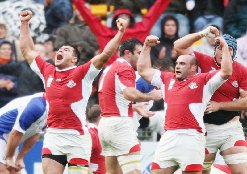
The Fijians ran in three tries in the first 43 minutes, but then a litany of errors and a fair bit of indiscipline helped Canada back into a game, and the Canucks may well feel hard done-by after what looked a legitimate try was denied them by TMO Caig Joubert with 10 minutes to go, a try that may well have swung momentum their way.

With Canada dominating proceedings for the most part of the second half, Fiji were let off the hook when full-back Mike Pyke ignored the two-man overlap and went for glory himself.

At first, it looked like the Canadian was held up and dotted down after two movements.  But referee Tony Spreadbury made the right decision to go upstairs and leave the final call to Joubert, who took a good few minutes to make his verdict.

After countless replays, it was clear that Pyke had not been held over or before the line and the try was successfully scored in one movement.  The South African TMO thought otherwise though and the jeers from the Canada supporters in an empty Millennium Stadium could have matched that of a capacity crowd.

Canada did well to lift themselves up and continue to put pressure on the Islanders for the final ten minutes, that nearly led to them snatching the game with time up on the clock.  But more about that later.

In a game dominated by two teams in different halves, Fiji would have been relieved to walk away with their bonus-point victory after their dominating opening 40 minute spell was negated by Canada after the break.

Fiji laid down the challenge before the game even kicked off with their traditional haka led by captain Mosese Rauluni.

Canada certainly started off well enough by securing the majority of possession by keeping the ball amongst their bigger forwards.  But the backline had a tough time against the classier Fijians and failed to get the ball moving through the hands when it counted.

The boot of Pyke didn't help the Canucks' cause much either with endless up-and-unders kicked too far, and in the end just giving possession away to the Fijians in their own 22.

Fiji were their brilliant selves in loose play, with their locks acting like wings as they side-stepped past hapless defenders and the wings acted like locks as they bashed their way towards the Canada tryline.

The tight exchanges were more of a concern to the Fijians -- as it was always going to be -- with the Islanders struggling in the line-outs, losing five altogether off their own throw.  The scrums also took a knock with Canada securing two feeds after pushing their opposition backwards.

Referee Spreadbury -- at times far too whistle-happy -- was forced to blow the game to a stand still after mistakes from both sides started to take their toll, with the small crowd begging for continuity.

However, the mistakes led to penalties and the penalties led to three-pointers as Canada wing James Pritchard opened the scoring with a well-taken shot at goal from the touchline.

Nicky Little got Fiji on the board with a monstrous 40-metre kick to level the scores in the seventh minute of the game after Canada flank Dave Biddle was adjudged off-side.

A wonderful try-saving tackle by skipper and scrum-half Morgan Williams on Fiji full-back Kameli Ratuvou inches from the line prevented the Islanders from taking the lead.

Pyke couldn't do the same for his team-mates though after lock Kele Leawere charged ten metres before trampling over the Canadian full-back for Fiji's first try of the afternoon by the posts.  Little converted the simple conversion and Fiji held a deserved 10-3 lead.

Pritchard kept Canada in tune with a 40-metre penalty kick of his own that just managed to creep over.

Fiji replied after lock Ifereimi Rawaqa showed off some sevens skills and danced his way just short of the tryline.  Ratuvou was on hand to take the quick ball from the ensuing ruck to crash over for his first try of the match.  Little missed the tricky conversion, but the Islanders now had a handy 15-6 lead that they took with them into half-time.

Canada would have been kicking themselves after two missed try-scoring opportunities before the half-time hooter because of fumbling hands.

Fiji made them pay even more after dangerous right wing Vilimoni Delasau showed his incredible pace and strength when he went over for try number three for the Islanders two minutes into the second half.

Flanker Akapusi Qera made the initial burst, galloping a good 30 metres with the tryline in sight.  Last week's man-of-the-match against Japan was too greedy though and went for glory with several team-mates in support.  After another desperate tackle from Williams, the ball was recycled well by the Fijians and flung right to Delasau who made a tough try look easy.

Little converted to take the score to 22-6 and it looked like that was the ball game.

Instead, Fiji switched off their engine and Canada went into fifth gear as attack after attack took the Canucks into the Fijians 22, after yet another gliding run from Pritchard.  The forwards got the charge on and mauled their way towards the Islanders' line.  Nine phases later, fly-half Ryan Smith brushed off a soft tackle from Little and dived over under the sticks.

Pritchard added the extras and just like that, Canada were back in the game with the scoreboard reading 22-13 and 60 minutes gone on the clock.

Again, it was ill-discipline from Canada that halted any threatening attacks they had on their opponents, but Fiji didn't do themselves any favours by turning over far too much ball.

This would often lead to a counter-attack from the Canucks and in the 70th minute replacement hooker Aaron Carpenter made a burst into open space.  The Canada backline was lined up with the biggest overlap the World Cup has seen.  But Pyke went on his own and the rest was TMO history.

Canada turned their next attack into points thanks to another penalty from Pritchard -- who only missed two kicks all afternoon.  That score took the Canucks within a converted try to win the game and they came so close in doing so.

With time up on the clock, the Canada forwards pushed and shoved and pushed again.  The crowd really got behind the Canucks and a match-winning try looked on the cards, but the Fijians held out long enough for Canada to make an error by spilling the ball.

If the Canadian supporters' hearts weighed anchor at that moment, they would have sunk completely after the ball was slapped to Ratuvou, who turned on the gas and raced the entire length of the field to score the clincher, and the bonus point try.

Man of the match:  Fiji let themselves down in this category in the second half after completely losing their flow and control of the game.  A solid performance from full-back Kameli Ratuvou kept Canada looking at the Saracens playmaker's back every time he got the ball.  And lets not forget his brace of tries, the second winning the game for his team.  Centre Seru Rabeni was impressive before he taken off in the second half, while skipper Mosese Rauluni was everywhere as usual.  It's not often though that the losing team gets the nod, but James Pritchard did everything right and would be gutted that his flawless performance on attack, defence and with the boot could only lead to a loss.

Moment of the match:  The dying seconds of the game must have had Canadians' hearts in their throats with an upset just inches away.  That, together with Ratuvou's match-winning sprint towards the line take the accolade.

Villain of the match:  You know who you are ...  the interesting call by Craig Joubert does it for us.  Though our law discussions may clear a few things up later this week.  Until now, all daggers point in the direction of the game's TMO.

The scorers:

For Canada:
Tries:  Smith
Con:  Pritchard
Pens:  Pritchard 3

For Fiji:
Tries:  Leawere, Ratuvou 2, Delasau
Cons:  Little 3
Pen:  Little

Canada:  15 Mike Pyke, 14 DTH van der Merwe, 13 Craig Culpan, 12 Dave Spicer, 11 James Pritchard, 10 Ryan Smith, 9 Morgan Williams (c), 8 Sean-Michael Stephen, 7 Dave Biddle, 6 Jamie Cudmore, 5 Mike James, 4 Mike Burak, 3 Jon Thiel, 2 Pat Riordan, 1 Rod Snow
Replacements:  16 Aaron Carpenter, 17 Dan Pletch, 18 Mike Pletch, 19 Luke Tait, 20 Colin Yukes, 21 Ed Fairhurst, 22 Ander Monro

Fiji:  15 Kameli Ratuvou, 14 Vilimoni Delasau, 13 Seru Rabeni, 12 Seremaia Bai, 11 Isoa Neivua, 10 Nicky Little, 9 Mosese Rauluni (c), 8 Sisa Koyamaibole, 7 Akapusi Qera, 6 Semisi Naevo, 5 Ifereimi Rawaqa, 4 Kele Leawere, 3 Jone Railomo, 2 Sunia Koto, 1 Graham Dewes
Replacements:  16 Vereniki Sauturaga, 17 Henry Qiodravu, 18 Netani Talei, 19 Jone Qovu, 20 Jone Daunivucu, 21 Maleli Kunavore, 22 Norman Ligairi

Referee:  Tony Spreadbury
Touch judges:  Christophe Berdos, Mark Lawrence
Television match official:  Craig Joubert
Assessor:  Steve Hilditch

Thirteen-man Tonga triumph

Tonga, despite being reduced to 13 men, ended a seven-year losing streak against Samoa by causing one of the biggest upsets of the World Cup, winning 19-15 in their Pool A match at Stade de la Mosson, Montpellier, on Sunday.

The Tongans, who played with 14 men for 20 minutes of the game and 13 men for the last five minutes, sent a strong message to pool rivals South Africa and England with a performance that showed plenty of heart.

They may not have the structure of their more illustrious rivals and talk of a quarter-final place may be premature, but they showed they can never be written off.

As one of the poorest nations at the World Cup, they showed that they can grind out victories.

As captain Nili Latu said:  "We came from Tonga [to the World Cup] with empty pockets, but determined to make a point.  We have got two big games coming up [against South Africa on September 22 and England six days later] and that is going to test us."

However, the Tongans passed a big Test in Montpellier on Sunday.

Despite being underdogs they played a tactically more astute game, especially in the second half.

As could be expected, the set pieces of both teams were not of a standard that will suggest they can be World Cup winners.  They are simply not clinical enough and can be disrupted far too easily.  That is why they struggle against the bigger teams.

Normally both sides do bring something special to the game, which includes a willingness to play the game a great pace and take the ball wide as often as possible.

Unfortunately the Sevens skills which these teams are so famous for seemed to have deserted them for large parts of the game.

As a result the first half lacked any real structure or the entertainment value you would have expected of an encounter between these two rivals.

The other disappointing aspect of the game was the extraordinary amount of kicking, as both teams looked flat and very lethargic in a game with a very high error count.

Added to that the option taking and execution of both teams also left a lot to be desired for teams

It was only in the final quarter that there was life to be found in this clash.

Tonga wasted no time in opening their account -- a sweetly struck Pierre Hola penalty, coming after a number of strong driving plays by the Tongans that put the Samoan defenders under pressure.

However, the Samoans hit back almost straight away -- with fullback Gavin Williams levelling matters with a penalty of his own.

Samoa showed their willingness to up the pace of the game, despite the intense heat, when they took a quick line-out and came within a TMO's call of scoring.  As is often the case with calls going to the TMO it wasn't very clear if the ball had been grounded and the doubt resulted in a five metre scrum.  It gave the Tongans a chance to ward off the immediate threat.

It took the Samoans another 15 minutes to get points on the board, another Williams penalty, when Tonga were penalised for not releasing the ball on the ground with the Samoans on attack just metres out from the Tongan tryline.

The Samoans now started to assert themselves on the game and the Tongans conceded a couple of quick penalties, the second of which Williams slotted to take his team's lead to 9-3 after just 23 minutes.

Tonga's prospects were dealt a further blow when centre Epeli Taione was yellow carded for repeated infringements in the 28th minute and Williams slotted a fourth penalty to give the Samoans an even bigger lead.

Ironically this finally sparked the Tongans into action and after a lack of concentration saw some of their earlier efforts come to nothing, Hola slotted his second penalty with just two minutes to go to narrow the gap.

Hola had another shot at goal right on the half-time hooter, but this one he dragged wide.

The penalty count continued to mount and Tonga were the first beneficiaries of this early in the second half when Hola slotted his third penalty to narrow the gap to just three points (12-9).

Samoa's frustration with the harrassing nature of the Tongan game started to show as they conceded some unnecessary penalties and lost any momentum they would have hoped to have build up.

The Tongans, thriving in the stop-start nature of the game looked the more assured of the two sides as the final quarter approached.

And the Tongans were soon rewarded as they not only lifted the tempo, but also the effectiveness of their game.

The reward came in the form of a try to previously yellow-carded centre Epeli Taione -- who was driven over in a heap of bodies, after a a maul and a series of forward-orientated drives.

Hola added the conversion and a penalty a few minutes later as the Tongans looked to pull clear.  At 19-12 ahead, they looked in control.

However, poor discipline cost them dearly as Williams slotted his fifth penalty of the afternoon for Samoa in the 69th minute -- following a cheap, high shot -- and the gap had narrowed to just four points again -- 19-15 to Tonga.

And it went from bad to worse when fiery flanker Hale T-Pole -- the man who was warned earlier for his cheap shot on an opponent -- was red carded for another act of foul play -- this time an elbow to someone's chops.

The Tongans simply did not learn and replacement forward Toma Toke was yellow carded two minutes later for another cheap, high shot on an opponent.

Yet, the Samoans failed to cash in on their numerical advantage -- with some really sloppy play resulting in every scoring chance going to waste.

But the 13-man Tongan team deserves credit for some ferocious tackling -- which, of course, was not always legal.

However, they hung on desperately and earned a valuable win -- their first against Samoa since 2000.

Man of the match:  It wasn't a game of many highlights and many heroes.  The standard of play was far too poor.  However, Tongan number eight Finau Maka certainly put his hand up all afternoon -- both on defence and attack.

Moment of the match:  It is simple.The only try of the match and the defining moment -- with centre Epeli Taione being driven over the line under a pile of bodies in the 59th minute.  It came from a maul and a series of drives, a typical forward try, but the centre was there to add his weight to the Tongan cause and it paid dividends.

Villain of the match:  They were by no means the only culprits in a series of transgressions, but Tongan centre Epeli Taione and replacement forward Toma Toke are both in the book for this award with their yellow cards.  However, the outright winner is Tongan flank Hale T-Pole, who was red carded for an injudicious elbow three minutes after he had been warned for a similar dig on an opponent.

The scorers:

For Samoa:
Pens:  Williams 5

For Tonga:
Try:  Taione
Con:  Hola
Pens:  Hola 4

Yellow cards:  Epeli Taione (Tonga, 28 -- repeated infringements), Toma Toke (Tonga, 75 -- foul play)
Red card:  Hale T Pole (Tonga, 72 -- foul play)

Teams:

Samoa:  15 Gavin Williams, 14 Sailosi Tagicakibau, 13 Elvis Seveali'i, 12 Seilala Mapusua, 11 Alesana Tuilagi, 10 Loki Crichton, 9 Steve So'oialo, 8 Semo Sititi (captain), 7 Ulia Ulia, 6 Daniel Leo, 5 Kane Thompson, 4 Joe Tekori, 3 Census Johnston, 2 Mahonri Schwalger, 1 Justin Va'a.
Replacements:  16 Tanielu Fuga, 17 Muliufi Salanoa, 18 Leo Lafaiali'i, 19 Justin Purdie, 20 Junior Polu, 21 Lolo Lui, 22 David Lemi.

Tonga:  15 Vungakoto Lilo, 14 Tevita Tu'ifua, 13 Sukanaivalu Hufanga, 12 Epeli Taione, 11 Joseph Vaka, 10 Pierre Hola, 9 Enele Taufa, 8 Finau Maka, 7 Nili Latu (c), 6 Hale T Pole, 5 Paino Hehea, 4 Inoke Afeaki, 3 Kisi Pulu, 2 Ephraim Taukafa, 1 Soane Tonga'uiha.
Replacements:  16 Aleki Lutui, 17 Toma Toke, 18 Viliami Vaki, 19 'Emosi Kauhenga, 20 Sione Tu'ipulotu, 21 Isileli Tupou, 22 Hudson Tonga'uiha.

Referee:  Jonathan Kaplan
Touch judges:  Alan Lewis, Bryce Lawrence
Television match official:  Lyndon Bray
Assessor:  Ian Scotney

France fire at last

France are back on song in the World Cup, making amends for their opening night loss with a 87-10 demolition of Namibia on Sunday.

What a turn up for the books!  Here, finally, was an established side making mince meat out of a school of minnows -- and how the French needed this fillip.

It seems like a year since last Friday, but not for France.  Les Bleus had been accused of "betraying" the nation following the loss to Argentina on the opening night of the World Cup.

They duly removed themselves from the spotlight and went into hiding to brood and plot revenge on all comers, and Namibia bore the brunt of their pent-up aggression.

This was a very different French side to the one that froze in Paris last week.  Gone were the nerves, replaced by confidence, hunger, steel and straight running.

France's forwards, relentless in attack and defence, built a solid platform on which the likes of Vincent Clerc, David Marty and Cédric Heymans danced a merry jig.

The Toulouse connection worked well:  pulling the strings were local heroes Frédéric Michalak, sporting an odd shaven corn-row hairdo, and Jean-Baptiste Elissalde.

The big win will serve to exorcise the Argentine demons, but one question remains:  did Bernard Laporte pick the right team for that opening game? France's future minister for sport might yet need the help of a spin doctor or two.

France exploded out of the blocks, attacking the Namibians on the hoof, eager to expunge their sins through speed of thought and limb.  Running away from their problems, if you will.

Heymans, back in his familiar position on the wing and clearly loving life, soon opened the scoring by dotting down in the corner after a rapier-like raid opened a narrow gap on the short side.

A rare foray into French territory then allowed Namibia fly-half Emile Wessels the time and inclination to drop a goal.

But France answered back brilliantly by scoring their second try after cutting Namibia's threadbare defence to smithereens in a break from their deep in their own half.  It was Marty who finished off the move by choosing a sublime angle and fending off a top-heavy tackle before diving over the line.

Things then went bad to worse for the Namibians with Jacques Nieuwenhuis receiving a red card for a high tackle on Sébastien Chabal.  It seemed that l'anesthésiste would need a hit of his own medicine, but the sight of his assailant leaving the field appeared to perk him up.

Critics of the World Cup's slight skew-wiff disciplinary policies might like to question the decision to permanently reduce Namibia to 14 men, but referee Alain Rolland had already had stern words with the hot-headed loose forward.

France took immediate advantage of their numerical advantage by releasing the brake on an unstoppable rolling maul, and Thierry Dusautoir was on hand to collect France's third try.

The hosts collected their bonus-point moments later via a fabulous break down the middle of the paddock.  There was more than a hint of a forward pass, but the speed of the move blurred the infringement, and Lionel Nallet showed good speed in arriving to take the final pass.

Clerc then added his name by scoresheet by skirting round a very ragged defensive line after collected a deft mis-pass from Heymans.

With Michalak now able to feed his runners at will and according to his own preferences, Nallet was soon celebrating his second in the last move of the half.

What a difference a week makes!  With the game all but won and with six tries under their belts, the French trooped off for the break to a standing ovation and with the stirring chimes of La Marseillaise ringing in their ears.  The Namibians were out for the count and the Irish, France's next opponents, surely quivering behind the sofa at their hotel.

France kept their foot on the pedal in the second half, but some courageous defence from the men from south-west Africa kept the hosts almost honest.

The French were clearly wanting to flex each of their muscles for all the world to see, and the next score came from Julien Bonnaire on the tail of a push-over scrum.

The following ploy out of the bag was the cross-field kick, and Jean-Baptiste Elissalde's pin-point punt found Chabal, of all people, lurking in the corner, and Bratley Langenhoven was powerless to stop France's brand new folk hero.

The score only seemed to enrage the man with a thousand nicknames, and l'homme des cavernes was soon over the whitewash for his second after running in a try from his own half, using his pace and immense strength to power over the line.

Elissalde then chose to edge into the limelight, opting to open his try account by using slight of hand rather than monsterism.

Namibia were now in tatters and another flowing move was punctuated by another try from Clerc.

A 75-3 lead would prompt most teams to easy off in deference of battles to come.  But France didn't want to just make their point, they were desperate to ram it down the optical nerves of the watching world.

And so the tries kept coming.  Clerc completed his hat-trick before being denied his fourth by a questionable decision by Simon McDowell in the video suite.

Raphaël Ibañez came off the bench to claim France's 13th and final try and the massacre was complete.

But it was Namibia who had the last word after Langenhoven intercepted to score in the last move of the game; the sporting French public greeting the consolation prize with a hearty cheer.

So all eyes now turn to Friday's crunch encounter between the hosts and Ireland in Paris.

Ireland coach Eddie O'Sullivan said witnessing his side's ugly win over Georgia was akin to watching a "horror movie".  He might be moved to compare this video nasty to being buried alive in a casket of rabid cockerels.  Allez les Bleus -- on this evidence they might yet go all the way.

Man of the match:  There are so many contenders that we feel compelled to award a collective gone.  If individuals must be name, we'll point to the contributions of Sébastien Chabal, Thierry Dusautoir, Frédéric Michalak, Jean-Baptiste Elissalde and Vincent Clerc.  But just pipping the post is Cédric Heymans, who sent a message to his boss that simply read:  "I'm not a fullback, I'm a wing"!

Moment of the match:  The standing ovation at the stoke of half-time told a story in itself, but how can we ignore Sébastien Chabal's 55-metre rampage that lead to his second try?

Villian of the match:  We've seen worse tackles in the last week, but Jacques Nieuwenhuis deserves this hideous gong for failing to heed the warnings that preceded his red card.

The scorers:

For France:
Tries:  Heymans, Marty, Dusautoir, Nallet 2, Clerc 3, Bonnaire, Chabal 2, Elissalde, Ibanez
Cons:  Elissalde 11

For Namibia:
Try:  Langenhoven
Con:  Losper
Drop goal:  Wessels

France:  15 Clément Poitrenaud, 14 Vincent Clerc, 13 David Marty, 12 Damien Traille, 11 Cédric Heymans, 10 Frédéric Michalak, 9 Jean-Baptiste Elissalde (c), 8 Julien Bonnaire, 7 Thierry Dusautoir, 6 Yannick Nyanga, 5 Lionel Nallet, 4 Sébastien Chabal, 3 Pieter de Villiers, 2 Dimitri Szarzewski, 1 Jean-Baptiste Poux.
Replacements:  16 Raphaël Ibañez, 17 Nicolas Mas, 18 Fabien Pelous, 19 Imanol Harinordoquy, 20 Lionel Beauxis, 21 Yannick Jauzion, 22 Aurélien Rougerie.

Namibia:  15 Tertius Losper, 14 Ryan Witbooi, 13 Bratley Langenhoven, 12 Piet van Zyl, 11 Heini Bock, 10 Emile Wessels, 9 Jurie van Tonder, 8 Jacques Nieuwenhuis, 7 Michael MacKenzie, 6 Jacques Burger, 5 Nico Esterhuize, 4 Wacca Kazombiaze, 3 Jane du Toit, 2 Hugo Horn, 1 Kees Lensing (c).
Replacements:  16 Johannes Meyer, 17 Johnny Redelinghuys, 18 Herman Lindvelt, 19 Tinus du Plessis, 20 Eugene Jantjies, 21 Lu-Wayne Botes, 22 Melrick Africa.

Referee:  Alain Rolland
Touch judges:  Carlo Damasco, Kelvin Deaker
Television match official:  Simon McDowell
Assessor:  Tappe Henning

Saturday, 15 September 2007

Portugal leave their mark

It was always going to be hard not to see them as the romanticists' victors on the day, but Portugal's brave efforts in a 108-13 defeat to New Zealand on Saturday were wondrous.

Nearly fifty points adrift at half-time, the men in red came out for the second half with a few fresh faces and some new-found adrenaline, and brought the Stade Gerland to its feet with a try, followed by a sustained period of pressure in the ABs half of the field.

But it was in the latter stages of each half where the differences between professionals and non-professionals came to the fore, with the All Blacks enjoying purple patches just before the break, and in the final ten minutes when Portugal's braves had shot their bolt.  In the end, the try tally was every bit as comprehensive as we expected -- 16-1 -- but Portugal's players will have an unforgettable experience and moment to savour for the rest of their lives.

But back to the All Blacks.  Back-line players Aaron Mauger, Joe Rokocoko and Conrad Smith each scored a brace, making the most of their minimal involvement in the game.

Moments of sporting splendour aside, it was an easy ride for the All Blacks who steam-rolled their opposition, scoring effortless tries throughout the match.

Rokocoko, who drew first blood for the All Blacks, would have been pleasantly surprised at the amount of space he was afforded en route to his second try in the 11th minute of the game.

The All Blacks took the quick line-out and Rokocoko was virtually untouched as he ran a good 55 meters before dotting down for the 40th try of his career.

The only try that required any real effort was Mauger's in the 29th minute.

The much-favoured All Blacks certainly didn't always look like a team unit, as a plethora of unforced errors characterized what was an anti-climactic first quarter for Jerry Collins' charges.

Two break-away tries by an inspired Rokocoko were all the disjointed All Blacks could offer in that particular period of play.

Fly-half Nick Evans struggled to take charge of his back-line early on -- nerves were always going to be factor for him.  As a result the All Black faithful got to see very little of both Mauger and Conrad Smith in midfield action.

The only positive aspect of the All Black game early on was their sheer dominance in the set-pieces, where they stole a fair share of the Portuguese line-outs.  The scrums were just an unfair contest altogether, with the All Black pack outweighing Os Lobos by over 100kg.

Portugal's top points scorer Goncalo Malheiro, who put on solid display, got Os Lobos onto the score-sheet with a well struck 21st minute drop-goal.  The cheer from the neutral fans in the crowd was deafening.

The complexion of the game soon changed however, as the All Blacks-even if only for a brief passage of play -- stepped into second gear, scoring six tries in fifteen minutes.

Portugal, who made a spirited start, went into to half-time with their backs firmly against the wall with the half-time score at 52-3 in favour of New Zealand.

Coach Tomaz Morais made some inspired half-time changes, as replacement hooker Rui Cordeiro scored the first Portuguese try of the game, after a determined forward pack pushed the All Blacks, far superior in size, backwards for several phases.

The stunned All Blacks responded in the only way they knew how when scrum-half Andrew Ellis exploited another gaping hole in the Portuguese defence to score his first All Black try.

The floodgates then opened as the All Black back-line shared seven more tries between them, two of which came from Smith -- who until that point in the game had barely touched the ball.

In all fairness Collins' team showed a lot more cohesion as the game wore on and Henry should be satisfied with what he saw.  He will now have the peace of mind knowing that he can call on anyone of his second-string to step-up to the plate should injuries develop in the knock-out stage of the tournament.

Man of the Match:  Jerry Collins displayed some sound leadership and performed consistently throughout the game.  It would have been tempting to award the man-of-the-match to Joe Rokocoko for his moments of brilliance.  Nick Evans was also a candidate with his 33 points on the afternoon.  But Collins was the only All Black that stood out for the whole game -- until he was substited of course.

Moment of the Match:  We talked about Portugal's try before, which is a clear winner, but the 29th minute Aaron Mauger try was absolutely brilliant and could have been scored against any of the world's leading rugby nations.  It all started with a good clean All Black line-out.  Thereafter we witnessed some superb handling from Chris Masoe, who off-loaded to Jerry Collins.  Collins off-loaded to Mauger, who finished in style.  A try worth watching over and over again.

Villain of the Match:  There was no villain really.  it was a clean game of rugby.

The scorers:

For New Zealand:
Tries:  Rokocoko 2, Toeava, Williams, Mauger 2, Collins, Masoe, Hore, Leonard, Evans, Ellis, Smith 2, MacDonald, Hayman
Cons:  Evans 14

For Portugal:
Try:  Cordeiro
Con:  Pinto
Pen:  Pinto
Drop goal:  Malheiro

New Zealand:  15 Mils Muliaina, 14 Isaia Toeava, 13 Conrad Smith, 12 Aaron Mauger, 11 Joe Rokocoko, 10 Nick Evans, 9 Brendon Leonard, 8 Sione Lauaki, 7 Chris Masoe, 6 Jerry Collins (c), 5 Ali Williams, 4 Chris Jack, 3 Greg Somerville, 2 Andrew Hore, 1 Neemia Tialata.
Replacements:  16 Anton Oliver, 17 Tony Woodcock, 18 Carl Hayman, 19 Rodney So'oialo, 20 Keven Mealamu, 21 Andy Ellis, 22 Leon MacDonald.

Portugal:  15 Pedro Leal, 14 António Aguilar, 13 Miguel Portela, 12 Diogo Mateus, 11 Pedro Carvalho, 10 Gonçalo Malheiro, 9 Luis Pissarra, 8 Vasco Uva (c), 7 Diogo Coutinho, 6 Paulo Murinello, 5 Gonçalo Uva, 4 Marcello d'Orey, 3 Ruben Spachuck, 2 João Correia, 1 Andre Silva.
Replacements:  16 Rui Cordeiro, 17 Joaquim Ferreira, 18 David Penalva, 19 Tiago Girão, 20 João Uva, 21 José Pinto, 22 Duarte Cardoso Pinto.

Referee:  Chris White
Touch judges:  Hugh Watkins, Marius Jonker
Television match official:  Dave Pearson
Assessor:  Bob Francis

Australia limbering up

Australia have once again underlined their credentials as serious World Cup contenders, after beating Wales 32-20 in Cardiff on Saturday to claim pole position in Pool B.

The Welsh delivered an abject first half, also punctuated unhelpfully by injuries to key personnel, at the end of which they were down by 22 points, and although there was a marked second-half improvement, a horrendous error by Stephen Jones gifted the Wallabies all their momentum back.

The stage was set for yet another bone-crunching spectacle between two rugby proud nations keen to show off their craft in front of a jam-packed Millennium Stadium in Cardiff.

What a shame then for the dedicated Welsh supporters that their team failed to come to the party.  It was as if all they came for was the cake and ignored the theme altogether.  Australia were the magicians of the first half and made the Welsh party-poopers look like a bunch of clowns.

Wallabies captain Stirling Mortlock waved his magic wand inside the opening two minutes with a well-executed penalty kick that gave his team an early lead.  Stephen Jones cancelled out Mortlock's penalty but he was wide with two further attempts while the game was technically still in the balance.

Wales were determined at times to take the game to the Wallabies, perhaps a little too much though after centre Sonny Parker was stretchered off and Colin Charvis had an appointment in the blood bin.

It was round about this time that the Wallabies struck with their first -- and perhaps best -- try of the match after a superb break from rookie and late replacement Berrick Barnes.  The 21-year-old was thrown into the deep end after regular pivot Stephen Larkham pulled out of the match with a knee injury.

The former rugby league player certainly did not disappoint after throwing a wild dummy that ended up with Matt Giteau under the posts and Barnes on the floor after a malicious tackle from Gareth Thomas.

The Wales skipper stood his ground and quite literally stopped Barnes in his tracks with a tackle that involved more shoulder and less arms -- oh, and it was late.  The outcome was a converted try, but Thomas may have a meeting with the citing commission later this week, though that may not have much affect on the Welsh star after he too was forced to leave the field clutching his arm after a collision with Mortlock in the midfield.

Thomas's injury meant James Hook -- who was benched for this encounter -- was called on to carry on the midfield duties with Kevin Morgan now controlling things at full-back in Parker's absence.

Barnes made a quick recovery from his earlier knock to nail a brilliantly taken drop-goal that flew a good 35 metres to take Australia into a ten point lead.  It could have been more had Mortlock not missed a sitter after Martyn Williams was penalised for holding on.

However he made up for his earlier blunder with a try of his own thanks to some quick reaction work from prop Matt Dunning and a sweetly-timed chip from veteran scrum-half George Gregan.

With Wales on the attack, Mark Jones panicked and passed the ball in the tackle to his imaginary friend.  Dunning pounced and offloaded to Gregan who sent in the kick that was well gathered by a chasing Mortlock, who picked up an injury for his efforts.

With Mortlock receiving medical treatment for a damaged forearm, Giteau was called upon to take over the kicking duties and fluffed his first attempt.

At 15-3, Wales were not completely out of it.  That was until a wheeling scrum resulted in big number eight Wycliff Palu picking up from the back and sending the ball through the Wallabies backline to Drew Mitchell on the wing.  Running out of space, Mitchell stepped inside before releasing a charging Chris Latham who powered over in the corner at the stroke of half-time.

Mortlock made the tricky touchline conversion and Australia had the match in the bag with a convincing 25-3 half-time lead.

After the interval, Mortlock was given a deserved rest and replaced by Scott Staniforth at number thirteen.

Wales jumped out of the half-time paddocks with a try to number eight Jonathan Thomas after a barrage of attacks on the Australians' try-line.  Hook converted and suddenly Wales were almost back in the game.

Another Hook penalty confirmed this in the 50th minute, but he missed another ten minutes later.  Wales were looking much better with just twenty minutes left to play.

Welsh hearts were then broken after a shocking mistake from Stephen Jones gave Australia their winning score to seal the match.

It was Latham again on the counter that cause the all the heartache for Wales after sending up a huge up-and-under on the Welsh defenders.  Jones looked to have it under control, but the ball hit his shoulder and bounced into the hands of Latham, who followed his kick up brilliantly to score untouched beside the posts.

Giteau added the extras and suddenly Wales were back were they started the half -- down and out.

Yellow cards shown to Drew Mitchell (dangerous tackle) and Nathan Sharpe (professional foul) in the 65th and 74th minute respectively, gave Wales a vague reprise.

Any team unable to score against a team with two men down probably deserves to lose -- and it nearly was the case for Wales after losing a scrum and two line-outs in quick succession.

However the ever-present Shane Williams was rewarded with a consolation try for Wales after knocking the ball out of Giteau's arms, picking up and touching down in the corner.  The replay did show the winger knocked on from the initial tackle, but it barely mattered by then anyway

The touchline conversion was made by Hook and with two minutes left to play, Wales played better in that short space of time than they did the entire match.  Though, as usual, it was just too little too late and Australia held out several Welsh attacks to walk away deserved victors.

Man of the match:  For Wales, Tom Shanklin was again on top of his game and did what he could with little ball he was given.  Try-scoring winger Shane Williams was like an annoying mosquito for the Wallabies who could have bitten a lot more if some gaps had opened up.  For Australia, hardworking flank George Smith was a pillar of strength on attack and defence.  Berrick Barnes made a dream starting debut, while Stirling Mortlock -- only on for the first 40 minutes -- was sensational in the midfield.  However, our vote goes to Wallaby veteran full-back Chris Latham who, like a fine red wine, just seems to just get better with age.  Second in Australia's all time try-scoring list, Latham's two tries takes his overall total to 39 in 75 appearances and his World Cup tally to 10 in four matches.

Moment of the match:  Stephen Jones's dropped catch that led to Latham's second try and ultimately the game for Australia.  A slap in the face for any Welsh supporter!

Villain of the Match:  Quite a few players can line up for their mug shot from this encounter.  Besides Drew Mitchell's yellow card for dumping hooker Matthew Rees like he would his high school sweetheart for Angelina Jolie, there was also the yellow against Nathan Sharpe for not rolling away in the tackle -- perhaps a tad harsh from referee Steve Wash.  But there were two other naughty boys who may have got away from some time in the sin bin, but face the wrath of the citing commissioners.  Wallabies hooker Stephen Moore was shameless when he dived knee first into Shane Williams after the winger was taken out into touch.  And Gareth Thomas was guilty for his late armless (not harmless) tackle on Berrick Barnes.  Shame on you both!

The scorers:

For Wales:
Tries:  J.  Thomas, S.  Williams
Cons:  Hook 2
Pens:  Jones, Hook

For Australia:
Tries:  Giteau, Mortlock, Latham 2
Cons:  Mortlock 2, Giteau
Pen:  Mortlock
Drop goal:  Barnes

Yellow card:  Mitchell (Australia, 65, dangerous tackle), Sharpe (74, Australia, not rolling away)

Wales:  15 Gareth Thomas (c), 14 Mark Jones, 13 Tom Shanklin, 12 Sonny Parker, 11 Shane Williams, 10 Stephen Jones, 9 Dwayne Peel, 8 Jonathan Thomas, 7 Martyn Williams, 6 Colin Charvis, 5 Alun-Wyn Jones, 4 Ian Gough, 3 Adam Jones, 2 Matthew Rees, 1 Gethin Jenkins
Replacements:  16 Thomas Rhys Thomas, 17 Duncan Jones, 18 Michael Owen, 19 Alix Popham, 20 Michael Phillips, 21 James Hook, 22 Kevin Morgan

Australia:  15 Chris Latham, 14 Drew Mitchell, 13 Stirling Mortlock (c), 12 Matt Giteau, 11 Lote Tuqiri, 10 Berrick Barnes, 9 George Gregan, 8 Wycliff Palu, 7 George Smith, 6 Rocky Elsom, 5 Dan Vickerman, 4 Nathan Sharpe, 3 Guy Shepherdson, 2 Stephen Moore, 1 Matt Dunning
Replacements:  16 Adam Freier, 17 Al Baxter, 18 Mark Chisholm, 19 Stephen Hoiles, 20 Phil Waugh, 21 Scott Staniforth, 22 Julian Huxley.

Referee:  Steve Walsh
Touch judges:  Mark Lawrence, Craig Joubert
Television match official:  Christophe Berdos
Assessor:  Steve Hilditch

Ireland shaken to the core

Ireland live to fight for their quarter-final place still, but only after overcoming a magnificent performance from Georgia in Bordeaux on Saturday to win 14-10.

It's been a World Cup marked by magnificent crowds and terrific displays from nations written off as cricket-score fodder.  Georgia gave the starkest evidence yet that rugby's world is growing, and every one of the 35,000 souls at the Stade Chaban Delmas let you know that they thought it was wonderful.

Georgia, trailing 7-3 at the break and then nicking the lead with an interception try early in the second half, made the notion of rugby serfs and nobility at this World Cup look like the arcane old theory of senile club committee members.

Even after Ireland had won the lead back, the Georgians proceeded to camp in the Irish half in the manner of the finest professional teams around the world, pressurising the Irish into mistakes up front and just failing to find the one killer forward drive that might well have won them the game.

In the final moments, they got over the line for what might have been the clinching try, but the ball was held up.  It was that close.

In defence, they stole Irish line-outs, wheeled Irish scrums, and smashed Irish runners backwards.  To a man, they were heroes, even in a defeat which yielded only the consolation nugget of a bonus point.

Ireland's task tonight was threefold:  to prove they could assert themselves on lowly opposition after that Namibian scare, to exorcise their own demons, and to pocket the all-important bonus point.  They failed on each count.

Georgia dominated every facet of this game but one.  They failed to score more points but thrashed the Irish on possession, territory, hunger, desire, passion and heart.

This began as a contest between back-to-back Triple Crown winners resplendent with marque names and part-timers from France's second division, yet it was impossible to tell which side was which for the whole duration of this titanic contest.

It's been on the lips of rugby fans for the past week, and this game served to underline the creeping realisation that there is little between the so-called "minnows" and the money-soaked practitioners of this game than mere gym membership.

It's obviously a great thing for this grand old sport (IRB please take due note), but it calls into question why we pay good money to see the so-called "stars" perform week in week out with their provinces and clubs.

With England looking like a pub XV with an ambitious fixture secretary and France acting like hosts with the least, European eyes and hopes are fixed on the Irish.

But on this evidence they'll be back at home before the month is out.

Of course, a win is always a win, and Ireland can be forgiven for having eyes only France and Argentina.  Yet this result was in doubt until the final whistle and Ireland's inability to alter events will leave their fans with more than a mere Bordeaux-induced headache.

Ireland started as they meant to go on -- nervously.  A worrying lack of understanding between Peter Stinger and Ronan O'Gara, today equalling the half-back partnership record help by Alessandro Troncon and Diego Dominguez of Italy, gave Georgia a field position that they never relinquished.

Georgia fly-half Merab Kvirikashvili had a chance to be the first name on the scoresheet when Ireland infringed far out, but his shot at goal was wide.

But Georgian fires continued to burn and Ireland only gained entrance to the opposition's 22 in 14th minute of the game.

After a couple of free-flowing raids were nipped in the bud, the Irish went for the drive from a line-out in corner, and Rory Best emerged from the relieved heap of green bodies with a broad grin on his face.  O'Gara added the extras and Ireland had finally opened their account.

But Georgia kept their foot on the pedal, with Kvirikashvili's monster boot keeping Ireland's share of the pitch down to the barest minimum.

The opportunity for a long-range shot at goal presented itself to the Irish on the 20-minute mark, but a visibly puffed-out O'Gara failed to find the target.

Ireland's frustrations soon became apparent and they began to concede territory and penalties like the seasoned pros.

A fabulous break-out from the Lelos then forced David Wallace to kill the move by slapping the ball away, and he duly earned a yellow card for his cynical effort.  Kvirikashvili punished Ireland further by slotting the ensuing penalty and it was, almost unbelievably, 7-3 at the break.

Tellingly, Georgia decided to stay on the pitch during the break and they chewed on apples and tactics.  Ireland, meanwhile, disappeared for what must have been a hair-drying session from Eddie O'Sullivan.

The unbroadcast words seemed to galvanise Irish action and big Shane Horgan began to carry into all areas of the pitch.

But just when Ireland seemed to be setting themselves up for a decent attempt at the Georgian lines, disaster.

With Stringer otherwise engaged at the bottom of a ruck, O'Gara's telegraphed pass from the base of the breakdown was intercepted by Giorgi Shkinin and all the Irish could do was yell at each other as the little wing dotted down under the sticks for the converted try -- and the lead.

The Lelos then managed to snatch a well-placed Irish line-out and the men in green looked in danger of usurping the English in awfulness.

A penalty against the Georgians allowed Ireland another crack at the hitherto untroubled white lines, but -- again -- they fumbled the opportunity.

A rare break-out from defence then allowed Ireland their next try.

Wallace collected the ball from the tail of a green line-out on the green line and he was away.  D'Arcy was on hand to make a few more precious yards.  The ball then went wide -- finally at speed -- to Girvan Dempsey, and the fullback sneaked into the corner and Ireland snatched back the lead.  O'Gara converted and Ireland breathed again.

But the nation with just eight rugby pitches was soon back in the driving seat.

A huge drive almost had the Irish waiting for a conversion, but a knock-on saved their blushes.

Georgia kept up the pressure and three long-distance drop-goal attempts threatened Ireland's tenuous hold on the lead.

The fitness then began to tell (were the Irish waiting for this?) and the heroic Georgians began to spill easy possession.

But still they kept Ireland honest with some deft touch-finders to the corners.

A brilliant bomb from Shkinin then put the Georgians into the Irish 22, and then a succession of magnificent inching driving mauls took the pack over the line and referee Wayne Barnes went "upstairs" to decide if the ball had been grounded.  Alas, great defence from Denis Leamy kept his country's honour intact.

But the Georgians weren't done.  With the last move of the game they won a penalty and shoved it straight into the heart of the Irish pack, only for a knock-on to deny them what could have been a page in history.

Man of the match:  Denis Leamy, Brian O'Driscoll and Gordon D'Arcy all did well, but the day belongs to the Lelos.  If NASA ever needed an environmentally friendly satellite-launcher they should check the availably of Merab Kvirikashvili's boot -- it's huge!  It's tempting to give a collective gong to the whole Georgian team, but we reckon Georgi Shkinin sneaks it for his big-hearted efforts in attack and defence.

Moment of the match:  Surely Georgi Shkinin's try -- a moment that shoved Irish hearts into Irish throats!

Villain of the match:  Who knows who the real culprits were, but the fight that sparked up at the final whistle was not a worthy conclusion to this spectacle -- a game that will go down in the annals of World Cup history.

The scorers:

For Ireland:
Tries:  Rory Best, Dempsey
Cons:  O'Gara 2

For Georgia:
Try:  Shkinin
Con:  Kvirikashvili
Pen:  Kvirikashvili

Ireland:  15 Girvan Dempsey, 14 Shane Horgan, 13 Brian O'Driscoll, 12 Gordon D'Arcy, 11 Denis Hickie, 10 Ronan O'Gara, 9 Peter Stringer, 8 Denis Leamy, 7 David Wallace, 6 Simon Easterby, 5 Paul O'Connell, 4 Donnacha O'Callaghan, 3 John Hayes, 2 Rory Best, 1 Marcus Horan.
Replacements:  16 Jerry Flannery, 17 Simon Best, 18 Malcolm O'Kelly, 19 Neil Best, 20 Isaac Boss, 21 Paddy Wallace, 22 Geordan Murphy.

Georgia:  15 Otar Barkalaia, 14 Giorgi Elizbarashvili, 13 Malkhaz Urjukashvili, 12 Davit Kacharava, 11 Giorgi Shkinin, 10 Merab Kvirikashvili, 9 Bidzina Samkharadze, 8 Giorgi Chkhaidze, 7 Rati Urushadze, 6 Ilia Maisuradze, 5 Mamuka Gorgodze, 4 Ilia Zedginidze, 3 Avtandil Kopaliani, 2 Goderdzi Shvelidze, 1 Mamuka Magrakvelidze.
Replacements:  16 Akvsenti Giorgadze, 17 David Khinchagashvili, 18 Levan Datunashvili, 19 Zviad Maisuradze, 20 Irakli Abuseridze, 21 Malkhaz Urjukashvili, 22 Otar Eloshvili.

Referee:  Wayne Barnes
Touch judges:  Malcolm Changleng, Paul Marks
Television match official:  Federico Cuesta
Assessor:  Tappe Henning

Friday, 14 September 2007

England reduced to zero

South Africa have shredded England's World Cup ambitions, inflicting a humiliating 36-0 World Cup defeat upon the English in Paris on Friday.

While the Springboks were tactically adept, and their execution and discipline spot-on, the focus will be on England.

It is rare to see any international team beaten to zero, and for the full eighty minutes England constructed not one meaningful scoring chance.  When Jason Robinson leaving the pitch in the second half, England's lone inspiration went with him, and it is difficult to see where any other may come from.

England were lucky.  They did not deserve much more than nil, but they were lucky South Africa did not get several more points.  England were outplayed.  South Africa outplayed the World Champions in this pool match.

It was decertified as "only a pool match" but it was a lot more for it decided -- barring catastrophe or miracle -- that South Africa have perhaps an easier time in the knock-out matches.  England are now left to gather their strength to play Samoa who gave South Africa a harder time than they did.

Afterwards England captain Martin Corry said:  "It's a big blow for us." What was obvious from it was that the World Champions will not be World Champions in November.

The Springboks were nearly faultless.  They were stronger than England, better organised than England and faster in everything than England who looked clumsy.  Playing alternating flyhalves proved a silly idea and destroyed any hope England may have had of playing with their backs.  Even when they were close to the South African line they did not look like scoring a try.

Nothing epitomised England's incapacity more than when they won a tighthead at a scrum and scrumhalf Shaun Perry kicked the ball out on the full opposite the place where they won the scrum.

Apart from the three tries they scored South Africa had another three excellent chances to score tries.  In fact it was inexplicable that they did not score one of them.

England were better at the scrums.  There their game stopped.  Their line-outs were adequate -- two lost, two skew.  But it was at the tackle that they were beaten.  The Springboks won turn-over after turn-over, one of which produced JP Pietersen's first try.  The Springboks were able to make headway when they had the ball, England simply could not.

The Springboks emptied their bench.  They gave all their players a chance to have a run to savour the moment.  They were that comfortable in victory.  England had some forced replacements.  Brave Jason Robinson, England's only star, went off bleeding when a hamstring shot him down.  Jamie Noon went off on a stretcher, and there was a lot of blood spilled.  The trenches were tough on the warm French night.

Andy Farrell kicked off.  (Was he really the England flyhalf, because that is how he often played which may well make him the biggest flyhalf in the history of rugby football!)  Almost immediately England were under pressure.  The South Africans had five throw-ins to line-outs in the first four minutes as England battled to contain the pressure.  The fifth line-out produced the first try.

The Springboks caught and mauled.  The mastodon moved in a slow plod and suddenly the match exploded into life as Fourie du Preez got the ball out and quickly off to JP Pietersen who went racing down the right touch-line.  He passed inside to Du Preez who stumbled but got a perfect pass inside to Juan Smith who raced over for a try while two team-mates were there to do in like manner if given the chance.  Percy Montgomery converted, taking his tally of Test points to 799 on a perfect night in Paris when he kicked impeccably -- off the tee that is for he had two poor dropped goal attempts.

Back the Springboks came and when Matt Stevens was penalised at a tackle Frans Steyn kicked a long penalty goal to make the score 10-0.

After the Springboks had fumbled and England kicked through, there was a period of England territorial dominance.  It was not threatening dominance, just being in a better position but when it broke South Africa could have score -- should have scored.

England were penalised and quick-thinking Fourie du Preez hoofed the ball straight down the middle of the field.  Jaque Fourie and Bryan Habana gave chase.  Fourie got the ball and looked certain to score till Josh Lewsey tackled him at the line and lost the ball forward.  A wiser man would have popped a pass to Habana who would have scored the simplest of tries.

South Africa settled down to attack.  Montgomery missed two drop attempts and Steyn another.

Robinson produced an electric moment when he marked, tapped and raced down the middle of the field darting, accelerating away.  But there was nothing to do anything with that moment of brilliance.

When Stevens was off-side at a tackle/ruck Montgomery made it 113-0.

Then came another great try.  Wikus van Heerden, the best ball poacher on the field, won a turn-over in brilliant fashion deep in Springbok territory.  The Springboks seemed about to make a mess of this gift when suddenly Du Preez picked up the ball and went racing down the field with an astonishing turn of speed.  He drew Robinson perfectly and passed to Pietersen on his right and the wing who had made the first try scored the second.  Montgomery converted and at half-time the Springboks led 20-0.

The match was won.

The match won, the Springboks consolidated in the second half, content to take points on offer and make sure that England's nil stayed intact, the first side to score nil in a World Cup match in 2007.

Montgomery goaled again to make it 26-0, and England made several changes, none of which had an impact on the game.

England had a five-metre line-out after the touch judge reported Du Preez for some perceived infringement in the air -- a silly decision, but they did not really look like scoring, and now the Springboks were content to pass the ball even in their own 22.

The Springboks got on the attack on their right but were not convincing as they bumbled their way left when suddenly Du Preez picked up the ball and went racing off to his right.  Three English players looked on in wonder as he slid amongst them and sent Pietersen over for his second try.  33-0.

Three tries and three times Du Preez had played a major role.

Now it was time to be jolly.  The Springboks could have scored as they ran out of their own 22 and Rossouw had the ball with men inside.  But he opted to kick and the ball rolled out.  Then they swept on the right and looked certain to score but Paul Sackey knocked on a pass from André Pretorius deliberately and was penalised for it.  Montgomery goaled and the scoring ended.

Man of the Match:  Despite the heroics and skill of Jason Robinson, the Man of the Match would be a South African.  You could start at 15 and go to 1, but there were especially great performances from Wikus van Heerden, Victor Matfield, John Smit, captain for the 49th time, Butch James with some judicious kicks, Frans Steyn, who was great in the tackle amongst other things, JP Pietersen who had by far his best match in a Springbok jersey, Percy Montgomery who was equalling Joost van der Westhuizen's record of 89 caps and our Man of the Match Fourie du Preez in one of the greatest exhibitions of scrumhalf play in the history of the game.  It seems that there is nothing he cannot do.

Moment of the Match:  As a call to sympathy it would have been the injury to Jason Robinson but really it was the vision, speed and skill of Fourie du Preez's break to set up the first try by JP Pietersen.

Villain of the Match:  Nobody at all

The scorers:

For South Africa:
Tries:  Smith, Pietersen 2
Cons:  Montgomery 3

Pens:  Steyn, Montgomery 3

England:  15 Jason Robinson, 14 Josh Lewsey, 13 Jamie Noon, 12 Andy Farrell, 11 Paul Sackey, 10 Mike Catt, 9 Shaun Perry, 8 Nick Easter, 7 Tom Rees, 6 Martin Corry (captain), 5 Ben Kay, 4 Simon Shaw, 3 Matt Stevens, 2 Mark Regan, 1 Andrew Sheridan.
Replacements:  16 George Chuter, 17 Perry Freshwater, 18 Steve Borthwick, 19 Lewis Moody, 20 Andy Gomarsall, 21 Peter Richards, 22 Mathew Tait.

South Africa:  15 Percy Montgomery, 14 JP Pietersen, 13 Jaque Fourie, 12 François Steyn, 11 Bryan Habana, 10 Butch James, 9 Fourie du Preez, 8 Danie Rossouw, 7 Juan Smith, 6 Wikus van Heerden, 5 Victor Matfield, 4 Bakkies Botha, 3 Brendon Botha, 2 John Smit (captain), 1 Os du Randt.
Replacements:  16 Bismarck du Plessis, 17 CJ van der Linde, 18 Johann Muller, 19 Bob Skinstad, 20 Ruan Pienaar, 21 André Pretorius, 22 Wynand Olivier.

Referee:  Joël Jutge
Touch judges:  Kelvin Deaker, Carlo Damasco
Television match official:  Simon McDowell
Assessor:  Ian Scotney

Wednesday, 12 September 2007

Tonga grab four-pointer

Tonga made a successful start to their World Cup on Wednesday, beating the USA 25-15 in Montpellier to give others in Pool A food for thought.

With Tonga leading 13-3 at half-time, the main difference between the two teams was speed to the breakdown, but the Islanders may look back on the fumbles that cost them a host of try-scoring opportunities and reflect that the win ought to have been more handsome.

The Sea Eagles had flown out of the blocks and within a mere 80 seconds opened the scores after a brutal, yet controlled driving maul saw Toulouse loose forward Finau Maka crash over.

And they continued their early dominance in the searing French heat as the Eagles were caught offside by referee Stuart Dickinson, allowing Pierre Hola to extend the lead to ten.

But the USA, who had given England such a torrid contest last Saturday, began to feel their way into the game as the Sea Eagles dropped their guard.

Peter Thorburn's side started to control possession but struggled to make inroads into the Tongan defence, as several slack kicking options from captain Mike Hercus hindered the Americans.

And it ultimately cost the Eagles as Tonga's physical presence forced them to hold on at the breakdown, with Hola piercing the uprights again.

With the score now stretched to 13-0, the US continued to feel the tackling intensity of their opponents, as they struggled to progress to within 20 metres of Tonga's line.

But their industrious efforts were rewarded after a late challenge gifted Hercus a simple penalty to reduce the lead back to ten on 32 minutes.

With half-time nearing, the tempo of the game increased dramatically as play spread from end-to-end.

Chris Wyles sparked a USA attack from deep inside his 22, racing 40 metres downfield.  The full-back then handed the ball on to flank Todd Clever, who continued the surge en route for the Tongan line.  But last-ditch tackling, notably from Vungakoto Lilo rescued the Islanders.

The second period opened just as frantically with the USA setting up camp deep inside Tongan territory.  And strong work from the Eagles pack saw hooker Owen Lentz believing he'd scored.  Dickinson went to the TMO Mark Lawrence, but the video proved inconclusive with no try awarded.

But America continued to threaten and deservedly squeezed over in the corner when Leeds Carnegie prop Mike MacDonald stretch for the line, bringing the scores to 8-13.

However, Tongan skipper Nili Latu handed his side some breathing space just as the Eagles were imposing themselves on the proceedings.  The flank punctured a hole in the American defence, which led to winger Joseph Vaka diving over wide out.

A grandstand finish had looked to be in the offing though, when Louis Stanfill barged over, but substitute Viliami Vaki immediately responded for the Tongans, keeping the Eagles at arm's distance.

Man of the match:  A tough call as the States dominated the second period, but Tongan flank Hale T Pole's efforts stood out for the Islanders.  Part of the impressive Sea Eagles' back-row, T Pole was a solid line-out option and also defended admirably for the attacking Maka and Latu.

Moment of the match:  A pulsating start to Tonga's World Cup campaign.  Excellent work from the forwards saw Finau Maka cross in less than two minutes.

Villain of the match:  The final member of the Tongan back-row trio, captain Nili Latu.  An apparent clenched fist from the flank when going into a tackle may have repercussions for Quddus Fielea's Pool hopes.  However, USA's Alec Parker's hair pull on lock Paino Hehea came close.

The scorers:

For Tonga:
Tries:  Maka, Vaka, Vaki
Cons:  Hola 2
Pens:  Hola 2

For USA:
Tries:  MacDonald, Stanfill
Con:  Hercus
Pen:  Hercus

Tonga:  15 Vungakoto Lilo, 14 Tevita Tu'ifua, 13 Sukanaivalu Hufanga, 12 Epeli Taione, 11 Joseph Vaka, 10 Pierre Hola, 9 Soane Havea, 8 Finau Maka, 7 Nili Latu (c), 6 Hale T-Pole, 5 Paino Hehea, 4 Lisiate Fa'aoso, 3 Kisi Pulu, 2 Aleki Lutui, 1 Soane Tonga'uiha.
Replacements:  16 Ephraim Taukafa, 17 Toma Toke, 18 Viliami Vaki, 19 Lotu Filipine, 20 Sione Tu'ipulotu, 21 Isileli Tupou, 22 Aisea Havili.

USA:  15 Chris Wyles, 14 Salesi Sika, 13 Paul Emerick, 12 Vahafolau Esikia, 11 Takudzwa Ngwenya, 10 Mike Hercus (c), 9 Chad Erskine, 8 Henry Bloomfield, 7 Todd Clever, 6 Louis Stanfill, 5 Mike Mangan, 4 Alec Parker, 3 Chris Osentowski, 2 Owen Lentz, 1 Mike MacDonald.
Replacements:  16 Blake Burdette, 17 Matekitonga Moeakiola, 18 Hayden Mexted, 19 Inaki Basauri, 20 Mike Petri, 21 Valenese Malifa, 22 Albert Tuipulotu.

Referee:  Stuart Dickinson
Touch judges:  Craig Joubert, Christophe Berdos
Television match official:  Mark Lawrence
Assessor:  Bob Francis

Fijians struggle to fly

Fiji, like many others, got their World Cup off to a successful but stuttery start on Wednesday, beating Japan 35-31 in a pulsating clash in Toulouse.

After a dull first half, the second half thrilled as Fiji threatened to pull away, but Japan bounced back time and time again to set up a grandstand finish, that had the crowd standing on their seats as Japan nearly pulled off what would have been a memorable victory.

Only Wales, who scored 37 points in defeat against New Zealand in Australia four years ago, have scored more in World Cup history and lost.

That's not to say this match won't be remembered -- far from it in fact.  Once you take out the diabolical first half, the spectators would have left knowing they got their full value for money.

The conditions demanded a running game of rugby, and with a side like Fiji taking centre stage at the Municipal Stadium -- where Toulouse have thrilled so often -- it was disappointing to see a first half wasted on so many errors from both sides.

With Japan taking most of the initiative on attack, it was their annoying inability to finish off their moves with the ball constantly finding the ground rather than the player.

Both sides had to rely on their kickers to get any form of points on the board with Fiji's Nicky Little having a tremendous day with the boot, while Japan's Shotaro Onishi can also hold his head high.

Little, Fiji's most-capped player, became the 12th man to pass 600 points in international rugby when he opened the scoring with a fourth minute penalty -- but little else went right for his side.

With only nine points scored and 30 minutes gone on the clock, the crowd were getting restless.  Where were these Flying Fijians everyone had come to see?

All credit to Japan though, who managed eight turnovers from Fijian ball and kept the Islanders under immense pressure that resulted in nine handling errors.

It was unfortunate then that the first try came against the run of play after a faulting Japan scrum ended with dynamic Fiji flanker Akapusi Qera pouncing on a loose ball and racing 60 metres to score under the posts.

Japan captain and number eight Takuro Miuchi and scrum-half Tomoki Yoshida were the guilty parties on that occasion.

Little slotted the simplest of conversions and it looked as if Fiji would go into the break four points up with the score standing at 6-10.

However, Fijian flyer Vilimoni Delasau was caught with a rather high tackle on his opposite number and given a yellow card for his efforts.  Onishi capitalised on the penalty and kicked a fine goal that took Japan into the break trailing by just one point.

Japan got the second half off to a good start, continuing where they left off the first 40 minutes with another penalty goal to Onishi who kept his 100 per cent kicking record in tact.

The Japan flags in the stadium were waved with less enthusiasm after Qera again was on hand to score his second try of the afternoon thanks to a fine break by captain and scrum-half Mosese Rauluni.

The Fiji skipper showed great skills to snap up the ball from a wheeled scrum from a Japan put in and made several hard yards before throwing a superb pass to Isoa Neivua.  The left wing drew his man well and passed a simple inside ball to a supporting Qera who went over again untouched for the converted try.  12-17 to the Fijians.

Any thoughts of Fiji taking control of this match were ruled out almost immediately when the Cherry Blossoms showed some brilliant character to bounce back and touch down with a fine try of their own.

Attacking just outside the Fiji's 22, New Zealand-born lock Luke Thompson found himself with the ball at inside centre and took it upon himself to play like one when he threw a lovely dummy to race unopposed for a converted try under the sticks.

That took Japan back into the lead with the scoreline reading 19-17.

The see-saw battle continued when Little kicked another penalty to re-capture the lead at 19-20 in the 54th minute.

Another break down the right hand touchline by Rauluni caught the Japanese napping and were only jolted wide awake after robust centre Seru Rabeni stretched out to score Fiji's third try.  The conversion was missed, but Fiji were now beginning to pull away.

Or were they?

Japan's never-say-die attitude would eventually reap rewards when prop Tatsukichi Nishiura sumo-wrestled himself over the Fiji tryline from a powerful maul off an attacking line-out.  Japan failed with their conversion, Onishi's first miss of the night but Japan were now trailing 24-25.

The Fijians showed they have muscle in their forward ranks too when lock Kele Leawere -- who ironically plays his club rugby in Japan -- touched down for the Islanders' four-try bonus point.  Little was more accurate with this conversion this time round and the score now read 24-32 with nine minutes remaining.

The lead was extended further with another Little penalty -- though don't let the name confuse you, it was a massive kick.

With two minutes left on the clock and the game all but won for the Islanders, Japan scored a dramatic try after again showing off some good skill and strength in a rolling maul.  With the forwards' charge halted just inches from the line, Thompson took on two Fiji defenders to crash over for his second try of the match.

Onishi converted to set up an edge-of-your-seat finale.

Japan only needed a try to win and with time up on the clock, had to keep the ball in play and in hand.  Fiji had their chances to kick the ball out and end the game, but they failed to find touch and Japan had another lifeline.

After an agonising 24 phases of play -- it could have been more, but at this stage we lost count -- Japan just couldn't break the Fiji's white wall of defenders.  Referee Marius Jonker was playing five minutes into injury time and both sides were running on empty.

Eventually, a wayward pass was kicked on and duly gathered by a Fijian defender who ended the day's play by launching the ball into the stands.

Nearly all the players flopped to the ground out of breath from what was yet another thrilling game of rugby.  What a shame there could only be one winner.

Man of the match:  Although it wasn't a pleasant opening 40 minutes, the second half was a fine display of passion and commitment from everyone on the pitch.  But there can only be one winner.  For Japan, inside centre Shotaro Onishi kept his team in the hunt throughout the game with his pinpoint kicks at goal.  Luke Thompson kept the forwards on top with his great work in the line-outs as well as in the driving mauls -- and let us not forget his brace of tries.  For Fiji, the half-back combination of Nicky Little and Mosese Rauluni was always going to be critical on Fiji's outcome of this match and both certainly didn't disappoint.  But our vote goes to the giant loose forward who runs like a wing and is as strong as a prop.  Take a bow Akapusi Qera who proved yet again how valuable he is to the Islanders' cause.

Moment of the match:  This has to be the last five minutes of the match that can be best described as ...  intense!

Villain of the match:  Fiji wing Vilimoni Delasau got what he deserved for his high tackle on Kosuke Endo.  But the real villain was the Fiji player who ended the game!

The scorers:

For Japan:
Tries:  Thompson 2, Nishiura
Cons:  Onishi 2
Pens:  Onishi 4

For Fiji:
Tries:  Qera 2, Rabeni, Leawere
Cons:  Little 3
Pens:  Little 3

Yellow card:  Delasau (Fiji, 39, high tackle)

Japan:  15 Go Aruga, 14 Christian Loamanu, 13 Yuta Imamura, 12 Shotaro Onishi, 11 Kosuke Endo, 10 Bryce Robins, 9 Tomoki Yoshida, 8 Takuro Miuchi (c), 7 Philip O'Reilly, 6 Hare Makiri, 5 Luke Thompson, 4 Hitoshi Ono, 3 Tomokazu Soma, 2 Yuji Matsubara, 1 Tatsukichi Nishiura
Replacements:  16 Taku Inokuchi, 17 Ryo Yamamura, 18 Takanori Kumagae, 19 Ryota Asano, 20 Yuki Yatomi, 21 Koji Taira, 22 Hirotoki Onozawa

Fiji:  15 Kameli Ratuvou, 14 Vilimoni Delasau, 13 Seru Rabeni, 12 Seremaia Bai, 11 Isoa Neivua, 10 Nicky Little, 9 Mosese Rauluni(c), 8 Sisa Koyamaibole, 7 Akapusi Qera, 6 Semisi Naevo, 5 Wame Lewaravu, 4 Kele Leawere, 3 Henry Qiodravu, 2 Sunia Koto, 1 Graham Dewes
Replacements:  16 Vereniki Sauturaga, 17 Jone Railomo, 18 Netani Talei, 19 Aca Ratuva, 20 Jone Daunivucu, 21 Gabiriele Lovobalavu, 22 Norman Ligairi

Referee:  Marius Jonker
Touch judges:  Paul Marks, Federico Cuesta
Television match official:  Malcolm Changleng
Assessor:  Stuart Beissel

Italy uproot tough Oaks

Italy grabbed a 24-18 win from their match against Romania in Marseille on Wednesday, but there was precious little else for Azzurri fans to crow about.

Immediately after Japan and Fiji had served us a reminder of how to play the game, both Italy and Romania spent 80 minutes showing us how not to.

The early runnings pointed to Italy redeeming their opening round humiliation, but that hope was short lived as the game rapidly descended into an error-ridden affair.  Even Italy's opening try came from a Romanian error.

Having secured the ball from the base of the scrum, Romania proceeded to gift the ball to Ramiro Pez who drew the last defender, allowing Santiago Dellape to cross in the corner.  That was to be the second row's last action in the game, having injured himself in the act of scoring he was promptly replaced.

Italy came into this tournament harbouring serious quarter-final ambitions, on this display they don't deserve to be anywhere near the knockout stages.  Their back line was devoid of ideas and when they did attempt to conjure something it invariably failed to trouble what was a mediocre Romanian defence.

Romania's biggest downfall, aside from constant handling errors, was their total lack of discipline.  When you concede sixteen penalties at this level you can not honestly expect to win, although the wayward boot of David Bortolussi ensured they were often let off for their infringements.

Bortolussi did manage one successful effort at goal, to give his side an eight-point cushion they would not surrender for the remainder of the half.  For their part Romania wasted two kicks at goal, Iulian Dumitras missing with two long-range chances.

Despite an increase in scoring the second half, in all honesty, was just as bad as the first.  However the Romanians did manage to rid their game of errors long enough to score two tries.  The first was from robust open-side Alexandru Manta, and even that was a total mess.

Having been driven over the line by his fellow forwards Manta managed to drop the ball before grounding it.  Luckily for him it went backwards before he applied downward pressure and, with the help of the TMO, the try was awarded.

Five minutes of inept rugby later and again Romania scored, this time courtesy of hard-working hooker Marius Tincu.  Although one does wonder that if had Italy bothered to tackle he would have been stopped a good twenty metres short.  As it was Mirco Bergamasco, in flapping his arms about in what we can only assume was an attempted tackle, waved the hooker through and had the decency to point the way to the line.

Leading by four points against an Italian side who were getting progressively worse you would have fancied Romania to go on and cause an upset.  But nine penalties in the remaining half an hour put paid to any chance they had.  Four in as many minutes led to a yellow card for Manta, and whilst he was cooling his heels Italy asserted some sort of dominance on the game, albeit through a penalty try.

Tony Spreadbury may have been a little hasty to head for the posts after the Romanian scrum buckled under pressure, but given the manner in which they had infringed prior to the set-piece he had every reason to do so.

Sadly, the remainder of the game failed to deliver anything of note, other than the fact Ramiro Pez kicked three penalties, with opposite number Ionut Dimofte replying with two of his own to secure a losing bonus point for Romania.

A comedy of errors would be the most apt way of describing this game.  But at this level of competition the regularity of basic errors and mindless infringements was anything but funny.  Italy, on current form, can at best hope for a third-placed finish, whilst Romania can only hope for a win over Portugal, rather than expect.

Man of the Match:  It is hard to distinguish who was the best of a very bad bunch, as that is what we had here.  In the end, despite a fair few infringements, this award goes to Romanian hooker Marius Tincu.  Italy's lack of tackling may have made him look better than he was, but to his credit he worked tirelessly and was always on hand to do the dirty work.

Moment of the Match:  The final whistle, need we say more?

Villain of the Match:  A collective award here goes to the Romanian forwards, who despite endless warnings and reminders from Spreadbury, continued to give away needless penalties and ultimately cost their side a chance of winning.  Lock and captain Sorin Socol especially needs to have a look at his behaviour.

The scorers:

For Italy:
Tries:  Dellape, Penalty try
Con:  Pez
Pens:  Pez 4

For Romania:
Tries:  Manta, Tincu
Con:  Dimofte
Pens:  Dimofte 2

Yellow card:  Manta (51, Romania, repeated infringements)

Italy:  15 David Bortolussi, 14 Kaine Robertson, 13 Gonzalo Canale, 12 Mirco Bergamasco, 11 Marko Stanojevic, 10 Ramiro Pez, 9 Paul Griffen, 8 Sergio Parisse, 7 Mauro Bergamasco, 6 Josh Sole, 5 Marco Bortolami, 4 Santiago Dellape', 3 Martin Castrogiovanni, 2 Carlo Festuccia, 1 Andrea lo Cicero.
Replacements:  16 Leonardo Ghiraldini, 17 Matias Aguero, 18 Valerio Bernabo', 19 Manoa Vosawai, 20 Alessandro Troncon, 21 Ezio Galon, 22 Roland de Marigny.

Romania:  15 Iulian Dumitras, 14 Catalin Fercu, 13 Csaba Gal, 12 Romeo Gontineac, 11 Gabriel Brezoianu, 10 Ionut Dimofte, 9 Lucian Sirbu, 8 Ovidiu Tonita, 7 Alexandru Manta, 6 Florin Corodeanu, 5 Cristian Petre, 4 Sorin Socol (c), 3 Bogdan Balan, 2 Marius Tincu, 1 Petrisor Toderasc.
Replacements:  16 Razvan Mavrodin, 17 Cezar Popescu, 18 Cosmin Ratiu, 19 Alexandru Tudori, 20 Valentin Calafeteanu, 21 Ionut Tofan, 22 Dan Vlad.

Referee:  Tony Spreadbury
Touch judges:  Bryce Lawrence, Lyndon Bray
Television match official:  Kelvin Deaker
Assessor:  Tappe Henning

Tuesday, 11 September 2007

Pumas wear Georgia down

Argentina ground out a rugged 33-3 victory over Georgia in Lyon on Tuesday, patiently eroding spirited resistance from their opposition to notch the win, iced with a bonus-point in the final minute.

The Pumas have something of an inferiority complex when it comes to their standing on the world stage, but on Tuesday they looked like fully paid-up members of the Six Nations club.  In other words, they struggled to put away a minnow that thought itself a piranha.

But unlike their "illustrious" European peers, the Pumas managed to extract themselves from the mire of a 6-3 lead at the break by absorbing the pressure, keeping cool and tweaking tactics.

Argentina coach Marcelo Loffreda had expressed his disappointment at the schedulers who handed them two games in the space of five days, and France's conquerors did look decidedly flat in the early stages of the game.

Argentina captain Agustín Pichot, who was down to start the game, gave way to Nicolás Fernández Miranda at the eleventh hour in a vivid illustration of the difficulties that a short turnaround can cause a team.  The Stade Français star strained a muscle in his right leg in the clash with the French, and decided not to risk the game at Stade Gerland.

But blaming fatigue on Argentina's early woes would be disingenuous.  The giant Georgian forwards, coupled with the big boot of fly-half Merab Kvirikashvili, caused the Pumas all sorts of problems, and their defence gobbled up serving after serving of Argentine beef.  Meanwhile, their unheralded backline seemed almost immune to the spells cast by Juan Martín Hernández and Felipe Contepomi.

Georgia took a leaf out of Argentina's book by exploding into the tournament, forcing the South Americans to spill the kick-off.  A red tide swept the Pumas backwards and they were rewarded for their efforts with a penalty for off-side and Kvirikashvili stepped up to claim the first points of the evening -- much to the delight of the crowd, whose chants of Allez les rouges rang through the night air.

Felipe Contepomi replied moments later with a penalty of his own and Argentina, slowly but surely, gradually started to assert their authority on proceedings.

Yet with little luck to be had out wide, the Pumas decided to tunnel for the line.  But a huge multi-phased attack of mauling came to nought and only served to inspire the Georgians and the neutrals in the crowd.

It is to the immense credit to the Lelos that the scoreboard attendant's third and final task of the half did not come until the 35th minute -- and it was only to add three more points to Contepomi's account for a rare Georgian infringement.

A lovely move through the hands on the brink of the break seemed to convince the Pumas that the answer to their problems lay out wide, and the lock was finally broken early in the second half after Hernández and Contepomi both wriggled through half-gaps before sending Lucas Borges over the line for the first try of the game.

Georgia subsequently attempted to spread their own wings, but their good intentions weren't quite commensurate with their skill levels.  The Pumas pounced on a spilt ball in midfield and Borges was soon across the whitewash for his second.

So the Pumas had two tries in the bag and two more to score in 20 minutes against tiring opponents for that all-important bonus point.  Easy, right?  Don't you believe it -- the Georgians picked up their game yet again and laid siege to the Argentine lines, turning over ball and chasing down long grubbers with speed and purpose.

The Pumas absorbed the pressure and Georgia finally began to fade as the minutes ticked down to single figures.  A rare missed tackle then allowed Patricio Albacete through for an easy try and the hunt for that bonus point was afoot.

Argentina attacked and attacked again, but the brave Georgians hung on as if they were protecting a slender lead.

But Hernández's clever pass out of a double-tackle opened the door to Federico Martín Aramburu, and the wing bagged that vital fifth point with the last move of the game.  So Argentina take the spoils, but the honours -- in the true sense of the word -- go to the Lelos.

Man of the match:  If this award could be won on effort alone it would surely go to a Georgian.  Besso Udesiani, at the base of the scrum, gave his all and made his presence felt all over the field, and wing Irakli Machkhaneli was a solid in defence as he was eager in attack.  Mario Ledesma had another great game for Argentina, as did ice-cool Felipe Contepomi, but the man who finally broke Georgia's resolve was Juan Martín Hernández -- so clever, so confident!

Moment of the match:  So many lovely moments from the Georgians, all stemming from their determination not to roll over and die.  We'll opt for their heroic break out of defence early on the second half that almost knocked the wind out of Argentina's sails.  How the crowd loved it!

Villain of the match:  Georgia lock Mamuka Gorgodze looked keen to pocket this gong by staging a fight or two, but no one seemed keen to indulge him.  But who would?  The man's a giant!  No award.

The scorers:

For Argentina:
Tries:  Borges 2, Albacete, Aramburu
Cons:  Contempomi 2
Pens:  Contempomi 3

For Georgia:
Pen:  Kvirikashvili

Argentina:  15 Ignacio Corleto, 14 Lucas Borges, 13 Gonzalo Tiesi, 12 Felipe Contepomi (c), 11 Federico Martín Aramburu, 10 Juan Martín Hernández, 9 Nicolás Fernández Miranda, 8 Juan Manuel Leguizamón, 7 Juan Fernández Lobbe, 6 Martín Durand, 5 Patricio Albacete, 4 Rimas Álvarez Kairelis, 3 Santiago González Bonorino, 2 Mario Ledesma, 1 Marcos Ayerza.
Replacements:  16 Alberto Vernet Basualdo, 17 Omar Hasan, 18 Esteban Lozada, 19 Martín Schusterman, 20 Hernán Senillosa, 21 Federico Todeschini, 22 Federico Serra.

Georgia:  15 Pavle Jimsheladze, 14 Irakli Machkhaneli, 13 Malkhaz Urjukashvili, 12 Irakli Giorgadze, 11 Besiki Khamashuridze, 10 Merab Kvirikashvili, 9 Irakli Abuseridze, 8 Besso Udesiani, 7 Grigol Labadze, 6 Giorgi Chkhaidze, 5 Mamuka Gorgodze, 4 Ilia Zedginidze (c), 3 David Zirakashvili, 2 Akvsenti Giorgadze, 1 David Khinchagashvili.
Replacements:  16 Goderdzi Shvelidze, 17 Avtandil Kopaliani, 18 Victor Didebulidze, 19 Zviad Maisuradze, 20 Bidzina Samkharadze, 21 Revaz Gigauri, 22 Giorgi Shkinin.

Referee:  Nigel Owens
Touch judges:  Dave Pearson, Simon McDowell
Television match official:  Hugh Watkins
Assessor:  Steve Hilditch

Sunday, 9 September 2007

Wales down brave Canucks

Wales got their World Cup trail off to a fine start on Sunday, beating Canada 42-17 in Nantes on Sunday, although they had to fight to do it.

Canada led 17-9 after five minutes of the second half, and it was the introduction of Gareth Thomas and Stephen Jones that steadied the Welsh ship, with the Welsh running in five tries thereafter.

However it was the first half that really got the Welsh fans needing manicures at half-time after chewing their nails to the bone.  Not even Nostradamus himself could have predicted Canada going into the break with a three-point lead after a well-structured game of rugby from the Canucks.

The game started off with a minute's silence for the passing of former Welsh Rugby Union (WRU) president and honorary life vice-patron Sir Tasker Watkins who died at the age of 88.

Wales did nothing to prove their critics wrong after their poor results leading up to the World Cup left them in the bad books.  It was as if Wales felt all they needed to do was turn up.

But how wrong they were, as Canada took it upon themselves to make a go of it and try pull off what would have been the tournament's second major upset in the space of three days.

Canada showed no signs of nerves and played a more controlled game of rugby with their big pack of forwards keeping the subdued Wales pack guessing with thundering rolling mauls from all over the park.

Wales never seemed to have a game-plan and relied on Canada to make the errors before launching any decent attack of their own.

The problem was Canada weren't making any mistakes and took play to the Welshmen -- be it from clever kicks from fly-half Andre Monro, or little bursting runs from wing DTH van der Merwe and full-back Mike Pyke.

It was the constant hustle and bustle of the Canucks that kept Wales so unsettled.  It also counted against Canada though, whose over eagerness resulted in four penalties against them, of which three were turned into points by fly-half James Hook.

With Wales boasting a generous 9-0 lead after 20 minutes played on the stadium clock, the game looked to be slowly drifting away from Canada.  The capacity crowd also had nothing spectacular to cheer about.

However that was all about to change as the remainder of the half was painted red -- with Wales sporting a dark grey kit, it's obvious they were not the ones in possession of the paintbrush.

Canada mounted an attack just outside the Wales' 22m line with twelve impressive phases of play that ended with lock Jamie Cudmore eventually finding a small gap in the wall of grey defenders.  The ref was right on the spot to award the first try of the match.

The touchline conversion was just pushed wide by wing James Pritchard, but Canada were at least on the board.

Van der Merwe nearly made it try number two for Canada, but failed to hang on to a sneaky interception.  Instead it was centre Craig Culpan who showed everyone how it's done when snatching a Hook pass near his own line and racing 90 metres to score.

It was unfortunate for Wales, who had launched their first real attack and had a try just begging to be scored with a five-man overlap to the left.  But Culpan showed good initiative and had the legs to outrun Hook to the corner flag.

Pritchard's conversion was successful this time round and Canada were applauded off the field as they went into the changing rooms 12-9 ahead.

Canada started the second half with the same confidence and verve as they did the first, with captain Morgan Williams marshalling his forwards to the Wales line yet again.

The nippy scrum-half then made an American Football-style dive over the ruck to score the third try for Canada.  The conversion missed yet again, but the Canucks held an impressive 17-9 lead.

It didn't come as a surprise when Wales coach Gareth Jenkins made two big substitutions, replacing James Hook and Kevin Morgan with Stephen Jones and Gareth Thomas respectively.

It was at that moment that the tables had turned for Wales as Sonny Parker immediately was sent into a gap by Jones for the side's first touchdown -- much to the relief of the players and their fans.

Jones made the simple enough conversion and Wales were already just one point adrift from Canada.

Winger Shane Williams had an interesting next few minutes as a comedy of errors plagued the Ospreys winger.  First he had a clean break with players on either side facing a clear run to the line.  Instead, he fumbled the ball and tripped with not even a feather touching him.

The second try-scoring opportunity was blown just moments later after a casual dive for the corner ended in Van der Merwe taking his opposite number out into touch.

However it was the Canucks seeing red after a simple pass for a clearance kick was dropped by Pyke on his line.  Towering Wales lock Alun-Wyn Jones seized the loose ball and fell over the line for only his second try for Wales.

Jones converted to give Wales the lead once again with 57 minutes of the match already played.

Shane Williams was then on hand to make up for his earlier two blunders to score two tries of his own.  The first coming off a Tom Shanklin break -- he never put a foot wrong all afternoon -- and the second from some genius play from Gareth Thomas.

All of a sudden the lead had stretched out to eighteen pints with Wales looking a lot happier with a 35-17 scoreline.

Another replacement that had an influence in the turning of this match was veteran flank Colin Charvis who was rewarded for his efforts with a superbly worked try of his own.  Again it was Stephen Jones who was responsible for setting everything up after slipping an inside pass to Charvis, who still had a lot of hard yards to make up.

Wales looked a completely different outfit and more tries could have been scored if it weren't for some wandering hands from the Canadians spoiling play.

However it was Canada who again took control in the last ten minutes as they continued to bash away at the Wales line.  Hats off to the Welsh defence though, who never gave the Canucks an inch.

Though the final scoreline will suggest an impressive victory for Wales -- the coaching staff will be very concerned leading up to their clash with Australia.  In fact, make that Fiji as well.

Man of the match:  For Canada, hats must be tipped to captain Morgan Williams and the entire Canada forward pack for their impressive march towards the Wales' tryline, which led to two tries.  For Wales, replacements Stephen Jones and Gareth Thomas were instrumental in playing Wales back into a better sounding tune.  Prop Gethin Jenkins was the pick of the Welsh pack, who really gave it his all in all facets of play.  But it was Tom Shanklin who never put a foot wrong from start to finish in the midfield.  The well-built centre wreaked havoc every time he touched the ball and kept the Canada defenders on their toes.  it was no surprise then that nearly all the breaks came from this man -- and all of them led to tries.

Moment of the match:  With the odds packed up against them, it has to be the intercept try by Craig Culpan at the stroke of half-time.  Not only did it put the Canucks in an unexpected lead -- put also was a way of showing everyone watching that Canada were not just here to make up the numbers.

Villian of the match:  Not a single punch thrown or any foul play that could have led to a yellow or red card.  In all -- a super game of rugby.

The scorers:

For Wales:
Tries:  Parker, Wyn Jones, S.Williams 2, Charvis
Cons:  S.  Jones 4
Pens:  Hook 3

For Canada:
Tries:  Cudmore, Culpan, Williams
Con:  Pritchard

Wales:  15 Kevin Morgan, 14 Mark Jones, 13 Tom Shanklin,12 Sonny Parker, 11 Shane Williams, 10 James Hook, 9 Dwayne Peel (c), 8 Alix Popham, 7 Martyn Williams, 6 Jonathan Thomas, 5 Alun-Wyn Jones, 4 Ian Gough, 3 Adam Jones, 2 Matthew Rees, 1 Gethin Jenkins
Replacements:  16 T Rhys Thomas, 17 Duncan Jones, 18 Michael Owen, 19 Colin Charvis, 20 Michael Phillips, 21 Stephen Jones, 22 Gareth Thomas

Canada:  15 Mike Pyke, 14 Dth van der Merwe, 13 Craig Culpan, 12 Dave Spicer, 11 James Pritchard, 10 Ander Monro, 9 Morgan Williams (c), 8 Sean-Michael Stephen, 7 Dave Biddle, 6 Jamie Cudmore, 5 Mike James, 4 Luke Tait, 3 Jon Thiel, 2 Pat Riordan, 1 Rod Snow
Replacements:  16 Aaron Carpenter, 17 Dan Pletch, 18 Mike Pletch, 19 Mike Burak, 20 Colin Yukes, 21 Ed Fairhurst, 22 Ryan Smith

Referee:  Alain Rolland (Ireland)
Touch judges:  Alan Lewis (Ireland), Hugh Watkins (Wales)
Television match official:  Malcolm Changleng (Scotland)
Assessor:  Bob Francis (New Zealand)