Saturday, 11 November 2006

Ireland make light work of heavy Boks

Impressive Irish put South Africa to the sword

Ireland underlined their Rugby World Cup credentials by notching up a handsome 32-15 victory over South Africa at Lansdowne Road in Dublin on Saturday.
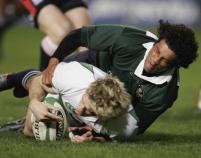
The margin did not flatter Ireland, who weathered an initial storm, and then produced phases of devastating running to blow away the South African resistance far more effectively than the wind that whipped into the tourists' faces during the conclusive first half.

It was a Test match for South Africa to commemorate 100 years playing in the Springbok jersey, but the Boks of yesteryear will surley be turning in their graves after the visitors appalling display.

South Africa never once had a stranglehold on the game that was marred by too many silly penalties, heaps of turnovers and ruined opportunities.

Not taking anything away from a superb Irish performance that left the former world champions scratching their heads for the majority of the match.

It was well noted in the build up to the match that this would not be the Boks strongest team ever, but if this was a test of South Africa's squad depth with the a Rugby World Cup just around the corner, Bok coach Jake White should have a lot to worry about.

The match started off well enough for the visitors, after some great running rugby off their first touch of the ball found them in the Ireland 22 and, better yet, a shot at goal.

After brilliant running off the ball from forwards and backs alike, Ireland's big number eight Denis Leamy was blown for hands in the ruck.

This must have been a relief to South Africa fly-half Andre Pretorius, who had fluffed a drop-goal attempt with an overlap shouting for the ball.

The No.10 struck the ball well enough for the gust of wind to bring the ball inside the left hand upright for the side's three points in as many minutes.

First blood to the Springboks, but it would be the first and the last time the visitors would score in that half.

With barely two minutes gone after the restart, Ireland came back strongly with an incredible burst into the Bok 22 that had the visitors scrambling back in defence.

Ireland fly-half Ronan 'O Gara popped the ball up to a flying Andrew Trimble off his left wing in the midfield, only for the young star to burst through two attempted tackles and score the first try of the match.

The pace and power of Trimble had the Lansdowne Road crowd standing on their feet, as the failed Bok defenders struggled to get back on theirs.

O'Gara made no mistake with the conversion and Ireland had an early four point lead.

South Africa certainly weren't deterred by the early five-pointer and carried on with their ambitious play, only to be let down by an unfortunate forward pass that had the Ireland defence on the ropes.

The Bok debutants certainly didn't have time to get themselves setteled into the fast pace of the game, and the nerves stood out on more than on one occasion from the influx of Ireland attacks.

Balls that were left to bounce when they should have been taken on the first attempt, caused unnecessary pressure on the new boys.

Passes that should have been made were instead kicked into the hands of the opposition who eventually punished them for their bad option taking.

A perfect example came when new Bok Bevin Fortuin kicked into the hands of Gordan D'Arcy, only for the giant centre to run back at the South Africans and earn his side a penalty for the South Africa big men not rolling away in the tackle.

O'Gara slotted the easy penalty to extend the lead for his team.

It was at this moment of the match that the floodgate opened for a barrage of Ireland attacks that left the Bok defence in sixes and sevens.

Not even Fortuin's high tackles could stop the electric pace of Trimble, who was once again involved in a superb attacking display for his country.

As the Bok midfield tried to contain the Ulster winger, Ireland scrum-half Peter Stringer spotted flank David Wallace floating unmarked on the touchline.

All Wallace had to do was catch the long, floating pass and use his speed to take him to the open tryline.

He did just that as he rounded off a superb try from some great vision from Stringer.

O'Gara was unfortunate not to nail the conversion as he had two attempts to do so.

The wind blew the ball off the kicking tee on the fly-half's first approach, only for O'Gara to try again with a drop-goal but to no avail.

Again the Irish were knocking on the South Africa's try-line door, but a shoddy pass resulted in Wallace failing to go over for his second after knocking on.

The visitors came close a few minutes later, after some well worked tactical kicking from Pretorius saw the Boks end up just five meters from the Ireland try-line.

The hosts were lucky not to be given a penalty try against them after countless offences on their line.

South Africa must have really been hoping for some luck of the Irish to come their way after yet another silly mistake in the ruck saw Ireland awarded with a penalty to clear their lines.

Amazingly enough, the Boks somehow found themselves scampering back again in defence as the Irish got used to the sloppy tackling from the visitors.

However, South Africa number eight Pierre Spies threw in the tackle of the game as he saved a certain try from none other than Trimble again.

The tackle set up a line-out five meters from the Bok line, but the big men failed to win their own throw and were forced to defend their line.

The Irish forwards made some good work from high quality ball and it took a stretched out arm from prop Marcus Horgan to dot the ball down on the stroke of half-time.

O'Gara made sure of the conversion and Ireland had a more than comfortable lead at half-time with the scoreline standing at 22-3.

The second half started well for the home team, just as they ended the first with the entire Ireland XV piling on the pressure.

The visitors match performance was clearly summed up after it took South Africa prop CJ van der Linde to clear the Bok tryline after the ball was turned over on an early Irish attack.

The second half wasn't nearly as close to the pace of the first and it took a good piece of work by flank Danie Rossouw in the Bok midfield to send wing Francois Steyn over to score on debut.

At last, South Africa had something to shout about, but Pretorius soon put that to rest after a sloppy conversion attempt.

O'Gara certainly didn't give the visitors much time to work on their comeback after nailing a beauty of a conversion from far out.

At 25-8, the game looked well done and dusted.

South Africa didn't seem to think so and the earlier try-scorer Steyn put in a wonderful pass to speed merchant Bryan Habana to race past two Ireland defenders for a brilliant touchdown.

With six minutes left on the clock, any hope of a miraculous Bok comeback was ruled out with another Ireland try to wing Shane Horgan in the corner.

That surley was the final nail in the Springbok coffin, or at least we thought so.

O'Gara rubbed the defeat in the Bok's noses by slotting another flawless kick on the right-hand touchline to end the match 32-15.

South Africa heads dropped as Ireland fans cheered their team on in what was a game full of Irish flair and heart.

Another reason the Irish could celebrate was the daunting number of records broken.

This included the highest winning margin, the most amount of tries scored and the biggest result scored against their southern hemisphere rivals.

Man of the Match:  A couple of Ireland players can take a well earned bow for this one.  In the forwards, Denis Leamy was outstanding with his brute strength on the charge, whilst Paul O'Connell was superb in the line-outs and in loose play.  The backline were phenomenal all night, and the Ireland team owe their victory to tremendous play from scrum-half to full-back.  But we agreed on giving the prize to centre Gordan D'Arcy for his wall-like defence and attacking flair that tore the Bok midfield in half.

Moment of the Match:  It has to be Trimble's opening try in the first five minutes of the game that signaled big things to come for the rest of the Test match -- and it certainly did!

Villain of the Match:  The whole Springbok team should earn a nomination for their uninspiring performance through the majority of the match.  But otherwise no red or yellow cards were issued.

The scorers:

For Ireland:
Tries:  Trimble, Wallace, Horan, Horgan
Cons:  O'Gara 3
Pens:  O'Gara 2

For South Africa:
Tries:  Steyn, Habana
Con:  Pretorius
Pen:  Pretorius

Ireland:  15 Girvan Dempsey, 14 Shane Horgan, 13 Brian O'Driscoll (captain), 12 Gordan D'Arcy, 11 Andrew Trimble, 10 Ronan O'Gara, 9 Peter Stringer, 8 Denis Leamy, 7 David Wallace, 6 Neil Best, 5 Paul O'Connell, 4 Donncha O'Callaghan, 3 John Hayes, 2 Rory Best, 1 Marcus Horan.
Replacements:  16 Frankie Sheahan, 17 Bryan Young, 18 Malcolm O'Kelly, 19 Simon Easterby, 20 Isaac Boss, 21 Paddy Wallace, 22 Geordan Murphy.

South Africa:  15 Bevin Fortuin, 14 Jaco Pretorius, 13 Bryan Habana, 12 Jean de Villiers, 11 Francois Steyn, 10 Andre’ Pretorius, 9 Ricky Januarie, 8 Pierre Spies, 7 Juan Smith, 6 Danie Rossouw, 5 Albert van den Berg, 4 Johan Ackermann, 3 CJ van der Linde, 2 John Smit (captain), 1 Lawrence Sephaka.
Replacements:  16 Chiliboy Ralepelle, 17 BJ Botha, 18 Johann Muller, 19 Jacques Cronjé, 20 Ruan Pienaar, 21 Wynand Olivier, 22 JP Pietersen.

Referee:  Paul Honiss (New Zealand)
Touch judges:  Bryce Lawrence (New Zealand), Taizo Hirabayashi (Japan)
Television match official:  David Changleng (Scotland)

Australia made to sweat by Azzurri

Late try seals Wallaby win

Australia captain Stirling Mortlock scored a late try to seal a narrow 25-18 win fover Italy at Stadio Flaminio in Rome on Saturday.  The Wallabies outscored the home side by three tries to none, but six penalties by fly-half Ramiro Pez kept the Azzurri in the hunt and the heat on the visitors.

The Australians were made to sweat and at times made to look very ordinary by an Italian team that deserved more than they got on the day.

It was a game in which the Wallabies' shortcomings were exposed like never before -- their suspect scrum was destroyed by the powerful Italian pack on a number of occasions and they also struggled to contain the impressive Italian mauls.

But the biggest flaw in the Australian game is that they offered very little other than their predicable phase play, which the Italians found relatively easy to defend against.

If you want to know where the tries came from -- well one was a bad Italian tap in the line-out, the other a great bust up the midfield from Wycliff Palu and only one of the three came from sustained phase play.

But enough about the Wallaby shortcomings -- let's talk about the Italian performance.

They have an awesome pack, which will hold its own in any competition.  Their line-outs may not be so flash, but they will get enough from this phase if they can concentrate for 80 minutes.

And it was those momentary lapses of concentration that probably cost the Azzurri the game.

The early passages were controlled by the Italians, who took the ball up strongly and moved it from side to side.

They were soon rewarded for their efforts, when the Australians were penalised and hooker Brendan Cannon yellow carded for what seemed a harmless push.

Fly-half Ramiro Pez pushed this effort wide, but he slotted the next three -- in the fifth, 11th minutes and 15th minutes -- to give his team a handy 9-0 lead.

The Wallabies had their chances, but they were squandered rather amateurishly -- once Chris Latham dropped the ball over the tryline.  They were prone to handling errors and as the scoreline suggested they were heavily penalised.

Australia finally got onto the scoreboard in the 21st minute, following a rare passage of sustained ball control, and captain Stirling Mortlock wasted no time in slotting the penalty to narrow  the gap to 9-3.

But the Australian scrum, which has been under pressure, crumbled in the 24th minute as the Italians just marched upfield.  The mess of a scrum soon turned into an Italian, penalty, which Pez duly slotted.

The Australians finally got their hands on the ball and put a few phases together, before fly-half Mat Rogers slipped over for a great try in the 27th minute.  The decisive pass came from inside centre Stephen Larkham, who drew the defence as Rogers looped around.

Mortlock added the conversion and kicked a penalty six minutes later -- following another period of sustained pressure and phase play -- for the Wallabies to take the lead for the first time.

But the Italians were not done yet and right on the stroke of half-time, as they marched upfield with another impressive maul, they were awarded a penalty -- which Pez slotted to regain the lead, 15-13 at the break.

The Australians were first to score after the break, but it was a fortuitous score -- with an Italian line-out going badly wrong, the tap finding a charging Guy Shepherdson, who just flopped over for the try.  Mortlock added the conversion to make it 20-15 in favour of the Wallabies after 44 minutes.

Pez had a chance to narrow the gap six minutes later, but he pushed a relatively easy shot at goal wide of the upright.  But he slotted one from a similar distance and angle in the 56th minute, to narrow the gap to 20-18.

But the crucial score came from the Australians in the 70th minute, with captain Stirling Mortlock going over for a great try, following a powerful midfield run by No.8 Wycliff Palu.  But Mortlock couldn't add the conversion, leaving the backdoor open for the Italians at 25-18.

The Italians tried bravely, but the Wallabies hung on to the end for a hard-earned win.

Man of the match:  You can look at Italian fly-half Ramiro Pez for his great goal-kicking, or even the front row of Martin Castrogiovanni, Carlo Festuccia and Andrea Lo Cicero for their powerful scrummaging performance.  No.8 Sergio Parisse also had a strong performance, as did his Australian counterpart Wycliff Palu.  Stephen Larkham and Mat Rogers had their moments, but out award goes to the captain Stirling Mortlock and it is not just for his match-clinching try.  As usual he put his body on the line for his country.

Moment of the match:  It simply has to be Stirling Mortlock's 70th minute try, not only because it sealed the win, but also for Wycliff Palu's great midfield bust.

Villains of the match:  There were two yellow card  -- Brendan Cannon for punching and Lote Tuqiri for a professional foul.  But Lote Tuqiri deserves the award on his own.  He was involved in off the ball stuff far too often.

The scorers:

For Italy:
Pens:  Pez 6

For Australia:
Tries:  Rogers, Shepherdson, Mortlock
Cons:  Mortlock 2
Pens:  Mortlock 2

Yellow cards:  Brendan Cannon (Australia, 3 mins -- punching), Lote Tuqiri (Australia, 79 -- professional foul)

Italy:  15 Gert Peens, 14 Kaine Robertson, 13 Gonzalo Canale, 12 Mirco Bergamasco, 11 Pablo Canavosio, 10 Ramiro Pez, 9  Paul Griffen, 8 Sergio Parisse, 7 Mauro Bergamasco, 6 Alessandro Zanni, 5 Marco Bortolami, 4 Santiago Dellapè, 3 Martin Castrogiovanni, 2 Carlo Festuccia, 1 Andrea Lo Cicero.
Replacements:  16 Leonardo Ghiraldini, 17 Carlos Nieto, 18 Carlo Antonio Del Fava, 19 Josh Sole, 20 Simon Picone, 21 Andrea Scanavacca, 22 Walter Pozzebon.

Australia:  15 Chris Latham, 14 Clyde Rathbone, 13 Stirling Mortlock, 12 Steven Larkham, 11 Lote Tuqiri, 10 Mat Rogers, 9 Matt Giteau, 8 Wycliff Palu, 7 George Smith, 6 Rocky Elsom, 5 Nathan Sharpe, 4 Mark Chisholm, 3 Guy Shepherdson, 2 Brendan Cannon, 1 Al Baxter.
Replacements:  16 Stephen Moore, 17 Nic Henderson, 18 Alistair Campbell, 19 Stephen Hoiles, 20 Josh Valentine, 21 Mark Gerrard, 22 Cameron Shepherd.

Referee:  Nigel Owens (Wales)
Touch judges:  Alan Lewis (Ireland), Hugh Watkins (Wales)
Assessor:  Bob Francis (New Zealand)

Scotland uproot stubborn Oaks

Romania undone by energetic Scots

Scotland coach Frank Hadden tasked his men to "smash" their first opponents of the November series, and they duly delivered, notching up a 48-6 victory over Romania at Murrayfield on Saturday.

But the final scoreline flatters the Scots who were outmuscled up front and forced to rely on the superior organisation of their backline and the fine support-running of their loose forwards.

Hadden's tenure began with a 39-19 win over the Oaks in Budapest in June of last year, and this result in Edinburgh tells us a little bit about Scotland's recent development.

There were encouraging signs from Scotland's clutch of debutants and the side's new-found desire to probe the gaps was nothing if not admirable.

Yet there are still plenty of areas that need to be worked on before they meet the Romanians in Pool C of the 2007 Rugby World Cup.

But it's hard to expect a group of men to hit the heights when just 12,000 of their compatriots make the effort to come and support.  Is a tenner for a ticket really too much to ask?

It was a game of contrasting style with the visitors determined to draw their hosts into a pitched battle and the Scots keen to avoid contact and spread possession wide.

Scotland were full of confidence from the off, refusing two kickable penalties as they went on search of a try to kick off proceedings.

The Romanians repelled an early attack but the home side eventually broke their opponents' resistance in the 14th minute when Johnnie Beattie crashed over for a debut try after Scotland captain Jason White had attracted the attention of three tacklers.

Phil Godman, handed a first start at fly-half, successfully added the conversion but Romania fullback Florin Vlaicu replied with a penalty to leave the score at 7-3 at the midpoint of the half.

Scotland immediately hit back, Hugo Southwell outpacing centre Catalin Dascalu on the outside before chipping over Vlaicu and collecting the ball to slide over for his sixth international try in the 21st minute.

Romania were penalised at a scrum five minutes later and White invited Godman to kick the straightforward penalty to move Scotland 15-3 ahead.

Southwell extended Scotland's lead to 17 points when he dived over in the same corner for his second try of the match in the 36th minute after a fine break from the base of a ruck from scrum-half Mike Blair.

But the half ended on a sour note for Scotland as White was stretchered off with a leg injury to be replaced by a third debutant, David Callam.

Scotland had fielded almost an all-Edinburgh backline, with Northampton's Sean Lamont the odd man out, and three of the capital side's players combined for the fourth try of the match six minutes into the second period.

Godman darted inside before feeding Simon Webster who in turn spread it to Dewey and he became the second debutant to cross for a try when he fended off two tacklers to skip over and move his side further ahead.

Vlaicu kicked a second penalty to double his side's tally while an event of more significance occurred in the 55th minute when James Hamilton replaced Nathan Hines to become the 1,000th player to be capped by Scotland.

Godman then got in on the try-scoring act when he skipped over for his first in international rugby after good work from Webster and Southwell.

Hooker Dougie Hall followed suit with his first try for Scotland in the 65th minute after the Edinburgh man was sent clear by a clever pass from replacement Chris Cusiter.

Cusiter, having to be satisfied with a role from the bench since Hadden took over and installed Blair as his scrum-half, danced over for Scotland's seventh try of the game following a slick handling move with replacement Chris Paterson to the fore.

Webster almost cut through with seconds left but was ankle-tapped to deny Scotland the chance to finish the game in style by bringing up their half-century.

Romania must take comfort from their strong start and the ability of their big forwards.  But this is not the Romania of old.  Argentina's quest for playmates is currently hogging the headline, but Europe have a needy -- perhaps moribund -- relative on their own doorstep.

Scotland deserved the win, and they deserve plaudits for accepting Romania's request for a game -- it is the only one the Oaks managed to get this November.

Man of the match:  Romanian's big forwards, hewn from the abrasive surrounds of France's Top 14 league, put in a terrific performance.  For Scotland, new boys Johnnie Beattie and Rob Dewey impressed, Phil Godman directed operations well and Simon Webster was his usual industrious self.  Mike Blair's constant sniping took the wind out of Romanian sails and Chris Cusiter enjoyed his returned to Scotland colours when he came off the bench for the final quarter.  But our man of the match is Hugo Southwell who has developed into a world-class performer; it was his penetrating running that uprooted the Oaks.

Moment of the match:  Perhaps Johnnie Beattie's try on debut -- or rather the composure of his father, John, in the BBC's commentary box, allowing himself a brief "good support work from Beattie" before breaking off.  The entry of James Hamilton, who became the 1,000th man to play for Scotland, will also live long in the memory.  But in terms of Scotland's development, perhaps the key moment was when Jason White was stretchered off just before half-time with what looked like a serious knee injury.  We wish him well.

Villain of the match:  Not much aggression in this encounter -- perhaps too little from Scotland's pack.  Romania wing Gabriel Brezoianu took a swing at the giant frame of James Hamilton, but we'll let him off -- Hamilton hardly noticed!

The scorers:

For Scotland:
Tries:  Beattie, Southwell 2, Dewey, Godman, Hall, Cuister
Cons:  Godman 4
Pen:  Godman

For Romania:
Pens:  Vlaicu 2

Scotland:  15 Hugo Southwell, 14 Simon Webster, 13 Marcus Di Rollo, 12 Rob Dewey, 11 Sean Lamont, 10 Phil Godman, 9 Mike Blair, 8 Johnnie Beattie, 7 Kelly Brown, 6 Jason White (c), 5 Scott Murray, 4 Nathan Hines, 3 Euan Murray, 2 Dougie Hall, 1 Gavin Kerr.
Replacements:  16 Scott Lawson, 17 Allan Jacobsen, 18 Craig Smith, 19 James Hamilton, 20 David Callam, 21 Chris Cusiter, 22 Chris Paterson.

Romania:  15 Florin Vlaicu, 14 Gabriel Brezoianu, 13 Catalin Dascalu, 12 Romeo Gontineac, 11 Ioan Teodorescu, 10 Ionut Dimofte, 9 Valentin Calafeteanu, 8 Ovidiu Tonita, 7 Cosmin Ratiu, 6 Florin Corodeanu, 5 Cristian Petre, 4 Sorin Socol (c), 3 Bogdan Balan, 2 Marius Tincu, 1 Petru Balan.
Replacements:  16 Razvan Mavrodin, 17 Ion Paulica, 18 Cezar Popescu, 19 Valentin Ursache, 20 Alexandru Lupu, 21 Ionut Tofan, 22 Csaba Gal.

Referee:  Matt Goddard (Australia)
Touch judges:  Tony Spreadbury (England), Federico Cuesta (Argentina)
Television match official:  Tim Hayes (Wales)

Wales storm past the Islanders

First-half blitz enough for the Welsh

Four first-half tries were enough to see Wales home to a 38-20 victory over the Pacific Islanders at the Millennium Stadium in Cardiff on Saturday, but this error-ridden game never quite lived up to its billing.

Before play started at the Millennium Stadium both captains laid wreaths as a sign of respect for Remembrance Day, but sadly this game fizzled out and will not live long in the memory for either side.

The Pacific Islanders set their stall out from the first minute, opting to run from deep inside their own territory in true island style but rarely made inroads.  Wales in contrast played with composure and showed glimpses of the flair their opponents were looking for.  Four tries in the first half for the Welsh, when the Islanders looked rusty, was enough to secure the win that was expected from them.  The disappointment was their failure to build on a strong position in the second half.

It was evident in the early exchanges that the Pacific Islanders had only been together for a week, but as the game progressed they started to find their rhythm and began to cause Wales problems with their pace and width.  If they are to be taken seriously as a side then they need to be given the time together to prepare for fixtures, for partnerships to gel and for an understanding to develop.

That said they were the architects of their own downfall in the first half when they played in the wrong areas and gave Wales two tries under the posts with easy intercepts.

Sweeney, controversially handed the kicking duties ahead of James Hook, set Wales on their way with a simple fourth minute penalty after the impressive Seru Rabeni hit Hook late and high.

They continued to exploit the Islanders lack of organisation after quick phase ball was moved wide to Mark Jones who finished superbly.  Faced with fifty meters and two defenders between himself and the line he stood up Latu before scorching down the line to score in the corner.  Sweeney added a tricky conversion from the touchline.

Looking to play with too much width from every possible chance, the Islanders increasingly began to turn over possession to Wales, who, marshalled by Mike Phillips and Ceri Sweeney, controlled play astutely.

To play Test rugby at this level you need to play yourself into the game, a concept that escaped the Pacific Islanders, as they coughed up two intercept tries to Hook and Lee Byrne respectively, trying to live up to their reputation of a free-running side.

Sandwiched in between those two gifts Sonny Parker showed Wales what they have been missing of late with a searing break into the Islanders' 22 before sending Kevin Morgan in by the posts.

For all the flair and pace the Islanders boasted it was the power and muscle of their physical forwards that yielded their opening score, Justin Va'a crashing over in the corner after a smart line out move.

Half-time was a welcome relief for a tired looking Islanders side, who for all their endeavour were failing to live up to their billing.  They were hardly helped by the lack of possession from set piece, as Sidoli and Owen pulled their line-out to pieces.

Whether Wales realised they had the game wrapped up, or the Islanders began to find their form, the second half was a different story.  For starters the Islanders outscored Wales, and on top of that they looked to be the more lively side and were rewarded for their persistent adventure with tries from Seilala Mapasua and Kameli Ratuvou.

Wales did find their form briefly in the second half, scoring the try of the game through Ceri Sweeney.  The move started deep inside their own 22 from another turnover.  Alix Popham read the situation well feeding Sonny Parker on the inside to inject pace into the move.  Mark Jones was in support and would have scored himself but for a superb last ditch tackle.  As it was Ceri Sweeney was on hand to cap a fine move, one their opponents would have been proud of.

Both sides will be able to take enough positives from the game to be happy, although neither side found the form they would have been looking for in a game that ultimately was won and lost by half-time.

Man of the Match:  For the Pacific Islanders captain Simon Raiwalui never gave up and was always on hand to lead the way, along with the impressive Nili Latu.  For Wales Kevin Morgan again showed his true class and Mike Phillips was busy at scrum half.  But back in the side for the first time in a year Sonny Parker was often the key in defence and attack.

Moment of the Match:  The two moments that stood out were the intercept tries scored in the first half.  Had it not been for them the Islanders may have been in touch going into half time, as it was they gifted Wales fourteen points and the game.

Villain of the Match:  None -- all good clean family fun.

The scorers:

For Wales:
Tries:  M Jones, Hook, Morgan, Byrne, Sweeney
Cons:  Sweeney 5
Pen:  Sweney

For the Pacific Islanders:
Tries:  Va'a, Mapasua, Ratuvou
Con:  Pisi
Pen:  Pisi

Wales:  15 Kevin Morgan, 14 Lee Byrne, 13 Sonny Parker, 12 James Hook, 11 Mark Jones, 10 Ceri Sweeney, 9 Mike Phillips, 8 Alix Popham, 7 Gavin Thomas, 6 Alun Wyn Jones, 5 Robert Sidoli, 4 Michael Owen, 3 Chris Horsman, 2 Rhys Thomas, 1 Duncan Jones (c).
Replacements:  16 Huw Bennett, 17 Adam Jones, 18 Gethin Jenkins, 19 Jonathan Thomas, 20 Gareth Cooper, 21 Gavin Evans, 22 Shane Williams.

Pacific Islanders:  15 Norman Ligairi, 14 Lome Fa'atau, 13 Seru Rabeni, 12 Seilala Mapasua, 11 Sailosi Tagicakibau, 10 Tusi Pisi, 9 Moses Rauluni, 8 Hale T-Pole, 7 Semo Sititi, 6 Nili Latu, 5 Daniel Leo, 4 Simon Raiwalui (c), 3 Tevita Taumoepeau, 2 Mahonri Schwalger, 1 Justin Va'a.
Replacements:  16 Aleki Lutui, 17 Census Johnson, 18 Ma'ama Molitika, 19 Epi Taione, 20 Junior Poluleuligaga, 21 Seremaiai Bai, 22 Kameli Ratuvou.

Referee:  Wayne Barnes (England)
Touch judges:  Donal Courtney (Ireland), Rob Debney (England)
Television match official:  George Clancy (Ireland)
Assessor:  Dick Byres (Australia)

Saturday, 4 November 2006

All square in Cardiff thriller

Disappointing end to exciting match

In an anti-climactic end to a terrific match, Wales and Australia opened the November international season with a 29-all draw at the Millennium Stadium in Cardiff on Saturday.

After the Welsh had clawed their way back from 17-6 down after 20 minutes to lead 26-17, tries by Chris Latham and Cameron Shepherd took the Wallabies 29-26 ahead, but James Hook -- on for Stephen Jones and delivering a flawless performance -- kicked a nerveless penalty to level the scores.

Hook then had the final play of the match, a superb touch-finder to Australia's corner, but referee Steve Walsh then blew for the end of the match, leaving the Welsh scratching their heads and wondering about the time-keeping once again.

What a great day for rugby football!  A great game on a great field before a great crowd -- a grand occasion.  The sun certainly shone in Cardiff, literally and metaphorically.  And the irony of it was that at the end there were two disappointed sides.  Two.

Perhaps what the great New Zealander Tom Pearce famously said -- "drawing is like kissing your sister" -- applied here.

The Wallabies were disappointed, for they wanted a win and after 30 minutes a Wallaby win seemed the only possibility.  And in the end they scored four tries to two, which suggests a winning effort.  The Wallabies always looked more likely to score tries but as their ill-discipline gave Wales chances so Welsh lapses gave them tries.

The Welsh were disappointed as they came back to take a nine-point lead and then squandered it and yet that last kick of the match took them deep into the Wallaby 22, but there was no further play as the final whistle sounded.

It was a great game of concentrated effort by two skilful sides.  The attacking and defending were of a high quality.

Millennium Stadium is such a wonderful palace of a ground and yet the playing surface remains a problem.  It is unstable and may have had something to do with scrums that were wonky and players who slipped.  For the Wallabies the scrums remain a problem.  One of their collapsed scrums gave the Welsh three points for the penalty and near the end they were destroyed in a scrum within the Welsh 22 and Wales had the put-in to the subsequent scrums.

Line-outs on the other hand were good for the Wallabies as they took four off Wales.

The difference came in the penalties -- 9-4 in Welsh favour.  In the second half Wales were not penalised once.  Four of the penalties were naughty - stamping, punching, late obstruction and collapsing a maul.

But those are all such tawdry things.  There were the glittering jewels of passing and running, and six thrilling tries.  Six?  Yes, even Matt Giteau's was fascinating as he caught the whole of the Wales napping, strolled, jogged, darted, tapped and scored while Wales waited for a kick at goal.

The Wallabies experimented with a backline shuffle.  It certainly worked for Giteau who had a lively match at scrum-half while he was there, judging effectively, passing accurately if off steps, always testing the defence and kicking long.  Mat Rogers was fairly anonymous at flyhalf, which may not have been a great success.  Lote Tuqiri had some good moments at outside centre and Stephen Larkham did some useful things at inside centre.  But it was not an experiment that could be regarded as a great success.

After Wales had won the singing and the weird hairdos, the Wallabies kicked off to get the November Tests going, and for 30 minutes they were in the ascendancy.  Wales got only scraps of possession as the Wallabies went through their familiar phases.  Their very first passing movement had them at the Welsh line on the Wallaby left after an astonishing, left-handed pass by Larkham had found Cameron Shepherd who had come off his left wing to be far out on the right.  The attack yielded three points from a penalty when Tom Shanklin was off-side, but Wales were probably grateful that it was only three.  They were probably astounded that it became 3-all when they went into Wallaby territory for the first time and Rodney Blake was penalised at a tackle.

On 12 minutes the Wallabies got the first try as they went through phases and then came back to their left when big Wycliff Palu surged through a gap and powered on till Kevin Morgan bravely stopped him.  But the Wallabies were bashing at the line till they passed flat to their left.  Mat Rogers flicked a dummy and they got a clever pass to Shepherd who was over.  Giteau converted well.  10-3.

When Blake was penalised at a collapsed scrum, spiky and tanned Gavin Henson kicked a magnificent penalty from a long way out and at an angle.  10-6, a score which flattered Wales.

Three minutes later Giteau got the try.  The referee played advantage on the Wallaby right as play petered out wide on their left.  Giteau saw the chance, tapped, darted, dived and scored far out.  He converted.  17-6 after 20 minutes.

It took the Wallabies 38 minutes to score again.

Shortly after Giteau's try, Welsh captain Stephen Jones went off with a twisted knee to be replaced by young James Hook, who proved that not only an old hand has a cool head.

The Wallabies had some good moments when Latham grubbered and when Vickerman broke.  Giteau missed with two kicks at goal, the second hitting the upright.  But it was Wales who scored.

Suddenly they got possession as they kept the ball in hand, possession begetting possession and their try when it came was a splendid one.

From a scrum Shanklin was a decoy and Henson squeezed a pass to fullback Morgan who switched with shorn Shane Williams who scored far out in the corner.  Hook converted.  It was astounding to look up at the scoreboard and see 17-13 after such Wallaby domination.

But Wales were not done yet.  They came running at the Wallabies again and when Tuqiri was off-side, Hook made it 17-16, the half-time score.

The tackle situation throughout the match was well protected, the Wallabies more firmly, but the first turn-over at the tackle came to Wales in the second half.

They also got the first points when Shane Williams chipped, chased and was impeded by Larkham.  Hook goaled and a miracle seemed imminent as Wales went ahead 19-17 with 29 minutes to play.

Wallaby hands wobbled in this half and when it happened a second time Shanklin kicked on and the Wallabies were forced to scamper in defence.  Stephen Hoiles, on for Palu, got back and fell on the ball, but it squired from him back into the Wallaby in-goal where Martyn Williams delighted himself and whole of Wales by scoring a try.  It was farish out but Hook converted.  26-17 with 23 minutes to go.

That lasted just on a minute.  It may have been that comfort produced relaxation  but suddenly Giteau, now at centre with Larkham off injured, cut clean through and sent Tuqiri racing for the line.  He looked certain to score but Shane Williams felled him.  But the Wallabies were at the line.  They went left and Shepherd forced his way over for his second try.  26-24 with 22 minutes to play.

They nearly scored again when Wales won a defensive line-out and made a regulation maul.  Suddenly Rocky Elsom burst out of the maul and looked about to score but three Welshmen banged at him and he lost the ball forward for a scrum to Wales -- an excellent scrum as they surged forward on their own ball.

The Wallaby try was the result of an aberration.  Morgan received the ball inside his 22.  He had time and space.  The touch-line was not far away on his left.  Instead he chose to kick a long diagonal to his right where one of the world's best counterattackers, Chris Latham was waiting.

Latham got the ball on the half-way line, not far from touch and started running.  He ran for 50 metres, beating four Welshmen who would stop him as part of a threadbare defence and over he went in the left corner.  Giteau missed the conversion but the Wallabies were winning with 15 minutes to play.

With nine minutes left Al Baxter was penalised for collapsing a maul and cool Hook kicked the penalty goal which drew the match.

The last nine minutes were thrilling but scoreless, though it took Matthew Rees's fingertips to grab Stepehen Hoiles from behind and prevent a possible try.

It was astonishing that when the final whistle went on this great encounter, some people booed.  It may have been an anticlimax but not a bad one.  But once again, the Welsh were left confused at the whistle, when they clearly expected another play where the whistle blew.  What is it with the Welsh and stadium clocks ... are we to coin the phrase a Welsh minute?

Man of the Match:  There were Dwayne Peel, the Williamses Martyn and Shane, Ian Gough Jonathan Thomas and James hook -- at least those.  There were Matt Giteau.  Daniel Vickerman and, our man of the match, Chris Latham for Australia.  Latham was everything he could have been on defence and attack.  Australia have a whole lot to thank him for.

Moment of the Match:  All the tries in their different ways but our choice is Chris Latham's 50m burst for a score.  He is always looking for a try.

Villain of the Match:  There was nothing bad enough to be described as villainy, but interestingly in view of the recent instruction on stamping by the IRB was the penalty -- and only that -- against Nathan Sharpe for doing just that early in the match.

The scorers:

For Wales:
Try:  S Williams, M Williams
Con:  Hook w
Pens:  S Jones, Henson, Hook 3

For Australia:
Tries:  Shepherd 2, Giteau, Latham
Cons:  Giteau 3
Pen:  Giteau

Teams:

Wales:  15 Kevin Morgan, 14 Gareth Thomas, 13 Tom Shanklin, 12 Gavin Henson, 11 Shane Williams, 10 Stephen Jones (captain), 9 Dwayne Peel, 8 Ryan Jones, 7 Martyn Williams, 6 Jonathan Thomas, 5 Ian Gough, 4 Ian Evans, 3 Adam Jones, 2 Matthew Rees, 1 Gethin Jenkins.
Replacements:  16 Rhys Thomas, 17 Duncan Jones, 18 Gavin Thomas, 19 Alun Wyn Jones, 20 Mike Phillips, 21 James Hook, 22 Mark Jones.

Australia:  15 Chris Latham (vice-captain), 14 Clyde Rathbone, 13 Lote Tuqiri, 12 Stephen Larkham (vice-captain), 11 Cameron Shepherd, 10 Mat Rogers, 9 Matt Giteau, 8 Wycliff Palu, 7 Phil Waugh (captain), 6 Rocky Elsom, 5 Daniel Vickerman (vice-captain), 4 Nathan Sharpe, 3 Rodney Blake, 2 Tai McIsaac, 1 Al Baxter.
Replacements:  16 Brendan Cannon, 17 Benn Robinson, 18 Mark Chisholm, 19 Stephen Hoiles, 20 Josh Valentine, 21 Mark Gerrard, 22 Adam Ashley-Cooper

Referee:  Steve Walsh (New Zealand)
Touch judges:  Paul Honiss, Bryce Lawrence (both New Zealand)
Television match official:  Kelvin Deaker (New Zealand)

Sunday, 29 October 2006

Namibia get a leg up

Solid victory in Windhoek

In the first leg of their World Cup qualifier against Morocco, Namibia gave themselves a great chance of going to France next year when they beat Morocco 25-7 in Windhoek.

The victory means that the Lions of the Atlas will have to win by at least 19 points when the two teams meet in Casablanca on 11 November.

The winner of this two-legged qualifier, will go to France.  The loser goes into répechage and plays the loser of the two-legged qualifier between Georgia and Portugal for the right to play Uruguay and qualify that way.

From the start it was a game of contrasting styles.  The Moroccans wanted to play through their forward while the Namibians wanted to get the ball wide to their speedsters.

After the Lions of the Atlas had started in fiery fashion, the Biltongboere got on top and after Emile Wessels had missed with a penalty attempt the Stellenbosch flyhalf goaled to give his side a 3-0 lead after 14 minutes.

The Moroccan forwards continued to dominate the line-outs and the loose where Namibia lost several turn-overs.  It was a physical battle.

Just before the break centre Lu-Wayne Botes grabbed a dropped pass and fed wing Guillaume Nel who raced ahead, drew the defence and gave to fullback Heini Bock who came dashing up on the outside.  Bock scored under the posts.

After the Lions had missed a second penalty attempt, Wessels goaled his second when the visitors were penalised for stamping.

Leading 13-0 the Biltongboere became their worst enemies when Irish referee Simon McDowell sent first scrumhalf Pieter Rossouw to the sin bin for a late tackle and then captain Kees Lensing joined him for stamping.  The latter decision incensed the home crowd.

Against 13 men the Lions drove hard at the Namibian line but the Namibians withstood attack after attack till the referee awarded a penalty try against them.  Thomas Garçia converted this time to make the score 13-7, and the home side was under pressure.  13 brave men withstood the onslaught and the big boot of Wessels drove the attackers back time and again, till at last the errant duo returned to the fray.

Namibia welcomed them back and it was the visitors' turn to defend, possibly dispirited by their failed attacks.

Quick ball from the loose enabled experienced Corné Powell to feed No.8 Jacques Burger who scored a try which Wessels converted.  20-7.

Just before the final whistle Botes chipped.  Replacement Rodger Thompson gathered, sidestepped and scored in the corner.

Scorers:

For Namibia:
Tries:  Bock, Burger, Thompson
Cons:  Wessels 2
Pens:  Wessels 2

For Morocco:
Try:  penalty
Con:  Garçia

Teams:

Namibia:  15 Heini Bock, 14 Guillaume Nel, 13 Lu-Wayne Botes, 12 Corné Powell, 11 Melrick Africa, 10 Emile Wessels, 9 Pieter Rossouw, 8 Jacques Burger, 7 Herman Lintvelt, 6 Tinus du Plessis, 5 Uakazuvaka Kazombiaze, 4 Heino Senekal, 3 Johannes Redelinghuys, 2 Johannes Meyer, 1 Kees Lensing (captain)
Replacements:  16 Morné Louw, 17 Gideon van der Berg, 18 Nico Genis, 19 Schalk van der Merwe, 20 Eugene Jantjies, 21 Rodger Thompson, 22 Adriaan du Plessis
Coaches:  Johannes Venter, Eden Meyer, Michael

Morocco:  15 Aziz Chahid, 14 Mounir Elhajji, 13 Eziyar Jawad, 12 Derraz Younès, 11 Boujouala Boubker, 10 Thomas Garçia, 9 Aissaoui Kamal, 8 Abdellatif Boutaty, 7 Mathias Garcia, 6 Hicham Housni, 5 Arif Hamid, 4 Hicham Laoni, 3 Samir Amechtane, 2 Jalil Narjissi (captain), 1 Mohamed Gouasmia.
Replacements:  Abdelkafi Abachri, Mounir El Hamzaoui, Mounir Jaoui, Karim Benherrou, Mohamed Loukrassi, Eziyar Hicham, Arif Nassim.
Coaches:  Bruno Barrero, Francis Was, Youssef Sridi

Referee:  Simon McDowell (Ireland)

Saturday, 28 October 2006

Important win for Georgia

Lelos defeat Leones

In a vital World Cup qualifier in Tblissi Georgia beat Spain 37-23 on Saturday, thus keeping the Lelos' hopes alive of qualifying for the World Cup in France

The defeat has dashed Spanish hopes of repeating their 1999 success when they went to the World Cup.

There were some 10 000 spectators in the Lokomotivi Stadium, vocal in their support of the home side.

Spain actually scored first.  Two penalty goals by flyhalf Esteban Roqué gave the visitors a 6-0 lead after just ten minutes, but two tries in five minutes, both converted, put Georgia 14-6 ahead after 25 minutes.  For the first the forwards, expected to be the Georgian strong point, mauled over the line for a try by No.8 Besarioni Udesiani and the second was scored by prop David Zirakashvili, both converted by fullback Malkhaz Urjukashvili.

Roqué and Urjukashvili exchanged penalties to make the score 17-9 at half-time.  Two mistakes had cost Spain dearly, but there had been enough in the first half to give Spain hope.

Hopes were dashed early in the second half when Urjukashvili added another penalty when Óscar Astarloa was sent to the sin bin.  In his absence Georgia added a third try, by replacement prop Avtandil Kopaliani, to take the score to 27-9 and two minutes later added a fourth, by fullback Urjukashvili who had a good afternoon.  34-9.  Spain was buried.

Still the Lions fought back with two tries - the first by fullback César Sempere, the second by Juan González, the first converted by Sempere, the second by replacement flyhalf Andrei Kovalenco.  Inside centre Irakli Giorgadze completed the scoring with a dropped goal five minutes before the final whistle.

Scorers:

For Georgia:
Tries:  Udesiani, Zirakashvili, Kopaliani, Urjukashvili
Cons:  Urjukashvili 4
Pens:  Urjukashvili 2
Drop:  Giorgadze

For Spain:
Tries:  Sempere, González
Cons:  Sempere 2
Pens:  Roque 3

Teams:

Georgia:  15 Malkhaz Urjukashvili, 14 Besiki Khamashuridze, 13 Rezo Gigauri, 12 Irakli Giorgadze, 11 Giorgi Shkinin, 10 Otar Barkalaia, 9 Bidzina Samkharadze, 8 Besarioni Udesiani, 7 Zviad Maisuradze, 6 Rati Urushadze, 5 Mamuka Gorgodze, 4 Ilia Zedginidze, 3 David Zirakashvili, 2 Akvsenti Giorgadze, 1 Goderdzi Shvelidze.
Replacements:  16 David Khinchagashvili, 17 Avtandil Kopaliani, 18 Giorgi Nemsadze, 19 Shalva Sutiashvili, 20 Irakli Abuseridze, 21 David Kacharava, 22 Giorgi Elizbarashvili

Spain:  15 César Sempere, 14 David Mota, 13 Alvar Enciso, 12 Javier Canosa, 11 Rafael Álvarez, 10 Esteban Roqué, 9 Pablo Feijóo, 8 Oscar Astarloa, 7 ,Alfonso Mata 6 Rafael Camacho, 5 César Bernasconi, 4 Andrew Ebbet, 3 Javier Salazar, 2 Mathieu Cidre, 1 Miguel Burgaleta.
Replacements:  16 José Maria Bohorquez, 17 Ion Insausti, 18 Sergio Souto, 19 Juan González, 20 Facundo Lavino, 21 Andrei Kovalenco, 22 Ignacio Martín

Referee:  Peter Allan (Scotland)
Touch judges:  Graeme Hannah, Jim Yuille (both Scotland)

Portugal sneak in

Last-gasp victory in Lisbon

Portugal's hopes of going to France next year are still alive, thanks to a last-minute try over Russia in Lisbon.

Portugal now face Georgia who beat Spain.  If Portugal win that they will head straight for France.  If they lose that they have to go into répechage.  There they will play the loser of the two-legged qualifier between Namibia and Morocco and then, if they win that, Uruguay.

Russia can no longer qualify.

Russia went 23-16 up with 15 minutes to go but, as time ran out, Portugal scored the try which may yet send them to France next year.  The try came with Portugal trailing 23-19.  Lock Marcelo D'Orey broke brilliantly to send inside cengtre Diogo Mateus in for the try.

Russia started off in splendid fashion when they grabbed a dropped pass and centre Andrey Kuzin scored the try.  5-0 after just two minutes.

Gonçalo Malheiro, whose error had led to the try, then goaled a penalty.  5-3, which Viktor Motorin cancelled out with a penalty goal.

From the kick-off, Portugal got on top and good teamwork brought a try for right wing António Aguilar, converted by Malheiro to give Portugal a 10-8 lead at half-time.

The lead did not last long in the second half for near the beginning No.8 Vyacheslav Grachev burst through to score.  Two penalties by Malheiro and one by Motorin were followed by Grachev's second try and Russia led 23-16 with 15 minutes to play.

Those 15 minutes belonged to Portugal.  First replacement Duarte Pinto reduced the lead to 23-19, to be followed then by all the drama of the finish.

Scorers:

For Portugal:
Tries:  Aguilar, Mateus
Cons:  Malheiro, Pinto
Pens:  Malheiro 3, Pinto

For Russia:
Tries:  Kuzin, Grachev 2
Con:  Motorin
Pens:  Motorin 2

Teams:

Portugal:  15 Pedro Leal, 14 António Aguilar, 13 Miguel Portela, 12 Diogo Mateus, 11 Pedro Carvalho, 10 Gonçalo Malheiro,8 Vasco Uva, 9 José Pinto, 7 Paulo Murinello, 6 Diogo Coutinho, 5 Marcelo D’Orey, 4 Gonçalo Uva, 3 Joaquim Ferreira, 2 João Correia, 1 Cristian Spachuk or Rui Corderio
Replacements:  16 Cristian Spachuk or Rui Cordeiro, 17 Juan Severino, 18 Sebastião Cunha, 19 João Uva, 20 Luís Píssara, 21 Duarte Pinto, 22 João Diogo Mota or Gustavo Duarte

Russia:  15 Dmitriy Zubarev, 14 Mikhail Babaev, 13 Andrey Kuzin, 12 Konstantin Rachkov, 11 Vladimir Ostroushko, 10 Alexey Korobeynikov, 9 Viktor Motorin, 8 Vyacheslav Grachev, 7 Artem Fatahov, 6 Aleksey Sarychev, 5 Kiril Kulemin, 4 Sergey Sergeev, 3 Victor Zdanovich, 2 Roman Romak, 1 Alexander Khrokin,
Replacements (from):  Oleg Shukaylov, Vladimir Marchenko, Valery Fedchenko, Vladislav Korshunov, Aleksandr Shakirov, Yury Kushnarev, Sergey Belousov, Ivan Prishchepenko, Victor Gresev

Referee:  Peter Fitzgibbon (Ireland)

Saturday, 16 September 2006

Spain win vital Czech encounter

RWC qualifier

On Saturday afternoon at the Josef Kohout Rugby Stadium in Ricany Spain beat the Czech Republic 33-12, an important win, especially away from home.

The second leg is in Madrid at the end of September.

The winner of this Europe Round 4 qualifier will go into Round 5 with Romania and Georgia.  The winner of that will go to the 2007 World Cup in France.  The runner-up will go into répechage.

On a pleasant if windy afternoon, Spain were always ahead, leading 13-0 at half-time thanks to two penalty goals by Esteban Roqué who also converted the try by Alfonso Mata five minutes before half-time.  Mata's try came from a maul started by prop Javier Salazar.

Early in the second half the Spanish Lions increased their lead to 20-0 with a try by scrumhalf Pablo Feijoo.  No.8 Óscar Astarloa tapped a penalty and sent Feijoo on a 60-metre run for the corner.

After the Czech coach had made several changes a try by Jiri Skall got the Czechs on the scoreboard.  Martin Kafka converted.

Esteban Roqué kicked two more penalties before Vaclav Jursik scored the Czechs' second try.  26-12.

Rafael Álvarez chipped, chased, gathered, beat two defenders and scored Spain's third try.

Scorers:

For Spain:

Tries:  Mata, Feijoo, Álvarez
Cons:  Roqué 3
Pens:  Roqué 4

For Czech Republic:
Tries:  Skall, Jursik
Con:  Kafka

Teams:

Spain:  15 César Sempere, 14 Juan Cano,, 13 Javier Canosa, 12 Alvar Enciso, 11 Rafael Alvarez, 10 Esteban Roque, 9 Pablo Feijoo, 8 Óscar Astarloa, 7 Alfonso Mata, 6 Rafael Camacho, 5 César Bernasconi, 4 Andrew Ebbet, 3 Javier Salazar, 2 Mathieu Cidre, 1 César Caballero.
Replacements:  16 Diego Zarzosa, 17 Ion Insausti, 18 Sergio Souto, 19 Cyril Hijar, 20 Igor Mirones, 21 Andrei Kovalenko, 22 Victor Marlet

Czech Republic:  15 Krejcí Tomáš, 14 Jursík Václav, 13 Rohlík Jan, 12 Kafka Martin, 11 Cí?ek Martin, 10 Snídal Martin, 9 Vítezslav Dosedla, 8 Miroslav Nemecek, 7 Ladislav Vondrášek, 6 Jirí Buryánek, 5 Jan Machácek, 4 Robert Voves, 3 Pavel Indrák, 2 Jan Oswald, 1 Lukáš Rapant
Replacements:  16 Jirí Skall, 17 Patrik Leroch, 18 Karel Kucera, 19 Martin Hudák, 20 Pavel Vokrouhlík, 21 Jaroslav Tomcík, 22 Martin Pachman

Referee:  Andrew Small (England)
Touch judges:  Rowan Kitt, Andrew Pearce (both England)
Match commissioner:  Klaus Blank (Germany)

Saturday, 9 September 2006

Springboks finish on a high

Two tries to one seals win

The Springboks ended their 2006 Tri-Nations on a winning note, beating the Wallabies 24-16 on a sunny spring afternoon at Ellis Park in Johannesburg on Saturday.  The South Africans outscored Australia by two tries to one.

Despite the win, the Boks still finish with the tournament's wooden spoon; Australia finish second.  These placing were a done deal even before the game, as was the competition for the Mandela Challenge Plate that the Wallabies had won with their two victories in Australia earlier in the tournament.

The match had its moments -- moments rather than passages of constructive play, melodious snatches in a pretty ponderous piece of music.

It was not quite the boring kickathon that the two teams produced when they last met in Sydney, although the first half promised to be a repeat as they kicked and kicked and produced a half-time score of 3-all -- a penalty apiece.  Not even the goal-kicking was much cop as the Wallabies missed two -- one by Stirling Mortlock and one by Cameron Shepherd and André Pretorius missed two.

In fact it was a match of many errors.  There were handling errors by both sides, the Wallabies guilty of forward passes when they looked scoring.  The Springboks managed four gross kicks out of hand.  Pretorius failed to kick a penalty into touch but kicked a good ball over the dead-ball line, and Jean de Villiers and Wynand Olivier both cleared poorly to touch.

There was a time in the second half when the Springboks were playing like men either drunk or recklessly playing Russian roulette with their historic invincibility at Ellis Park.  They were sloppy in the tackle and sloppy in their handling.

The Wallabies must have been glad there were not more scrums, because the truth is that they are still not good enough as they buckled.  And yet from two wonky scrums they managed good attacks as the Springbok forwards, intent on scrumming, locked themselves in.

Ellis Park was not full -- 51,174 spectators for the third Highveld Test in successive weeks as "grassroots" found the exercise financially withering.  But John Smit, the Springbok captain, whose Tri-Nations had threatened to be the most miserable of all time, was pleased -- pleased with the victory and with the support at Ellis Park, saying that the momentum a second victory gave his side was paramount, especially with the World Cup final just a year away.

The Wallabies did not leave Johannesburg empty-handed as they were given the Mandela Plate, courtesy of their two home victories over the Springboks.

The Wallabies had the first chance to score when they got a really good maul going and BJ Botha was penalsied for collapsing it, but Mortlock hooked his kick to the left.

There was a bizarre near miss.  Stephen Larkham, 40 or so metres out, chipped and Rocky Elsom chased.  Fourie du Preez was at the ball and went strolling back with it.  At the line it stopped, by which time big Elsom was bearing down on him and Fourie managed to push the ball down on the line for a five-metre scrum.  It was an incident which may well have deserved a conversation with the television match official.

In this early part of the match the Wallabies were much more threatening.  When the Springboks overthrew a line-out George Gregan was on hand to attack.  Pedrie Wannenburg conceded a penalty and Mortlock opened the score after 17 minutes.

After that, more and more, the Springboks got on top,.  They counter-attacked and Pierre Spies had a great break past Rodney Blake.  He gave a perfect past to Jaque Fourie who, Mortlock looming, played inside on a switch to Wynand Olivier who looked certain to score till Clyde Rathbone mowed him down from behind.  Gregan was on hand to get the tackle ball and Olivier was penalised for holding on.

The Wallabies tapped a penalty for obstruction and debutant JP Pietersen was hard pressed on defence.

After missing two penalties, Pretorius, who was not as much in control as he had been against the All Blacks in Rustenburg, goaled the third when Daniel Vickerman was penalsied at a tackle on the half-way line and five metres in from touch.

At half-time Breyton Paulse came on as a substitute for Akona Ndungane -- it turned out to be a significant substitution on vital defence and decisive attack.

From the kick-off for the second half, Rathbone caught the ball.  He evaded AJ Venter but not Os du Randt and conceded a penalty for holding on.  Pretorius made it 6-3 with an easy kick.

But the Wallabies were soon back in front when the Springboks went on a drunken wobble.  De Villiers gave a poor clearance but the Springboks won the line-out.  They then won a turn-over but Victor Matfield eschewed the option of a simple pass and went on a crazy run.  He then lost the ball.  Matt Giteau scooped the ball up and went left where the Wallabies had numbers.  Big Wycliff Palu cut inside with power and at the line gave Larkham an easy try, which Mortlock converted.  10-6 after 45 minutes.

When Vickerman was penalised for an air tackle at a line-out, Pretorius made it 10-9 but the Wallabies attacked.  They were knocked out near the Springbok corner-post.  A quick throw-in saw Paulse hoof the ball miles down the field where Latham had no angle and kicked out just outside the Wallaby 22.  From the line-out Pretorius dropped a perfect goal.  12-10 after 53 minutes.

Spies caught the kick off and raced down the touch-line on his right.  He had just Latham to beat but opted to grubbered and grubbered into touch.

At this stage the Wallabies made changes, bringing on Mark Chisholm and Mark Gerrard.  When the Springboks got a maul going, Chisholm was penalised for collapsing it.  Du Preez tapped and charged at the backpedalling Wallabies.  Through and past Palu, Jeremy Paul, Gerrard, Blake and Nathan Sharpe he went to force his way for a try.  Pretorius converted.  19-10.  Now the Wallabies had to produce something extra to win.  They could not.

Palu had a great break past Du Preez, Venter and Wannenburg from a scrum but Fourie got him in the nick of time, but the Springboks were off-side in the subsequent disarray and Mortlock made it 19-13.  after 59 minutes.

Larkham kicked a high ball on 20-year-old Pietersen who knocked it on many metres where Venter showed disregard for the laws of the game and played it, way off-side, Mortlock made it 19-16.

After Matfield had flung an impossible line-out take at Du Preez's feet Sharpe had a great run till Paulse tackled him.  The move developed but Paulse was back up to intercept and clear.  But it looked as if the Wallaby was in the ascendant.  The ascendant fizzled out.

Paulse was also involved in a great Springbok attack down the right with Pietersen showing wonderful handling skills but inside five metres from the Wallaby line, Spies lost the ball forward and Giteau cleared.

Back the Springboks came down the right with Pietersen and Matfield prominent -- Pietersen twice.  The ball went back to the right where slightly-built Paulse crashed between Gerrard and Larkham, stretched and scored a splendid try.  24-16 with seven minutes to play.

Both sides made changes in that short time but neither looked likely to score though George Smith did find time for a bit of gratuitous stamping.

Man of the Match:  Chris Latham's positional play and boom-boom boot were outstanding, Nathan Sharpe was excellent and Phil Waugh still stole ball, but the stars were probably Springboks -- again Pierre Spies, strong Os du Randt, Breyton Paulse for his cameo appearance and our Man of the Match staunch Fourie du Preez who is such a good footballer and such a good team man.

Moment of the Match:  There was not great sparkle in the match but our Moment of the match is Breyton Paulse's try, build-up and finish.

Villain of the Match:  A few fisty-cuffs and a little bit of tap-dancing, but nothing overly naught.  No award.

The scorers:

For South Africa:
Tries:  Du Preez, Paulse
Con:  Pretorius
Pens:  Pretorius 3
DG:  Pretorius

For Australia:
Try:  Larkham
Con:  Mortlock
Pens:  Mortlock 3

Teams:

South Africa:  15 JP Pietersen, 14 Akona Ndungane, 13 Jaque Fourie, 12 Jean de Villiers, 11 Wynand Olivier, 10 André Pretorius, 9 Fourie du Preez, 8 Pedrie Wannenburg, 7 AJ Venter, 6 Pierre Spies, 5 Victor Matfield, 4 Johann Muller, 3 BJ Botha, 2 John Smit, 1 Os du Randt.
Replacements:  16 Chiliboy Ralepelle, 17 Lawrence Sephaka, 18 Albert van den Berg, 19 Jacques Cronjé, 20 Ruan Pienaar, 21 Butch James, 22 Breyton Paulse.

Australia:  15 Chris Latham, 14 Clyde Rathbone, 13 Stirling Mortlock, 12 Matt Giteau, 11 Cameron Shepherd, 10 Stephen Larkham, 9 George Gregan (captain), 8 Wycliff Palu, 7 Phil Waugh, 6 Rocky Elsom, 5 Dan Vickerman, 4 Nathan Sharpe, 3 Rodney Blake, 2 Jeremy Paul, 1 Benn Robinson.
Replacements:  16 Tai McIsaac, 17 Al Baxter, 18 Mark Chisholm, 19 George Smith, 20 Brett Sheehan, 21 Mark Gerrard, 22 Scott Staniforth.

Referee:  Steve Walsh (New Zealand)
Touch judges:  Alan Lewis (Ireland), Hugh Watkins (Wales)
Television match official:  Eric Darrière (France)
Assessor:  Michel Lamoulie (France)

Saturday, 2 September 2006

Pretorius penalty gives Boks a win

Losing streak ended at Royal Bafokeng Stadium

The Springboks ended their long-running losing streak with a nail-biting 21-20 win over the All Blacks at the Royal Bafokeng Stadium in Rustenburg on Saturday -- South Africa's first win of the 2006 Tri-Nations tournament.

The teams scored two tries each, but Pretorius landed a 78th-minute penalty to put the Boks into the lead, which they clung on for their first win since June.

It not only ended a five-match losing streak for South Africa, it punctuated New Zealand's 15-match winning run.

Wow!  Take common sense and form and reason and throw them all away when 15 men stand up and decide that that other 15 -- the best in the world, they say -- are also just 15 men and can be beaten.  Take a team beleaguered, belittled and befuddled and give them a chance to play rugby football with serious determination and throw predictions in the bin.

This is the glory of sport -- the upset.  This is the glory of sport -- rival against rival in nail-biting contest.

The Springboks had little going for them -- a dilapidated season, playing on a ground they had never played on before to rob them of the advantage of being in their own "country" and with a threadbare crowd that spent much of the match like a sedate crowd of cricket watchers at a five-day test.

Then when the crowd sensed the possibility of a Springbok victory they got right behind the Springboks.  After all just being there proved their loyalty to the cause.

After the match Mils Muliaina said that the Springboks deserved to win, and that would be fair.  There was just a single point in it and obviously the All Blacks could have won but this time the pressure told and they became uncharacteristic -- their handling unsure.  Their captain Richie McCaw said that they had become frantic and lacked the composure which instead the Springboks had.  Perhaps chasing records produces counter-productive pressure of its own.  Perhaps having nothing but pride to lose produces winning determination.

Problems for the All Blacks started at the line-out.  They lost six to the Springboks and threw one in skew.  That was telling, and this time the Springboks used the ball won far better than they had done in their previous four Tri-Nations matches.  When Jason Eaton came on the All Black line-out got onto an even keel but by then a lost line-out had given the Springboks their second try.

For their part the Springboks did what people had been imploring them to do -- play with the ball in hand and play wide, for the All Blacks may be great attackers out wide but they are not great defenders there.

At flyhalf André Pretorius set his men running and they attacked space.  It was his brilliant pass that sent Pedrie Wannenburg plunging for the try.

The much-questioned Springbok loose forwards did well enough.  Jerry Collins was great for New Zealand and Richie McCaw was the boss of the tackle but otherwise the Springboks were well and truly in the game.

It was a day to remember at the Royal Bafokeng Sports Palace outside the western town of Rustenburg with its platinum mine.  It was a day when the Springboks struck gold.

There was a time when it looked as if it was going to be the chaos of Springs in 1964 but the gates were thrown open to let the people in, just in time.  There were singable anthems, the controversial throat-cutting haka and then a gripping match on an outstanding playing surface.

In the first couple of minutes Wannenburg dashed up and thumped Doug Howlett to ground.  Then the Springboks played wide to their right but Akona Ndungane was penalised for hanging on.  Penalties continue to blight the Springboks game.  In this match the count was 12-10 against them and seven of their dirty dozen are for tackle/ruck offences.

South Africa scored first when Rodney So’oialo was penalsied for going into the side of a maul.  He was also the player penalised last, and that was the one that counted as Pretorius set up his ball on a sand castle, peaked out from under a boxer's eyebrow and goaled the vital, winning kick.

After Fourie du Preez kicked the ball away Aaron Mauger had a frightening break which suggested that Springbok defence was leaky indeed but from then on it was, as John Smit described it "alert".

Having kicked badly and having missed a tackle Du Preez then went into the side of a tackle and was penalised.  Carter goaled to make it 3-3 after nine minutes.

When Ali Williams for a sceond time interfered with a line-out jumper in the air, Pretorius made it 6-3 after 16 minutes.

Then the All Blacks scored one of those tries that they make look so incredulously easy.

From a line-out after a poor clearing kick by Pretorius, they went left with Joe Rokocoko coming in from the right wing and Howlett sprinting down the left to send Sitiveni Sivivatu running.  Back they came right where Chris Jack took Carter's pass, which may have been meant to be a skip pass, and the big lock charged at the posts.  He got a pass to Jerry Collins who would surely have scored if he had not let Carter do so.  Carter converted and the All Blacks led 10-6.

Was this the sign of things to come?  Hindsight answers that.

The Springboks responded almost immediately when So’oialo dithered and then passed to his right.  The pass reached Bryan Habana who did what he did so well last year -- intercepted and jogged off for a try under the posts.  Pretorius converted.  13-10 after 20 minutes.

The score stuck on that for 20 minutes till just before half-time when AJ Venter made an appearance in the match, falling on the tackle area to be penalised and enable Carter to give his side parity at 13-all at half-time.

Not that nothing happened in those 20 minutes:  Os du Randt went off with a cut head, Carter -- astounding to relate -- missed a penalty kick at goal.  Rokocoko set the All Blacks going left and right.  The Springboks won a turn-over and Matfield, in his favourite position of fly-half, grubbered into touch.  The Springboks won an All Black throw into a line-out five metres from their own line but Carter smashed Du Preez back for a five-metre scrum.  The All Blacks bashed and then lost the "use it or lose it" maul.  The Springboks cleared but not out and the All Blacks were counter-attacking with Jerry Collins breaking.  The All Blacks went over.  Andrew Hore grounded the ball under the Springbok posts.  The referee consulted the television match official, Hugh Watkins of Wales, and he advised that So’oialo had obstructed Jean de Villiers.  Instead of a try the All Blacks were penalised.

So’oialo did not have the sport of game he will want prominently in his memory bank.

The second half belonged mainly to South Africa.  Pretorius tried to drop at goal three times.  The first attempt was charged down and he missed the other two by substantial margins.

The Springboks attacked and Chris Jack intercepted but the big man lacked the legs to carry him 70 metres.

Then Collins counter-attacked and Ndungane intercepted well inside his 22, but Rokocoko mowed him down without the possibility of a try.

The Springboks now sent on Breyton Paulse and Ruan Pienaar.  Pienaar was at scrum-half this time and had a great 27 minutes.

The Springboks won an All Black line-out and went far left.  Then they came back right and Pierre Spies straightened for the line.  In straightening he took out three defenders.  The ball came back to the Springboks quickly -- Pienaar to Pretorius going further right.  Under pressure Pretorius got a perfect pass to Wannenburg who scored far out.  The conversion was missed.  Later that seemed a crucial miss.

Going left Muliaina slipped a perfect grubber behind the Springboks backs and into their in-goal area where Rokocoko got to the ball first and got it down for a try far out.  Carter's boot was true and the All Blacks led 20-18 with 14 minutes to play.

Pretorius did much to keep the Springboks in All Black territory as he probed the diagonals.  They also had the ball in hand and De Villiers looked to have got away but a great Carter tackle pulled him down.

The All Blacks were in Springbok territory on the Springbok left.  Howlett was penalsied for diving on Paulse, and Pienaar kicked the penalty down onto the All Black 22.  He kicked because Pretorius was having trouble with cramp and Butch James was off the bench and looking likely to replace him.  This was significant in the unfolding drama.

The Springboks won the subsequent line-out and the All Blacks were penalised.  Cramp forgotten, Pretorius's nerve and body held as he goaled the kick that made the score 21-20 to the Springboks.

There was 1 minute and 17 seconds left on the clock.

It was still not time to rejoice -- not against the All Blacks who can score from anywhere.

The Springboks got the kick-off and kicked the ball out.  The All Blacks got the ball from the line-out and attacked.  Felled in a tackle by BJ Botha, the great McCaw lost the ball forward.  It was a scrum to the Springboks.  Do or die.  The scrum fell down and was reset.  It fell again and the siren went.  The ball had to be fed into the scrum.  It fell again and had to be reset.  The Springboks won the ball.  Kick it out and the game would have been won.  But Wannenburg picked up and dummied Kellher as he drove forward.  A pile of All Blacks fell on him.  The referee decided the situation was unplayable and blew the final whistle.

The unlikely had happened.

There were speeches and the King of the Bafokeng presented the Freedom Cup to South Africa, wrongfully it seems.  They were also, after all, the last team to beat the All Blacks before the mighty New Zealanders went on their winning spree, a spree which has come to an end after fourteen glorious months.

Man of the Match:  Daniel Carter and Jerry Collins were magnificent for New Zealand, such effective players and Aaron Mauger was back again to give direction.  For the Springboks there was a choice between André Pretorius and his steel nerve or the exuberance of young Pierre Spies who was playing just his third Test.  Our Man of the Match is Pierre Spies.

Moment of the Match:  There was Bryan Habana's intercept.  There was the television match official's verdict that Rodney So'oialo had obstructed and so there was no try for Andrew Hore.  But our moment of the match is that last penalty kick at goal by Andre Pretorius that flew, straight and true, between the winning uprights.

Villain of the Match:  Perhaps for his crucial errors Rodney So'oialo would be a candidate.  But by and large people behaved.

The scorers:

For South Africa:
Tries:  Habana, Wannenburg
Con:  Pretorius
Pens:  Pretorius 3

For New Zealand:
Tries:  Carter, Rokocoko
Cons:  Carter 2
Pens:  Carter 2

Teams:

South Africa:  15 Jaque Fourie, 14 Akona Ndungane, 13 Wynand Olivier, 12 Jean de Villiers, 11 Bryan Habana, 10 André Pretorius, 9 Fourie du Preez, 8 AJ Venter, 7 Pierre Spies, 6 Pedrie Wannenburg, 5 Victor Matfield, 4 Johann Muller, 3 BJ Botha, 2 John Smit (captain), 1 Os du Randt.
Replacements:  16 Chiliboy Ralepelle, 17 Lawrence Sephaka, 18 Albert van den Berg, 19 Jacques Cronjé, 20 Ruan Pienaar, 21 Butch James, 22 Breyton Paulse.

New Zealand:  15 Doug Howlett, 14 Joe Rokocoko, 13 Malili Muliaina, 12 Aaron Mauger, 11 Sitiveni Sivivatu, 10 Dan Carter, 9 Jimmy Cowan, 8 Rodney So’oialo, 7 Richie McCaw (captain), 6 Jerry Collins, 5 Ali Williams, 4 Chris Jack, 3 Carl Hayman, 2 Andrew Hore, 1 Tony Woodcock.
Replacements:  16 Anton Oliver, 17 Neemia Tialata, 18 Jason Eaton, 19 Marty Holah, 20 Byron Kelleher, 21 Luke McAlister, 22 Rico Gear.

Referee:  Chris White
Touch judges:  Alan Lewis (Ireland), Eric Darrière (France)
Television match official:  Hugh Watkins (Wales)
Assessor:  Michel Lamoulie (France)

Sunday, 27 August 2006

Belgium shock Spain

Final of IV Nations

Belgium beat Spain 18-6, six kicks to two kicks, in the final of the inaugural IV Nations tournament.

The result is a surprise to Spain and a blow to the country's hopes of qualifying for the 2007 Rugby World Cup.  This tournament was to have acted as part of the Spanish preparation for their match against Czech Republic and the Spanish side had something of an experimental look about it.

To get to the final Spain had had a convincing (25-7) victory over the Welsh Amateurs while Belgium had beaten the French Amateurs 15-12.

The match was slow and only kicks scored.  The Belgian fullback Carlos Fiero kicked three penalties in the first 20 minutes to give his side a 9-0 lead.  Experienced Spanish flyhalf Esteban Roqué reduced the deficit to 9-6 but then Foero added a fourth to make the score 12-6 at half-time.

Spain made every effort to score a try in the second half but, despite chances, did not manage a single point while Belgium added two dropped goals.  The Belgium pack denied Spain possession and was the instrument of victory.

In the play-off for third place.  France Amateurs beat Wales 28-17.  The tries each scored a try but seven penalty goals and four yellow cards put paid to Welsh hopes.

Scorers:

For Belgium:
Pens:  Fiero 4
Drops:  Fiero, André

For Spain:
Pens:  Roqué 2

Teams:

Belgium:  15 Carlos Fiero, 14 D Nemesdaze, 13 Thibaut André, 12 Dirk Haghendooren, 11 Simon Marote, 10 Peter Dunman, 9 Olivier Mahieu, 8 Pierre Plasman, 7 Bertrand Billi, 6 Mathieu Molreu, 5 Damien Godefroy, 4 Mathieu Verschelden, 3 Jerome Wey, 2 Norman Wende, 1 Alain Miriallakis
Replacements:  16 Patrice Gautier, 17 Julien Massimi, 18 Cyrille Nana, 19 Geoffroy Mulls, 20 Charlie Fourneau, 21 Daniel Nkwasina, 22 Romain Orban, 23 Aaron Denmati, 24 S.  Gunsl, 25 Noam Dubart, 26 Fabian Renquin.

Spain:  15 Rafael Álvarez, 14 Tomás Salvador, 13 David Mota, 12 Javier Canosa, 11 Juan Cano, 10 Esteban Roqué, 9 Matthieu Lo, 8 Álvaro Lázaro, 7 Juan González (captain), 6 Rafael Camacho, 5 Guillermo Bárcena, 4 Andrew Ebbet, 3 Manuel Serrano, 2 José Maria Bohorquez, 1 Jon Insausti
Replacements:  16 Diego Zarzosa, 17 Javier Salazar, 18 Carlos Souto, 19 Iván Criado, 20 , 21 Antonio Beltrán, 22 César Caballero, 23 César Sempere, 24 Álvar Enciso, 25 Matthieu Cidré

Referee:  Bruno Gaudefrin (France)

Saturday, 26 August 2006

All Blacks shine in Pretoria

Boks' losing streak continues

New Zealand recorded a well-deserved 45-26 victory over South Africa in a bruising encounter in Pretoria on Saturday, running in five tries and ensuring the Boks' worst run of defeats since they were re-admitted to rugby union post-Apartheid.

There are few feathers left to add to Graham Henry's cap, but one was added at Loftus Versfeld this weekend:  a win over the Boks in South Africa.  Just one diminutive gold pot remains out of his grasp -- for the moment, that is.

The All Blacks, who have already won the tournament, scored five tries and were good value for the win, with Henry making it third time lucky after two consecutive away losses against the Springboks in as many years in the Tri-Nations.

Jake White's cap is not quite as cluttered as his counterpart's.  This is now the worst losing streak since South Africa's readmission and the spotlight over the Bok boss will grow a little more intense.

It was a beautiful day on the Highveld.  Opulent cumulus clouds hung motionless in the big African skies.  There was a palpable sense that something grand was about to happen.

Indeed it did:  the Boks restored a little pride in their rugby and the All Blacks proved that they are fallible.

A fallible 45-26 victory?  A pride-restoring 45-26 defeat?  Perhaps we should back up a wee bit -- it was an extremely confusing afternoon.

Like Pretoria, recently renamed Tshwane, this was a game that struggled to define itself.  Was it a brilliant advert for rugby or a disjointed mess?  A joy to behold or embarrassment?

It would be unfair to say that either side played poorly -- but neither side would look back at this match with much fondness.

Yes, there were moments of brilliance -- but also episodes of pure idiocy.  Some beautiful rugby, but also some moments of barbarism -- the sort of thuggery that Helen Clark might be inclined to call "acts of assault".  Indeed, the citing commissioner is unlikely to have an early night.

The schizophrenia extended even to the stadium clock.  South Africa owned the first 20 minutes of the game and the last 20 minutes; New Zealand feasted on the sandwich's filling.

Despite the flaky performances, two absolute truths remain etched in stone -- the All Blacks are still the current Picassos of world rugby, able to forge masterpieces with the merest flick of the wrist; the Springboks continue to paint by numbers.

And so it was that South Africa began the game -- blasting the visitors with big hits and crash balls, playing with fire in their bellies and textbooks in their pockets.

It worked wonderfully as an opening gambit but the All Blacks hit back once their hosts had burnt themselves out.

Percy Montgomery kicked two penalties to put the Springboks 6-0 up after only four minutes.  Dan Carter managed to halve the deficit with a three-pointer only for the hosts to extend their lead through a Fourie du Preez try.

All Blacks captain Richie McCaw, having turned the ball over from Akona Ndungane, then lost possession himself, allowing scrum-half Du Preez to pick up and motor over for the opening score.

Carter brought the All Blacks to within five points with another penalty before Mils Muliaina sped down the near touchline, offloaded to Rico Gear, who cut inside only to be stopped a metre short.

The recycled ball was spread wide and Carter stabbed on for Neemia Tialata to touch down.

Carter stretched the lead to eight points with penalties prior to and after half-time before the Boks conceded three tries in 10 minutes.

First, Luke McAlister stripped the first line of defence from the halfway line to go over before Jerry Collins took a quick tap and sent Sitiveni Sivivatu past a clutch of forwards to score the third try.

The fourth came when New Zealand forced a turnover, launched a counter attack, and saw Muliaina finish off a flowing move to put his side 38-14 up.

The game needed two late tries from Jaque Fourie to make the scoreline easier on the eye for the hosts.

The centre scored the first of his brace when he received a flip-pass from Jacques Cronjé on a blindside move to power his way over from close range and then got his second when he was on the shoulder of Jean de Villiers to score under the posts.

That brought the Boks to within 10 points, but as they were edging closer to the All Blacks line, another turnover saw Gear run 70 metres to complete the victory.

Man of the match:  The Springbok half-backs didn't disgrace themselves, Jean de Villiers was a welcome addition to the SA lines, and Jaque Fourie took his tries well.  But this award will be returning to New Zealand.  Dan Carter recovered from so early wobbles to stamp his usual authority on proceedings.  Jerry Collins and Chris Masoe were as cerebral as he was forceful.  Rico Gear created much those around, and Sitiveni Sivivatu had one of his better games.  But we're handing this award to the calm and ever-dependable Mils Muliaina, the unsung hero of New Zealand's dazzling backline.

Moment of the match:  The early exchange raised a few eyebrows -- you don't see idols melt into mortals on everyday of the year.  But for that eternal "that was-the-game-in-which..." moment, look no further the that soaring 62m penalty from Dan Carter on the stroke of half-time -- it meant so much than three points.

Villain of the match:  Isaia Toeava will feel a little villainous after dropping a try-scoring pass, but we'll leave the AB fines council to sort that one out.  As usual, a few silly slaps were exchange by the 'prettier' members of both sides; more unusually, several of the bigger fellows decided to come to blows in a few very ugly encounters.  There's plenty of video to pick over, but for the moment we'll single out the most obvious offender, Ali Williams, who landed a accomplished right-hook to Johann Muller's face.  The big AB lock seems destined to miss out on a the trip to Rustenburg.  Not much of a punishment, granted.

The scorers:

For South Africa:
Tries:  du Preez, Fourie 2
Cons:  Pretorius
Pens:  Montgomery 2, James

For New Zealand:
Tries:  Tialata, McAlister, Sivivatu, Muliaina, Gear
Cons:  Carter 4
Pens:  Carter 4

The teams:

South Africa:  15 Percy Montgomery, 14 Akona Ndungane, 13 Jaque Fourie, 12 Jean de Villiers, 11 Bryan Habana, 10 Butch James, 9 Fourie du Preez, 8 Jacques Cronjé, 7 Pierre Spies, 6 Solly Tyibilika, 5 Victor Matfield, 4 Johann Muller, 3 CJ van der Linde, 2 John Smit, 1 Os du Randt.
Replacements:  16 Chilliboy Ralepelle, 17 BJ Botha, 18 Albert van den Berg, 19 Pedrie Wannenburg, 20 Ruan Pienaar, 21 Wynand Olivier, 22 André Pretorius.

New Zealand:  15 Leon MacDonald, 14 Rico Gear, 13 Mils Muliaina, 12 Luke McAlister, 11 Sitiveni Sivivatu, 10 Daniel Carter, 9 Piri Weepu, 8 Chris Masoe, 7 Richie McCaw, 6 Reuben Thorne, 5 Ali Williams, 4 Greg Rawlinson, 3 Greg Somerville, 2 Anton Oliver, 1 Neemia Tialata.
Replacements:  16 Keven Mealamu, 17 Tony Woodcock, 18 Chris Jack, 19 Jerry Collins, 20 Jimmy Cowan, 21 Sam Tuitupou, 22 Isaia Toeava.

Referee:  Alan Lewis (Ireland)
Touch judges:  Chris White (England), Hugh Watkins (Wales)
Television match official:  Eric Darrière (France)
Assessor:  Michel Lamoulie (France)

Saturday, 19 August 2006

All Blacks retain Tri-Nations crown

Australia go down in Auckland

New Zealand clinched the 2006 Tri-Nations title courtesy of a tense 34-27 victory over Australia at Eden Park in Auckland on Saturday.

The visitors put up a sterling challenge and had the better of their illustrious opponents during the early exchanges.  But the All Blacks upped the gears in the second half to notch up their 21st consecutive home win and seventh Tri-Nations title, four of those coming in the last five years.

The results mean that the South African leg of the tournament has been reduced to little more than a victory parade for the all-conquering ABs;  the Springboks and Wallabies now must ready themselves to play for that most unpalatable of substances -- pride.

"It's all yours, New Zealand."

Danie Craven said that at Eden Park in 1956.  It's true again at Eden Park fifty years later as the All Blacks stood to receive the Blesidloe Cup and the Tri-Nations Cup.

Even with two matches still to play, the All Blacks are the champions of all that is available to them so far in 2006.  But it was not easy.

The Wallabies had the champions on the ropes in the first half but then, like true champions, they tightened a little and came back in the second half, winning it 23-7.  The All Blacks have the quality of champions and in warding off the Wallabies they had to fight against a physical onslaught.

Physical it was, and enthralling it certainly was as both sides sought to play with the ball in hand.  For one thing there was little kicking, in fact just 23 line-outs in the match.

There were many turn-overs, mainly in the first half and mainly in favour of the Wallabies -- 12-6 was the half-time statistic -- as the All Blacks played a risky game which threatened to sink them.

The All Black line-out held up well and the Wallaby scrum, creaky at times, stood up but it was in the area of the tackle that the fierce contest raged with Richie McCaw an obvious target for the Wallabies, especially for Phil Waugh and Rocky Elsom who were not always scrupulous in their methods.

Elsom was particularly prodigal, giving away four penalties and nine points.  But Waugh was the one sin-binned late in the game -- for quite calculatedly grabbing Ali Williams when he did not have the ball and was supporting the ball-carrier in a movement which could have led to a try.  Lote Tuqiri weighed in with a tackle on McCaw that looked remarkably like a spear tackle.  He was not sanctioned, except by the crowd at whom he sneered.

Those were the bad bits of a match that had so much going for it.

The first shot fired in the first half was by Stephen Larkham as he charged straight ahead and made ground from the first line-out after New Zealand had sought to run from his kick-off.  Carl Hayman was penalised at the tackle and Stirling Mortlock, who had another giant of a game, goaled the penalty.  The Wallabies led 3-0 after two minutes.

Then it was New Zealand's turn to attack.  They went right, left and right again till Elsom and Dan Vickerman were penalised for being off-side and Elsom, who had infringed earlier in the movement, earned his first talking-to.  Carter goaled.  3-3 after five minutes.

In this half Carter's play was more hesitant than his majestic usual and he missed two kicks he would have been expected to goal.

The All Blacks threatened to go right when McCaw turned a pass inside to Joe Rokocoko but a forward pass destroyed a possible try.

When McCaw looked likely to win a turn-over off Greg Holmes Waugh battered into his face and set the All Black captain's nose bleeding, which troubled him for the rest of the match.  But it was McCaw who later gave away a penalty at a tackle that enabled Mortlock to make the score 6-3 after 15 minutes.

New Zealand's line-out was working well though -- evidently reaping the rewards of Robin Brooke's coaching -- and they threatened with their first long maul from the line-out, a tactic which would eventually produce their first try.

When Nathan Sharpe held on, Carter goaled.  6-6 after 20 minutes.

After the Wallabies, with the light wind, had done what the All Blacks did, namely run the ball from their own 22, disaster struck the All Blacks.  They had been doing a lot of risky passing but mostly it was at close quarters.  Jerry Collins tried doing it far out and long and with his left hand.  He floated it high and wide.  Tall Lote Tuqiri plucked the ball out of the twilight sky and raced just over 50 metres to score the first of his two tries in the match.  Mortlock converted, 13-6 after 26 minutes.

At this stage Carl Hayman left the field injured and was replaced by Greg Somerville.  It may come as a surprise to some that the All Black scrum improved with the change and put increasing pressure on the Wallabies, forcing a turn-over through a wheel.

After Carter had missed an easy penalty at Goal when Vickerman was off-side, Elsom was penalised at a tackle and Carter put the ball into touch.  The All Blacks, remarkably confident and efficient at lien-outs compared to their previous two Tri-Nations matches, threw deep and mauled some 20 metres to, and then over, the Wallaby line where the television match official confirmed that Jason Eaton's long reach had scored a try.  It was the young lock's first Test try.  Carter missed the comfortable conversion.  13-11.

The selection of Isaia Toeava had been much debated and it was not a great success as the young man's hands proved fallible.  In the second half he was replaced by Leon MacDonald with Mils Muliaina moving to outside centre.

Toeava's second knock-on on the All Black left sent the Wallabies counter-attacking down their left.  This led to a line-out in All Black territory.  New Zealand tried to run the ball out of their own 22 but Muliaina was turned over and suddenly Mortlock was hammering at their line on his right.

The Wallabies went left on a frantic attack and Elsom managed to stumble past McAlister.  Down he turned over and stretched for the line.  The referee consulted the television match official.  It was a tough decision.  Did he lose the ball forward before grounding it?  Did the ball spit forward after he had grounded it.  eventually the TMO advised that a try had been scored -- a debatable but understandable decision.  Mortlock converted and the wallabies led 20-11 at half-time.

The All Blacks were different in the second half.  The risky passes were gone, the forwards more physically active, meeting muscle and bone with muscle and bone.  Gradually they ate away at the Australian lead.

Two penalties for off-side took the score to 20-17 after 50 minutes but then the Wallabies attacked for the first time in the half, as Tuqiri grabbed the ball at a knock-back from the kick-off.  They won an attacking scrum and Wycliff Palu had a good moment when he charged.  But he followed this with a bad moment when he knocked on and New Zealand was relieved.

Substitutions were happening now -- Piri Weepu for Byron Kelleher who had suffered erratic ball in the first half, Ali Williams for Eaton, and a few others.  Waugh and Mortlock were replaced for bleeding.

Rokocoko had a great moment when he caught a kick and started at counter-attack from well inside his own half.  Weepu went for the line in a battering attack but lost the ball forward over it.

The All Blacks created space for Doug Howlett who came back inside.  Weepu went blind and gave the ball away with an attempted grubber.  The Wallabies cleared but there was lock Williams waiting back for the ball.  He countered with power down the right and from there the ball went far left where Muliaina straightened brilliantly to give lock Chris Jack and easy run-in for a try -started by lock, finished by lock, both in "funny" positions.  Cater converted.  24-20.  The All Blacks were ahead for the first time with 17 minutes to play.

They went even further ahead four minutes later with a present of a try.  Larkham, who had grown quieter as the match progressed, got good ball from a scrum and moved to his right.  Suddenly Carter was up on him, and Larkham spilled the ball in the tackle into the eager arms of McAlister who was just inside his half of the field.  The burly inside centre pumped his powerful thighs down the field for a try which delighted him.  Carter converted.  31-20.

Mat Rogers replaced Larkham who was playing his 90th match for Australia.

At this stage it looked as if the All Blacks were cruising to a big victory.  After all they had scored 20 points to nil in the half, but the Wallabies were proud and determined.

With eight minutes to go they scored a wonderful try as far out Matt Giteau got the ball going right and then slid a long grubber in behind the All Blacks to his left.  there was not an All Black soul in the big empty box and Tuqiri raced after the ball.  It sprang benignly for him and he stretched out and scored as Howlett clung to him from behind.  Mortlock converted.  31-27 with eight minutes to play.

At this stage the Wallabies were rejuvenated and victory was not unlikely.  Mark Chisholm, on for Elsom, had a great charge but then Chris Masoe, on for Rodney So'oialo, won a turn-over off Clyde Rathbone and the All Blacks made attack out of defence.  Waugh was cynical in grabbing Williams.  The referee and the touch judged conferred and bloodied Waugh left for the sinner's chair.  Carter kicked the penalty.

There was just time for the kick-off, which Chris Jack won and bashed the last nail in the Wallaby coffin with a great left-footed kick down the touch-line.

Man of the match:  There were some great performances.  Veterans Chris Latham and Stirling Mortlock were magnificent for Australia as was industrious Lote Tuqiri apart from that bad moment with Richie McCaw and his puerile reaction to it.  For the All Blacks Mils Muliaina was full of constructive endeavour and, of course, Richie McCaw was a telling factor.  If opponents have to go to so much trouble to contain one man, he is doing a great job.  Keven Mealamu was as lively as ever, and Joe Rokocoko was superb on and off his wing.  But our Man of the Match is inside centre Luke McAlister who was so effective in all departments of the game.

Moment of the Match:  There was something special about all the tries but the most special of them all for the vision and skill was Lote Tuqiri's second try, the one off Matt Giteau's perfect grubber.

Villain of the Match:  It will be interesting to see what happens to Lote Tuqiri and Phil Waugh if the citing commissioner decides on activity.  But for the time being Phil Waugh is the official villain for his well-deserved yellow card.

The scorers:

For New Zealand:
Tries:  Eaton, Jack, McAlister
Cons:  Carter 2
Pens:  Carter 4

For Australia:
Tries:  Tuqiri 2, Elsom
Cons:  Mortlock 3
Pens:  Mortlock 2

Yellow card(s):  Waugh (Australia) -- holding back the attacking player (77).

The teams:

New Zealand:  15 Malili Muliaina, 14 Doug Howlett, 13 Isaia Toeava, 12 Luke McAlister, 11 Joe Rokocoko, 10 Dan Carter, 9 Byron Kelleher, 8 Rodney So'oialo, 7 Richie McCaw (captain), 6 Jerry Collins, 5 Jason Eaton, 4 Chris Jack, 3 Carl Hayman, 2 Keven Mealamu, 1 Tony Woodcock.
Replacements:  16 Andrew Hore, 17 Greg Somerville, 18 Ali Williams, 19 Chris Masoe, 20 Piri Weepu, 21 Sam Tuitupou, 22 Leon MacDonald.

Australia:  15 Chris Latham, 14 Clyde Rathbone, 13 Stirling Mortlock (vice-captain), 12 Matt Giteau, 11 Lote Tuqiri, 10 Stephen Larkham, 9 George Gregan (captain), 8 Wycliff Palu, 7 Phil Waugh, 6 Rocky Elsom, 5 Dan Vickerman (vice-captain), 4 Nathan Sharpe, 3 Rodney Blake, 2 Jeremy Paul, 1 Greg Holmes.
Replacements:  16 Tai McIsaac, 17 Al Baxter, 18 Mark Chisholm, 19 George Smith, 20 Brett Sheehan, 21 Mark Gerrard, 22 Mat Rogers.

Referee:  Chris White (England)
Touch judges:  Mark Lawrence, Craig Joubert (both South Africa)
Television match official:  Willie Roos (South Africa)
Assessor:  Bob Francis (New Zealand)