Sunday, 23 September 2007

ABs cruise past Scotland

New Zealand gave some shreds of hope to their fellow World Cup aspirants with a stuttering 40-0 win over Scotland at Murrayfield on Sunday.

Take a glance at the final score and you would automatically assume that New Zealand produced a clinical display to account for a valiant Scotland.  You would, however, be severely mislead, for in reality this was a frustratingly poor game, with only a few glimpses of genius.

It was always going to be a rearguard effort from Scotland, especially after Frank Hadden opted to rest the bulk of his first-choice side, and a disintegrating set-piece hardly made matters easier for them.  The writing was on the wall from as early as the fifth minute when Richie McCaw cruised over untouched from an attacking scrum.

But the platform the All Blacks needed was not forthcoming, or at least they were not willing to take the necessary steps to build it.  It was clear they were the superior side, yet the nature of their rugby, at times, suggested they were over-confident.  For the regularity at which they wasted possession was ill-befitting of their lofty status.

Handed the easiest pool in the World Cup, and with two particularly easy wins already, you could not blame New Zealand for approaching this game as if it was actually going to be a test of their ability.  They treated it, for the most, as if it was a game were they could ill afford to gamble on kickable penalties.  Although the disdain showed by the crowd on those occasions when McCaw requested Dan Carter to kick penalties, rather than show some adventure, suggests that even the Scottish fans were not pleased with the safety-first style.

Given the approach, Graham Henry will be a wee bit concerned that his men failed to fully impress.  A near total domination of territory and possession, and only six tries to show for their efforts will not please the 'Three Wise Men', for at least a further six went begging via elementary errors.

McCaw alluded to the fact that a second-string Scottish side would give them more of a challenge than a tired first-choice team, he couldn't have been further from the truth.  The scrum was a non-contest, Scotland were simply destroyed, so much so that they dreaded not gaining advantage from the countless All Black errors.

Credit then to Dave Callam who was nothing short of heroic in his efforts at the base of the scrum.  That he was able to get back to the gain line more often than not is testament to his ability, for his fellow forwards showed no such resolve at the initial set-piece.  Scotland coach Frank Hadden will need to work wonders on the scrum before the Italy game, else it could be a repeat performance in an altogether more important game.

It was not as if the rest of their game was much better either, and the unlucky injury to Chris Paterson may actually have been a blessing in disguise.  For before he departed the fray it was quite clear his kicking was out of sorts.  Two penalty kicks in the opening quarter failed to find touch, an inexcusable crime at this level, and three clearance kicks sliced carelessly off the side of his boot did little to redeem him.

Perhaps the only significant event of a lacklustre first half was Doug Howlett's try, the first of two on a special day for the Auckland wing.  The try itself was as easy as they come, Leon MacDonald drawing the last defender before sending Howlett in from ten metres out.  What the try signified though was far more important.

Having scored a hat-trick against Italy, Howlett had drawn level with the great Christian Cullen as the joint leading try-scoring All Black of all time.  His 15th minute effort here taking him out all on his own.  A second try late in the game ensured he will have more than a fighting chance of making it to fifty before the World Cup is over.

A Carter penalty early in the second half was followed up by a searing break from Luke McAlister, straight from the re-start no less, suggested as if New Zealand were finally clicking into gear.  The knock-on deep in the Scottish twenty two with numbers on either side confirmed that this was going to continue to be a distinctly average game.

Continued Scottish infringements deep in their own territory seemed as if they would allow New Zealand to pull away with the game.  But they were equalled by constant All Black errors, hardly the sign of a team who are billed as favourites.  It would seem that the relative ease of their pool could well be their downfall later in the tournament -- a display like this against either France or Australia and they will be waiting another four years, at least, before they win the World Cup again.

Two of the last three tries were a result of Scottish exhaustion, while one came from their own mistake, allowing Carter to race away.  With only two conversions from six attempts, and a pretty shocking all-round display from the fly-half it seems as if New Zealand are starting to wobble slightly.  Maybe, just maybe, the prospect of a quarter-final against France is starting to play on their mind.  After all they are a team who are clearly under done.

As for Scotland they go forward to their vital clash with Italy with nothing from this game.  Most of those given a chance to prove themselves failed miserably.  Saint Etienne could well prove to be the scene of another frustrating Pool C encounter.  Or maybe Scotland and Italy could surprise us and finally give this pool a game of note.

Man of the Match:  The main candidate from Scotland comes in the form of David Callam.  He was given no platform at the scrum and yet produced a back-foot display that came close to perfection.  That he then still found the energy to make himself known in the loose, not to mention his relentless tackling, is a wonder.  However his efforts were in vain, and rightly so this award goes to a New Zealander.  Leon MacDonald looked to be the best on the field before he went off injured, and so the award goes to Doug Howlett, and not just for his two tries.  He worked hard in both attack and defence and his efforts merited the two record-breaking scores he claimed.  New Zealand will need him to continue in the same rich vein if they are to make it all the way to Paris on October 20.

Moment of the Match:  Scotland knew they would need to start well, and so an early Richie McCaw try did little for their cause.  From then on in it was an uphill battle they were destined to lose.

Villain of the Match:  With the amount of frustration on display it was a wonder tempers did not boil over.  Credit then to all involved for sticking to the game.

The scorers:

For New Zealand:
Tries:  McCaw, Howlett 2, Kelleher, Williams, Carter
Cons:  Carter 2
Pens:  Carter 2

New Zealand:  15 Leon MacDonald, 14 Doug Howlett, 13 Conrad Smith, 12 Luke McAlister, 11 Sitiveni Sivivatu, 10 Daniel Carter, 9 Byron Kelleher, 8 Rodney So'oialo, 7 Richie McCaw (c), 6 Chris Masoe, 5 Ali Williams, 4 Reuben Thorne, 3 Carl Hayman, 2 Anton Oliver, 1 Tony Woodcock.
Replacements:  16 Andrew Hore, 17 Neemia Tialata, 18 Chris Jack, 19 Sione Lauaki, 20 Brendon Leonard, 21 Nick Evans, 22 Isaia Toeava

Scotland:  15 Hugo Southwell, 14 Nikki Walker, 13 Marcus Di Rollo, 12 Andrew Henderson, 11 Simon Webster, 10 Chris Paterson, 9 Chris Cusiter, 8 David Callam, 7 John Barclay, 6 Kelly Brown, 5 Scott Murray (c), 4 Scott MacLeod, 3 Craig Smith, 2 Scott Lawson, 1 Alasdair Dickinson.
Replacements:  16 Fergus Thomson, 17 Gavin Kerr, 18 Jim Hamilton, 19 Allister Hogg, 20 Rory Lawson, 21 Dan Parks, 22 Rob Dewey.

Referee:  Marius Jonker
Touch judges:  Paul Marks, Dave Pearson
Television match official:  Hugh Watkins
Assessor:  Michel Lamoulie

Australia stay on track

Australia kept themselves on course for a likely quarter-final showdown against England with a clinical 55-12 win over Fiji in Montpellier on Sunday, a win that virtually guarantees first place in Pool B.

Australia grabbed the result in much the same way they had against Japan:  weathering the enthusiasm of their opposition and taking a throttling control of the game, before cutting loose in the latter part of the first half.

The second half yielded less in the way of controlled Australian play though, with the heat taking an apparent toll on both sets of players, and the match rarely rose above trotting pace for much of it.

Yet the Wallabies kept the scoreboard ticking over with penalties from Matt Giteau and a sweet drop goal from Berrick Barnes, and Adam Ashley-Cooper grabbed the all-important fourth try just before the hour mark to make the game safe.

A capacity crowd of 33,000 crammed into the wonderful Stade de la Mosson hoping for an exhibition of running rugby from both sides on a day boasting perfect conditions for that style of rugby.

Instead, the Australians took some time to get their rhythm going against a Fijian side committed to the tackle, that led to the Wallabies fluffing several try-scoring opportunities.

Starved of the ball, the islanders were forced to defend, which made it even more frustrating to watch as the Fijians kicked away any ball they did get instead of playing to their natural game.

It was always going to be a tough ask for Fiji, especially with their second-stringers taking the field, but they made life difficult for themselves with dreadful play in the line-outs as well as the scrums.

The Wallabies casually stole ball after ball and were hardly ever contested on their own throw, yet Fiji still opted to kick for touch instead of just keeping the ball in hand.

Australia on their other hand kept their composure after being scoreless with fifteen minutes gone on the clock, and did everything right to keep the Fijians from getting their hands on the ball -- not that they would have done anything with it anyway.

Superb pin-point kicking from full-back Chris Latham and centre Matt Giteau forced the Islanders to run the ball out close to their own line on a few occasions.  Yet the Wallabies failed to finish off with either forward passes, a foot in touch or a penalties for holding on ruining their chances.

In total, five opportunities went begging -- a statistic that will count against the Wallabies against tougher opposition and something coach John Connolly will no doubt want to fix.

But their patience paid off after another burst from danger man Wycliff Palu finally got the Wallabies on the board after the ball was flung to birthday boy Lote Tuqiri.

The Fijian-born winger stepped on the gas, but was stopped in his tracks before offloading the ball in the tackle that was nearly intercepted by Maleli Kunavore -- who instead slapped the ball in the hands of a supporting Giteau to speed over easily for his first of two converted tries.

Wallabies captain George Gregan, playing in his 137th match for Australia, was his usual chirping self -- clearly frustrated with his team's inability to get more tries on the board.

However Giteau did his talking with the boot and slotted his first penalty kick of the match ten minutes later -- which must be said, was a wrong call by referee Nigel Owens.  The Fijians will feel hard done by after prop Matt Dunning lost the ball, and not stolen as adjudged by the Welshman.

But it mattered not with the Wallabies taking their second try after a neat left-footed grubber kick from Latham that caught the Fijians off-guard.  But not winger Drew Mitchell, who followed up well for his first touchdown of the match.  His opposite number Vilimoni Delasau perhaps guilty of not reacting accordingly on that occasion.

Giteau converted from the touchline and suddenly the Wallabies were 17-0 in front after 30 minutes played.

Australia now started to get their groove on with the backs and their forwards combining well to set up Giteau's second try of the match and his 20th for his country.  It seemed all too easy for the Western Force player, who -- with Tuqiri on his outside -- simply ducked and spun his way over.

With 40 minutes up on the clock and the half-time hooter sounded, Fiji managed to put in the final attack of the half which led to a fantastic try to left wing Isoa Neivua in the corner.

And surprise, surprise -- the try was scored thanks to the Fijian backline thinking on their feet.  Which showed just how dangerous these Islanders can be when the ball is spread wide.  The conversion was missed, but Fiji were on the board with the halftime score reading 22-5 in favour of the Australians.

Australia played it safe early on in the second with Giteau slotting another penalty which showed the Wallabies weren't messing around.

Wallaby rookie Berrick Barnes then played to his team's advantage after a Fijian strolled off-side by nailing a monster drop-goal that sailed over from 40 metres out.

All this precautious play was ruled out after some lacklustre tackling from a Fijian line-out led to Mosese Rauluni -- a halftime replacement -- taking a dart through an open gap.  The veteran scrum-half drew Mitchell superbly (no pun intended), before offloading to a supporting Aca Ratuva to touch down for his first international try -- and such a fine one at that.

Visibly rattled, Gregan instructed Giteau to kick for posts yet again after Fiji captain was successful with his touchline conversion.

With the score now reading 31-12 and with 30 minutes remaining on the clock, the Wallabies would have been concerned when their bonus point try would be scored.

They had no reason to worry when Ashley-Cooper took a Barnes pass at an excellent angle and at speed for the bonus point score.  Gregan doing well with quick recycling of the ball on that occasion too.

With the heat taking it's toll on all the players, replacements were fast in coming from both sides.

The Wallabies though were forced into two substitutions after Barnes signaled his intent to leave the field after limping around with a tightened thigh muscle.  He had also just taken a big hit from replacement back Seru Rabeni, who welcomed the young gun to Fiji rugby.

Rabeni was certainly out to make his presence felt after sending another Wallabies player off in the form of Scott Staniforth, who was Barnes replacement.  He was duly replaced by Julian Huxley who managed to stay on longer than just two minutes.

With the entire Australia bench on the pitch, the fresh legs contributed to Mitchell's second try after a promising surge by Fiji on the Wallabies tryline, was counter-attacked with a try to the men in green and gold.

Two suspect moments raised a few eyebrows for the entire length of the field try.  The first coming from Latham who's slap down of the ball off a Fiji pass seemed to go forwards before he hoofed the ball ahead.

The second was the grounding of the ball by Mitchell, who put in a flawless dive but knocked the ball on in the process.  Had the TMo been called in, the try would definitely not been given.

With the game now in the Wallabies pouch, the Fijian holes opened up as the tired Islanders failed to keep up with the fitter Australians.

Stephen Hoiles collected his second try of the World Cup after an initial break from Huxley saw lock Dan Vickerman acting like a centre and spin a lovely pass to the replacement back row player for a five-pointer in the corner.

With time up on the clock, Fiji again had an attack on the Wallabies line turned over to work in their favour after a chip by reserve scrum-half Sam Cordingley was collected magnificently by Tuqiri.

The winger charged a few yards before flinging the ball to Giteau on the wing who burst towards the middle of the pitch and sent a mind boggling pass to Mitchell for the winger to stroll in for his hat-trick.

Game, set and match.

Man of the match:  For the Fijians, we can tip out hats to the replacements bench for their sudden impact on the match.  Mosese Rauluni and Seru Rabeni are sure to cause Wales some problems when they face each other next week.  For the victorious Australians, forwards Wycliff Palu, Rocky Elsom and Dan Vickerman all impressed.  In the backs, Chris Latham was his usual attacking self with an added touch of class with the boot.  Drew Mitchell deserves a special mention for his hat-trick, while George Gregan showed he's not over the hill just yet.  But our vote goes to Matt Giteau who steered the backline along brilliantly.  If he wasn't scoring tries, he was constantly involved setting them up for everyone else.  He also proved he can be relied on with the boot in Stirling Mortlock's absence after missing just two kicks at goal.  His pin-point kicking was a joy to watch and certainly is worth every penny the Western Force spent on him.

Moment of the match:  The last play by the Wallabies showed pure class.  Their ability to turn it on from their own try-line and finish off with a try at the other end of the field, just shows that this is a special group of players that are proving with every match they play that the World Cup is their's for the taking.

Villain of the match:  For such a physical display of rugby, there was not one punch up which was nice to see.  However, if there is any villain award to be given -- it has to be Drew Mitchell for putting in an Oscar worthy performance after celebrating his second try that was clearly not even scored.

The scorers:

For Australia:
Tries:  Giteau 2, Mitchell 3, Ashley-Cooper, Hoiles
Cons:  Giteau 4
Pens:  Giteau 3
Drop goal:  Barnes

For Fiji:
Tries:  Neivua, Ratuva
Con:  Bai

Australia:  15 Chris Latham, 14 Drew Mitchell, 13 Adam Ashley-Cooper, 12 Matt Giteau, 11 Lote Tuqiri, 10 Berrick Barnes, 9 George Gregan (c), 8 Wycliff Palu, 7 Phil Waugh, 6 Rocky Elsom, 5 Dan Vickerman, 4 Mark Chisholm, 3 Guy Shepherdson, 2 Stephen Moore, 1 Matt Dunning
Replacements:  16 Adam Freier, 17 Greg Holmes, 18 Hugh McMeniman, 19 Stephen Hoiles, 20 Sam Cordingley, 21 Scott Staniforth, 22 Julian Huxley

Fiji:  15 Norman Ligairi, 14 Vilimoni Delasau, 13 Maleli Kunavore, 12 Seremaia Bai (c), 11 Isoa Neivua, 10 Waisea Luveniyali, 9 Jone Daunivucu, 8 Jone Qovu, 7 Aca Ratuva, 6 Netani Talei, 5 Ifereimi Rawaqa, 4 Isoa Domolailai, 3 Henry Qiodravu, 2 Vereniki Sauturaga, 1 Alefoso Yalayalatabua
Replacements:  16 Bill Gadolo, 17 Jone Railomo, 18 Wame Lewaravu, 19 Sisa Koyamaibole, 20 Mosese Rauluni, 21 Gabiriele Lovobalavu, 22 Seru Rabeni

Referee:  Nigel Owens
Touch judges:  Christophe Berdos, Mark Lawrence
Television match official:  Craig Joubert
Assessor:  Bob Francis

Saturday, 22 September 2007

Wilko keeps England alive

England kept alive their World Cup dream with a 44-22 win over Samoa at Stade de la Beaujoire, Nantes, on Saturday.  The victory came courtesy of the defending champions' one bright star, fly-half Jonny Wilkinson.

It was Wilkinson's first appearance at the 2007 tournament, having missed England's first two matches through and ankle injury, and he yet again proved his value to a team that looked bereft of ideas for large periods of the game.

Stand-in captain Martin Corry, who scored two of his team's four tries, was obviously pleased with the win and England's ability to grind out a win.

But apart from Wilkinson's performance -- which included 24 points and two classic drop-goals -- they produced very little that would suggest the 2003 champions would be able to move past the quarter-finals.

Before they can start thinking of the play-offs England will still have to negotiate the tricky Tongans in a pool decider in Paris next Friday, September 28.

But for now they are alive!

While the English forwards were clearly superior against the Samoans on Saturday, it is what happened behind the packs that should be of major concern to England head coach Brian Ashton.

While Wilkinson's influence was there for all to see -- and they indeed appeared to have become a one-man band -- the Samoan's were far more creative in the backs.

They often broke tackles much more easily and were prepared to run from deep.

What let the Pacific Islanders down was their ball control and very poor display in the set pieces.  While they found it easy to break the first line of defence, they were often stopped by the cover and were just never patient enough to ensure those many half-chances became real threats.

The second-half also brought no joy for the Samoans at set-piece time either, in fact it got worse, as they struggled to win anything decent at line-out time and their scrums were also in disarray.  However, it was at the breakdown where they won most of their possession and a string of penalties with their energetic display.

The other aspect of this game that was glaringly obviously for all to see is how little there was happening in the England backline outside of Wilkinson.  This is not a backline of international standards, not by any stretch of the imagination.

For one thing, the Wilkinson-Olly Barkley combination at 10 and 12 simply did not work and Ashton is no closer to an answer to his backline woes than he was in the Six Nations.

England got off to a flyer and within the first two minutes they not only went on the attack, they even got a try through stand-in captain Martin Corry.

Wilkinson slotted the conversion and then added a drop-goal as the England forwards enjoyed a period of dominance.  Within six minutes England had taken a 10-0 lead.

At that stage Samoa were struggling a tad, as the English forwards managed to assert themselves.

However, the Samoans soon found their own rhythm, as England reverted to type and opted for a very slow, dour, forward-orientated game.

The Samoans were soon rewarded for their efforts as fullback Loki Crichton slotted penalties in the eighth and 12th minutes, to narrow the gap to just four points.

However, it then became the Wilkinson show for a long period of the first half.  Not only did he restore the lead to 10 points with two penalties, but in the 32nd minute he put through a neat little grubber that gifted wing Paul Sackey a try.

Wilkinson's conversion gave England a comfortable 23-6 lead.

Samoa again managed to get themselves back into the game in the last few minutes of the half, with two more Crichton penalties taking the score to 23-12 at the break.

Crichton and Wilkinson exchanged early penalties in the second half, before a break and chip from Samoan hooker Mahonri Schwalger saw Junior Polu following through to get a hand ahead of an English chaser.  The TMO had several looks at it, before the stadium exploded with joy when the Samoans were rewarded for their enterprise.  Crichton's conversion narrowed the gap to just four points, 22-26.  Allez les Bleus chanted the neutrals in the crowd...

Wilkinson had a great chance to increase the advantage to seven points in the 56th minute, but his radar was off the mark and Samoa remained within striking distance of a win.

The assertion that England are nothing without Wilkinson were given further credence when the fly-half slotted a drop-goal in the 69th minute to increase the lead -- that at a period when England were taking the ball through numerous phases without looking like breaking down the Samoan defensive wall.

The Samoans' struggles at set pieces were further highlighted when they gave away a penalty on the halfway line soon afterwards and Wilkinson slotted the kick from just over 50 metres out to make his team's lead 10 points -- 32-22.

Corry sealed the win for his team with a 76th minute try, set up by a turnover, as the Samoans started to tire and their concentration faltered.  Wilkinson's conversion made it 39-22.

It was now a matter of England trying to secure the bonus point for a fourth try.

The try came in the dying seconds as Sackey stepped his way past the tired defenders to go over in the corner.  The call went to the TMO, who ruled a good try.  Wilkinson's conversion drifted wide, but it was job done -- not very well, but done -- for England.

Man of the match:  The Samoans would look at full-back Loki Crichton as their star player, but the man with the biggest influence on the day was without doubt fly-half Jonny Wilkinson.  He kicked his goals, especially those late in the second half, and the value and timing of those two drop-goals can never be underestimated.

Moment of the match:  The bonus-point try by Paul Sackey in the 80th minute will be invaluable in the overall context of the tournament, but the score that sealed the game for England was stand-in captain Martin Corry's 76th minute try.  At that stage Samoa were still within vague reaching distance of England and Corry put the matter beyond doubt.

Villain of the match:  There were the usual questionable Samoan tackles, as was to be expected, but nothing that really could be termed "nasty".  No award!

The scorers:

For England:
Tries:  Corry 2, Sackey 2
Cons:  Wilkinson 3
Pens:  Wilkinson 4
Drop Goals:  Wilkinson 2

For Samoa:
Try:  Schwalger
Con:  Crichton
Pens:  Crichton 5

Teams:

England:  15 Josh Lewsey, 14 Mark Cueto, 13 Mathew Tait, 12 Olly Barkley, 11 Paul Sackey, 10 Jonny Wilkinson, 9 Andy Gomarsall, 8 Nick Easter, 7 Joe Worsley, 6 Martin Corry (c), 5 Ben Kay, 4 Simon Shaw, 3 Matt Stevens, 2 George Chuter, 1 Andrew Sheridan.
Replacements:  16 Mark Regan, 17 Perry Freshwater, 18 Steve Borthwick, 19 Lewis Moody, 20 Peter Richards, 21 Andy Farrell, 22 Danny Hipkiss.

Samoa:  15 Loki Crichton, 14 David Lemi, 13 Seilala Mapusua, 12 Brian Lima, 11 Alesana Tuilagi, 10 Eliota Fuimaono-Sapolu, 9 Junior Polu, 8 Henry Tuilagi, 7 Semo Sititi (c), 6 Daniel Leo, 5 Kane Thompson, 4 Joe Tekori, 3 Census Johnston, 2 Mahonri Schwalger, 1 Kas Lealamanua.
Replacements:  16 Tanielu Fuga, 17 Fosi Pala'amo, 18 Justin Purdie, 19 Alfie Vaeluaga, 20 Steve So'oialo, 21 Jerry Meafou, 22 Lolo Lui.

Referee:  Alan Lewis
Touch judges:  Lyndon Bray, Alain Rolland
Television match official:  Bryce Lawrence
Assessor:  Ian Scotney

Argentina almost there

Argentina have one foot in the quarter-finals of the World Cup after crushing Namibia 63-3 in Marseille on Saturday, scoring nine tries to nil.

The Pumas took a while to hit their rhythm, but late in the first half the tries started to flow, and from then on it was one-way traffic, with the Argentinians running in a second-half welter of tries through the backs.

Moreover, they remain the only side at the World Cup that has yet to concede a try.

Argentina now face Ireland knowing the Irish must both score four tries and deny the Pumas a losing bonus-point to progress to the play-offs;  anything less from the Irish and the Argentinians will be through to the quarter-finals.

Argentina believe that the wider rugby world does not regard them as one the 'top tier' nations, but they certainly looked the part for the first 20 minutes of this match -- they seemed strangely vulnerable to the snap of a minnow.

But unlike some of the more established rugby-playing nations -- the Englands and Irelands of this world, if we must name names -- Argentina boast plenty of shrewd operators and used their brains to right their lilting ship.

And so with a sail tightened here and a knot loosened there, it became plain-sailing for the men from South America.

Namibia drew first blood -- their only points of the match -- after Argentina infringed in defence.  Morne Schreuder, a late replacement for Tertius Losper, slotted the ensuing penalty.

Felipe Contepomi replied with a penalty of his own moments later, but that predicted try-fest was still conspicuous by its absence.

With running options limited by Namibia's tenacious tacklers, Contepomi sent a telepathic message to his twin brother and chipped through the lines.  Manuel sneaked through but lost control of the ball at the vital moment and the Kelvin Deaker, the man with the remote, disallowed the try.

Poor handling then became all the rage, with butterfingers butchering a number of Argentine attacks.

With the free-flowing stuff failing to materialise, Argentina's canny skipper Agustín Pichot decided to tweak tactics by asking his forwards to deliver what his backs could not.

The big men responded well, breaching Namibia's defence with a surging maul in the 26th minute of the game.  Rodrigo Roncero was awarded the try, but the effort was spirited up by the community of forwards.

Juan Manuel Leguizamón added Argentina second try after an equally muscular piece of foreplay.  It was powerful five-metre scrum that did the damage this time, and Namibia's loose forwards were unable to impeded the London Irish star's drive from the base.

Sitting pretty on the cushion of two tries, the Pumas decided to stretch their legs once again -- and this time passes began to stick.

Manuel Contepomi made up for his earlier fumble by punctuating a flowing move by scoring in the corner, and Argentina went to the break with a 25-3 lead in their pocket and just one try away from that vital bonus point.

The Namibians made it patently obvious that they would not make things easy for their neighbours from across the South Atlantic by raising their game early in the second half.

A series of splendid rolling mauls put Argentina in reverse, but the South Americans trumped that with a piece of first-phase brilliance.

Pichot fed Felipe Contepomi off the back of an innocuous scrum outside Namibia's 22, and the Leinster star opened a hole in the defence by feinting inside and out.  The gatemen of the gap could only gawk at each other as the surgeon knifed between them to collect Argentina's all-important four try.

Job done.  But the Pumas did not feel the need to clock off early.

A trademark run from Leguizamón spawned his second and Argentina's fifth, and he was soon followed over the line by his club colleague, Gonzalo Tiesi.

Ignacio Corleto then got on the end of a fine phase of inter-passing to score, and the game -- as a contest -- was over.

But credit to Namibia for refusing to throw in the towel, even after referee Stuart Dickinson awarded a penalty try for a popped scrum on their line.

Argentina's top cats were then wrapped in cotton-wool in preparation for next Sunday's date with Ireland in Paris, and it was left to their understudies to hammer the final nails home.

The massacre was duly completed by replacement fly-half Federico Todeschini who linked up well with Tiesi for Argentina's ninth and final try.

It was a nice moment for Todeschini.  The Montpellier pivot had feared that he might be sent home after he picked up an injury early in the tournament, and his mates acknowledged his scoring return with big smiles -- smiles that will send shivers down Irish spines.

Man of the match:  The Namibians played with heart but were thoroughly outgunned in all facets of play, with wing Deon Mouton engineering the only moments of relative danger.  Argentina's sublime halfback combo of Felipe Contepomi and Agustín Pichot orchestrated this win, but we'll hand our award to Juan Manuel Leguizamón whose work from the base of the scrum broke Namibia's resolve and kept his side on the front foot.

Moment of the match:  Perhaps Argentina's fourth try, not so much for its bonus-point appeal but for the moment of individual magic from Felipe Contepomi.

Villain of the match:  Not a naughty moment in the whole game -- no award.

The scorers:

For Argentina:
Tries:  Roncero, Leguizamón 2, M Contempomi, F Contempomi, Tiesi, Corleto, Penalty try, Todeschini
Cons:  Contempomi 4, Todeschini 2
Pens:  Felipe Contempomi 2

For Namibia:
Pen:  Schreuder

Argentina:  15 Ignacio Corleto, 14 Hernán Senillosa, 13 Gonzalo Tiesi, 12 Manuel Contepomi, 11 Horacio Agulla, 10 Felipe Contepomi, 9 Agustín Pichot (c), 8 Juan Manuel Leguizamón, 7 Juan Martín Fernandez Lobbe, 6 Lucas Ostiglia, 5 Patricio Albacete, 4 Carlos Ignacio Fernandez Lobbe, 3 Omar Hasan, 2 Alberto Vernet Basualdo, 1 Rodrigo Roncero.
Replacements:  16 Mario Ledesma, 17 Juan Martín Scelzo, 18 Rimas Álvarez Kairelis, 19 Gonzalo Longo, 20 Nicolás Fernandez Miranda, 21 Federico Todeschini, 22 Federico Serra Miras.

Namibia:  15 Heini Bock, 14 Deon Mouton, 13 Du Preez Grobler, 12 Corne Powell (c), 11 Melrick Africa, 10 Morne Schreuder, 9 Eugene Jantjies, 8 Tinus du Plessis, 7 Jacques Burger, 6 Michael MacKenzie, 5 Nico Esterhuize, 4 Wacca Kazombiaze, 3 Marius Visser, 2 Johannes Meyer, 1 Johnny Redelinghuys.
Replacements:  16 Hugo Horn, 17 Kees Lensing, 18 Herman Lindvelt, 19 Heino Senekal, 20 Jurie van Tonder, 21 Bratley Langenhoven, 22 Piet van Zyl.

Referee:  Stuart Dickinson
Touch judges:  Simon McDowell, Carlo Damasco
Television match official:  Kelvin Deaker
Assessor:  Stuart Beissel

Scotland muddle through

South Africa maintained their run towards the World Cup quarter-finals with a less than satisfactory 30-25 win over Tonga in Lens on Saturday.

A win it was, and it was convincing enough in the end, with even a bonus point accrued, but Jake White will doubtless be concerned at just how poorly his reserves played for the first 55 minutes, and even more concerned at the lapses in concentration that took Tonga within a whisker of a huge upset in the final ten minutes.

Only the injection of first-teamers Frans Steyn, Victor Matfield, Juan Smith and Bryan Habana got the Boks going, with Tonga leading 10-7 until that point.  Then the Boks scored three tries -- two of them flowing 50m moves -- in six minutes in a purple patch around the hour mark.

But two late Tonga tries brought the score back to 27-22 with eight minutes to go, setting up a tense finish.

Pool A's top-of-the-table contest started in a typically robust fashion with Tonga striking first, as Bobby Skinstad was caught offside from JP Pietersen's fumble on nine minutes.

Pierre Hola duly slotted the opening three points as South Africa rapidly realised that the Sea Islanders weren't set on relying on next week's fixture against England for quarter-final qualification.

However, the Springboks were handed an immediate opportunity to respond when referee Wayne Barnes spotted a Tongan offside, but Andre Pretorius hooked the simple penalty wide of the posts.

Then came a fine territorial kick from full-back Ruan Pienaar -- causing all kinds of problems for his opposite number Vungakoto Lilo -- that resulted in a penalty.  But for the second time in quick succession, Pretorius was off target.

However, the Lens crowd were starting to witness sustained Springbok pressure, and from a quick-tap penalty Pienaar raced down the left wing to dive over on 19 minutes, converted well by Pretorius.

Then a spark of Tongan brilliance on 25 minutes saw Hola send captain Nili Latu motoring through a large gap in the South African defence.  But the recycled ball and pass was adjudged forward by Barnes as prop Tonga'uiha strolled over with a beaming smile, which was swiftly removed.

And on the stroke of half-time it was Hola who missed the opportunity to reduce the arrears to just one point, with the game poised beautifully at 7-3.

Tonga flew out of the blocks in the second period as errors continued to cloud South Africa's game.

Again Latu was involved as they set up camp inside their opponents 22, and the Islanders subsequently crossed the whitewash thanks to a forward-dominated move, finished by Kisi Pulu.

That prompted coach Jake White to send on five of his seven VIP's, far sooner than expected, with the score at 7-10.

And it took them just five minutes to level the scores as Tonga were caught offside, with the kicking responsibilities now handed to Frans Steyn.

Then patience from the Springboks, coupled with weary Tongan legs, saw substitute Juan Smith finish off an unrelenting surge, converted by the record-breaking cap Percy Montgomery.

But as the game entered its final quarter, tempers began to flare, with Steyn and Joseph Vaka with both sent to the sin-bin.  That all took place off the ball as Skinstad showed fine strength to dive over in the corner.

The floodgates looked to be opening as Pietersen sparked a length of the field score for Pienaar to grab his second.

And more tries followed.  However, they were added to theTongan tally with the Springboks stunned.

Immediately following wing Bryan Habana's yellow card for a high tackle, a Hola cross-field kick found Sukanaivalu Hufanga to score.

Their second quickly followed, reducing the Boks' lead to just five, as smart footballing skills saw Viliami Vaki dive over after a length of the field move, the try converted by Hola.

The two sides then traded penalties as the clock ran down after a pulsating encounter with the Spingboks desperately managing to cling to the Pool summit.

Man of the match:  Tonga's start performer so far in the World Cup!  Nili Latu was once again immense in every aspect of play.  His work in the tight exchanges, coupled with excellent link play with his backs always gave Hola an option.

Moment of the match:  Tonga's two quick-fire tries in the second period!  Hufanga and Vaki were the men who set up the grandstand finish.

Villain of the match:  Tough to class any of these gladiators as "villains".  A match played at a physical and frantic pace, which was largely competed in good spirits.  The sin-binnings of Frans Steyn and Joseph Vaka were possibly the only negatives.

The scorers:

For South Africa:
Tries:  Pienaar 2, Smith, Skinstad
Cons:  Pretorius, Montgomery
Pens:  Steyn, Montgomery

For Tonga:
Tries:  Pulu, Hufanga, Vaki
Cons:  Hola 2
Pens:  Hola 2

Yellow cards:  Steyn (South Africa), Vaka (Tonga -- both 62, both fighting), Haban (69, South Africa, high tackle)

South Africa:  15 Ruan Pienaar, 14 Ashwin Willemse, 13 Wynand Olivier, 12 Wayne Julies, 11 JP Pietersen, 10 André Pretorius, 9 Ricky Januarie, 8 Bob Skinstad (c), 7 Danie Rossouw, 6 Wikus van Heerden, 5 Albert van den Berg, 4 Bakkies Botha, 3 CJ van der Linde, 2 Gary Botha, 1 Gürthro Steenkamp.
Replacements:  16 John Smit, 17 BJ Botha, 18 Victor Matfield, 19 Juan Smith, 20 Bryan Habana, 21 Frans Steyn, 22 Percy Montgomery.

Tonga:  15 Vungakoto Lilo, 14 Tevita Tu'ifua, 13 Sukanaivalu Hufanga, 12 Epeli Taione, 11 Joseph Vaka, 10 Pierre Hola, 9 Sione Tu'ipulotu, 8 Finau Maka, 7 Nili Latu (c), 6 Viliami Vaki, 5 'Emosi Kauhenga, 4 Paino Hehea, 3 Kisi Pulu, 2 Aleki Lutui, 1 Soane Tonga'uiha.
Replacements:  16 Ephraim Taukafa, 17 Taufa'ao Filise, 18 Inoke Afeaki, 19 Lotu Filipine, 20 Soane Havea, 21 Isileli Tupou, 22 Aisea Havili.

Referee:  Wayne Barnes
Touch judges:  Paul Marks, Federico Cuesta
Television match official:  Malcolm Changleng
Assessor:  Michel Lamoulie

Friday, 21 September 2007

Ireland on the brink

France sent Ireland's high hopes of World Cup quarter-final qualification into freefall on Friday, beating the men in green 25-3 and leaving them needing a huge win over Argentina.

It was France, France all the way.  The glory was all theirs -- much to the relief of the anxious nation.  In the end they deserved their margin of victory and maybe more.  They also seem assured of making the quarter-final, "a chance to play a little more in the competition", as captain Raphaël Ibañez said afterwards.

Except for some moments in the first half and a brief bit of battering at the French line, Ireland did not look like scoring anything worthwhile.  Even when they battered the French looked too organised and too strong for them.  The Maginot Line did not save France in World War II but there were no chinks in the French defence at Stade de France and no way round it either.  On defence they were superb.

That said, the Irish defence in the face of an onslaught was also superb, breached only by a genius of a kick by Frédéric Michalak and a slightly lucky chip by Jean-Baptiste Elissalde which a mixture of bungling by the Irish and excellent work by Vincent Clerc made into France's second try.

For one thing Ireland could not really cope in first phases.  France had 21 throws into line-outs and did not lose one, a skew throw apart.  Ireland had 20 throws into line-outs and lost five.  It was not just the winning either.  French ball was so much handier.

France had the better of the scrums, especially when Paul O'Connell was in the sin-bin for "persistent offending in the maul".

In fact Ireland paid dearly for ill-discipline.  The final penalty count was 14-11 in France's favour but four of those Irish penalties came near the end, when the battle was well and truly lost.  Elissalde turned five of those penalties into 15 points.  France led 15-3 before scoring their two tries.  Six of those 14 penalties were at the tackle/ruck to two conceded by France.  After the match both captain Brian O'Driscoll and coach Eddie O'Sullivan admitted that ill-discipline had cost the side dearly.

French selection helped.  This time they had the luxury of a full-back at full-back, a left wing on the left wing, an outside centre at outside centre, a recognised goal-kicker and a clever scrum-half.

Ireland started well enough.  There was lots of kicking initially but, despite an early penalty by Elissalde, Ireland were on top.  They could have levelled the score but Ronan O'Gara missed a penalty he would normally be expected to goal.

There had been a lot of pressure on O'Gara from rumours and innuendo, apparently about his gambling debts, in the French press.  It was the sort of thing which could have been expected to draw the Irish together and motivate them, and the obvious emotion of the singing of Ireland's Call seemed to suggest that there was a fierce desire for victory.  The French sang the Marseillaise in far more relaxed fashion.  But in the match it was the French who were filled with passionate intensity.

O'Gara did not have a great game and as the organiser of the Irish side was insignificant in comparison with Elissalde, who was the French conductor on the Paris evening.

Ireland must have hoped that at last the centre pairing of Brian O'Driscoll and Gordon D'Arcy, so often lauded as the best in the world, would at last catch alight.  It did not.  Eventually the Irish were reduced to running out of deep defence, but to no avail as the Maginot Line moved up into Irish territory.

France looked like scoring the first try in the first quarter of the game.  Marcus Horan knocked on and flung a foot at the fallen ball as the Irish ran down their right.  Cédric Heymans snapped up the ball and strode away.  Raphaël Ibañez carried it on and then the French went wide right but the television match official confirmed that Clément Poitrenaud had been tackled out at the corner by Shane Horgan.  But two penalties in four minutes took the French to 9-0 after 21 minutes.

Still the electric atmosphere in the great ground, packed with 80 000 spectators, persisted.  Athenry sounded, bands played and the award of a scrum was greeted with cheers or cheers.

France attacked with two five-metre line-outs in a row but Ibañez broke away and held on and they were penalised.

Eventually Ireland got on the scoreboard when O'Gara kicked a soaring drop when the referee was playing advantage.  9-3 after 36 minutes.

France had time to batter at the Irish line and Elissalde popped over an easy penalty to make the score 12-3 at the break.

Ireland had a good few moments in the second half when for the first -- and only -- time in the match new scrum-half Eoin Reddan broke.  Ireland set up a great attack but eventually their hands let them down.

When Frankie Sheahan was penalised for lifting a leg in a maul, Elissalde moved the score to 15-3 after 54 minutes.

The try was a set move.  France had an innocuous scrum not far inside the Irish half.  on the French right.  They looked to move left when suddenly, from behind the breaking scrum Vincent Clerc started running.  Michalak then kicked a kick of great brilliance -- deliberately off the side of his right boot, lobbing a perfect ball back into the empty box behind the scrum where Clerc raced onto a benign bounce to score the first try of the match.

It was a delicious moment.

The second try came when O'Connell was sitting in the sin bin.  This time Elissalde went right and chipped.  The Irish defenders should have got the ball.  Instead Clerc helped himself to it, just in from touch and near the corner flag.  Standing still he managed to resist the attentions of three defenders as he swirled and plunged over for a try in the corner.

There were 12 minutes to play and the Irish managed to mount an attack after four penalties in quick succession.  The last two were against Damien Traille for stopping the Irish within 10 metres of a penalty.  For this persistence Traille also trudged off to the sin bin.

Man of the Match:  There were lots of French candidates but none did as much to secure the winning as Jean-Baptiste Elissalde who was the general and the maker of winning points.

Moment of the Match:  The making and the scoring of the first try by Vincent Clerc.

Villain of the Match:  There were candidates here, too.  There were the sin-binners Paul O'Connell and Damien Traille, and also those who conceded penalties for putting feet on prone bodies -- David Wallace of Ireland and Raphaël Ibañez of France.  But there was nothing untoward in a match excellently controlled.

The scorers:

For France:
Tries:  Clerc 2
Pens:  Elissalde 5

For Ireland:
Drop goal:  O'Gara

Yellow cards:  O'Connell (64, Ireland, persistent infringement), Traille (75, France, persistent infringement)

France:  15 Clément Poitrenaud, 14 Vincent Clerc, 13 David Marty, 12 Damien Traille, 11 Cédric Heymans, 10 Frédéric Michalak, 9 Jean-Baptiste Elissalde, 8 Julien Bonnaire, 7 Thierry Dusautoir, 6 Serge Betsen, 5 Jérôme Thion, 4 Sébastien Chabal, 3 Pieter de Villiers, 2 Raphaël Ibañez (c), 1 Olivier Milloud.
Replacements:  16 Dimitri Szarzewski, 17 Jean-Baptiste Poux, 18 Lionel Nallet, 19 Yannick Nyanga, 20 Lionel Beauxis, 21 Yannick Jauzion, 22 Aurélien Rougerie.

Ireland:  15 Girvan Dempsey, 14 Shane Horgan, 13 Brian O'Driscoll (c), 12 Gordon D'Arcy, 11 Andrew Trimble, 10 Ronan O'Gara, 9 Eoin Reddan, 8 Denis Leamy, 7 David Wallace, 6 Simon Easterby, 5 Paul O'Connell, 4 Donncha O'Callaghan, 3 John Hayes, 2 Jerry Flannery, 1 Marcus Horan.
Replacements:  16 Frankie Sheahan, 17 Simon Best, 18 Malcolm O'Kelly, 19 Neil Best, 20 Isaac Boss, 21 Paddy Wallace, 22 Gavin Duffy.

Referee:  Chris White
Touch judges:  Dave Pearson, Hugh Watkins
Television match official:  Jonathan Kaplan
Assessor:  Michel Lamoulie

Thursday, 20 September 2007

Wales blossom in Cardiff

Wales bounced back from the loss to Australia by recording an emphatic 72-18 victory over Japan at the Millennium Stadium in Cardiff on Thursday, treating the few fans in attendance to eleven tries.

Shane Williams scored twice to take his try tally to 34 on his 50th appearance, moving into second place behind Gareth Thomas in nation's all-time scoring list as Wales notched up their 300th Test victory.

The predicted try spree sets up Wales nicely for what promises to be a winner-takes-all final group game against Fiji in Nantes on September 29, but the men in red were the first to admit that there is still plenty to work on.

The Welsh team needed a special performance and they didn't disappoint as the Dragons extinguished their critics' smoke with a firey performance that left the Japanese breathless.

But Wales again failed to finish off several try-scoring opportunities which could have ended the match with a much higher scoreline.

The men in red will need to get out of their starting blocks a lot faster and keep the continuity going, especially against their next opponents.

If they manage to do this and get some good structure early on, they will have set a decent platform to play off which would result in more tries and less pressure on themselves.

Many positives can be taken away from this match -- besides touching down for eleven tries -- it was Wales's burning desire to attack and get more use out of the ball through a backline oozing talent.

The line-outs worked like a dream -- which probably can't be too difficult against a team like Japan -- and led to a couple of tries.

Japan will be kicking themselves for turning over to much ball and coach John Kirwan summed it up perfectly after the match saying: "If you turn over that amount of ball, you are going to get punished!"

Unfortunately for Japan, it was Wales to take on the punishing role as the Cherry Blossoms just couldn't keep up with a fast flowing game and made life very simple for a rampant Welsh outfit.

The game started off very scrappily with Wales making far too many handling errors, knocking on whilst under pressure from thumping Japanese tackles.

Japan played off Wales's errors magnificently and crept into their opponents half to kick the first points of the night thanks to the trusty boot of inside centre Shotaro Onishi -- who was later stretchered off the field in the second half.

With Wales still struggling to get into gear, a wayward kick from full-back Kevin Morgan ricocheted off a Japanese player only for Stephen Jones to legally pick up a good fifteen metres in front of Morgan and put winger Dafydd James into a gap.

James made sufficient ground before offloading to lock Alun-Wyn Jones who put in a juggling act before diving over for Wales's first -- and incredibly lucky -- try of the match.  Jones added the extras and Wales were back in the lead.

The home team started getting some rhythm together, and were close to scoring their second if it weren't for referee Joël Jutge's foot getting in the way.  The result was a five metre scrum to Wales with number eight Alix Popham picking up from the base and having a run on his own, only to be left stranded on the blindside.

Japan skipper Takuro Miuchi cooly ripped the ball off his opposite number and sent wing Hirotoki Onozawa away down the left touchline.

The rest of the Japanese linked up superbly and the ball passed through five pairs of hands before right wing Kosuke Endo ended off a fine counter-attack with one of the best tries scored in the World Cup to date.

Stephen Jones, captain for the day, had strong words under the posts and Wales responded with three tries in 17 minutes to secure the bonus-point before half-time.

James Hook, patrolling wide on the left, shaped to deliver an inside pass but handed off centre Yuta Imamura and sprinted clear for his fifth Test try.

Popham then laid the platform with a charge for the line and hooker Thomas Rhys Thomas, making his first World Cup start, powered through two defenders to score Wales' third.

And just before the interval, Morgan made amends for a miserable first-half performance with a neat step and finish to secure Wales the bonus point.

The Welsh continued in the same vein after the interval and after Duncan Jones had cleaned up at the line-out, scrum-half Michael Phillips escaped a splintered Japan defence to score next to the posts.

Phillips was in determined mood.  He regathered his own delicate chip over the Japan midfield, beat three defenders and swung a long pass out for Shane Williams to score his first.Wales made their first change after just 50 minutes and it was a significant one with lock Ian Evans, who has been out of action since December, replacing Alun-Wyn Jones.

It did nothing to halt Wales's momentum.  Shane Williams made a dart, Stephen Jones provided a neat inside pass and Dafydd James stretched to score Wales's seventh try.

Japan got further reward for their plucky, if limited, endeavours and stung Wales with another counter-attack try after Popham attempted a blind pass.

Winger Hirotoki Onazawa picked it off, raced past Morgan and beat the retreating Evans and Shane Williams to score under the posts.

That was Popham's last act.  Michael Owen came on at the restart and within a minute he had combined from the back of dominant scrum to send replacement scrum-half Gareth Cooper over in the corner for Wales's eighth try.

This was one-way traffic.  Shane Williams's poor footballing skills let him down but the Japan defence then opened up for Martyn Williams to score as Wales hit 60 points.

The flanker was over again with seven minutes remaining as Wales attacked from the line-out and Sweeney swung a great flat ball allowing Williams to hit the gap and score untouched.

And Shane Williams rounded off the day with a simple finish after a clever inside pass from Hook.

Man of the match:  Hats off to Japan's two explosive wingers Kosuke Endo and Hirotoki Onozawa for taking the opportunities that came their way.  But the night belonged to Wales and several players stood out.  Stephen Jones made up for his blunder against the Wallabies and put in several breaks which could count against the likes of Fiji.  Alun-Wyn Jones was remarkable in the line-outs and in the tight exchanges as well as the loose.  Scrum-half Michael Philips has proved that he is a number nine for the future -- Dwayne Peel watch out! But our vote goes to Martyn Williams who put in a solid 80 minutes that included several powerful runs -- two of which led to tries as well as setting up two more.  He gave Wales direction whenever they lost their way.

Moment of the match:  The first try scored by Japan will go down as one of the best scored in the tournament, with Kosuke Endo sprinting a full 117 metres before dotting down.

Villain of the match:  The game was played in a a very gentlemanly manner.  Perhaps Shane Williams can receive a little stick for a little greedy piece of work that resulted in the rugby ball getting kicked out soccer style when a try was on for his partner in crime, Dafydd James.

The scorers:

For Wales:
Tries:  Alun-Wyn Jones, Hook, Thomas, Morgan, Phillips, S Williams 2, James, Cooper, M Williams 2
Cons:  S Jones
Pen:  S Jones 5, Sweeney 2

For Japan:
Tries:  Endo, Onozawa
Cons:  Onishi 2
Pens:  Robins

The teams:

Wales:  15 Kevin Morgan, 14 Dafydd James, 13 Jamie Robinson, 12 James Hook, 11 Shane Williams, 10 Stephen Jones (c), 9 Michael Phillips, 8 Alix Popham, 7 Colin Charvis, 6 Martyn Williams, 5 Alun-Wyn Jones, 4 Will James, 3 Chris Horsman, 2 Thomas Rhys Thomas, 1 Duncan Jones
Replacements:  16 Huw Bennett, 17 Gethin Jenkins, 18 Ian Evans, 19 Michael Owen, 20 Gareth Cooper, 21 Ceri Sweeney, 22 Tom Shanklin.

Japan:  15 Christian Loamanu, 14 Kosuke Endo, 13 Yuta Imamura, 12 Shotaro Onishi, 11 Hirotoki Onozawa, 10 Bryce Robins, 9 Tomoki Yoshida, 8 Takuro Miuchi (c), 7 Hare Makiri, 6 Yasunori Watanabe, 5 Luke Thompson, 4 Hitoshi Ono, 3 Tomokazu Soma, 2 Yuji Matsubara, 1 Tatsukishi Nishiura.
Replacements:  16 Taku Inokuchi, 17 Ryo Yamamura, 18 Hajme Kiso, 19 Ryota Asano, 21 Koji Taira, 22 Tatsuya Kusumi.

Referee:  Joël Jutge
Touch judges:  Mark Lawrence, Craig Joubert
Television match official:  Christophe Berdos
Assessor:  Bob Francis

Wednesday, 19 September 2007

Italy stuck in first gear

Italy are now clear second favourites in their race to finish as Pool C runners-up behind the All Blacks after a desperately poor 31-5 win over Portugal on Wednesday.

Despite being on the front foot for most of the match, the Azzurri shortcomings in attack were glaring, and Scotland will be eager to get the All Blacks out of the way and get to Saint Etienne for their match with the Italians now.

This was, from an Italian perspective, as frustrating a performance as they could not have hoped for.  At fleeting moments they bordered on the brilliant, but for the whole they teetered just below average.  Portugal, for their part, were resolute in defence, and bar one visit to the Azzurri twenty-two in the first half, from which they scored, spent the majority of the game on the back foot.

Positives both sides will take from this, but Italy, vying for a place in the quarter finals will feel the negatives outweigh them by far.  It was similar to Scotland's win on Tuesday, with the difference coming in that Portugal were a superior side to Romania, and therein lay Italy's problem.

For long periods they were unable to break down a stubborn and committed Portuguese defence, that, in fairness, worked feverishly until the final whistle.  That Italy spent the final four minutes of the game chasing a bonus point score suggests they were worthy of one, but they were not.

Credit must go to Portugal, to bounce back from a hundred-point drubbing is testament to the spirit in their squad.  However, as much as they toiled, they were unable to produce enough quality ball to sustain their sporadic attacks.  The one meaningful attack they did string together was devastating, and yielded the try it so deserved.

Having failed to produce a performance of note in the tournament to date, Italy came out with all guns blazing.  Receiving the kick-off they set a maul and literally ran Portugal back to half-way, and it seemed as if they had been stung into action by the criticism levelled at them.  Further evidence of this came after four minutes, in which they kept the ball throughout, when Andrea Masi crossed for the opening score.

Sadly that was where the Italian promise ended, that was until the final ten minutes, and Portugal's dogged defence dominated the game.  Chasing a bonus point from the off, Italy tried in vain to score four tries, yet they had to settle for four David Bortolussi penalties and Masi's lone try until the seventy-second minute.

It took Portugal thirty minutes to even enter the Italian twenty-two, but it was worth the wait.  Their first attack, sparked by Duarte Cardoso Pinto, led to their only score of the game.  The wily fly-half pirouetted through the Italian defence before the ball was sent wide to replacement Diogo Gama who drew the last defender and sent second row David Penalva over for his first international try.

The Azzurri did little to help themselves, often opting to force the pass rather than set another phase, the result was an error count they would have been happy with as a score.  It leaves one wondering just who will progress to the quarter-finals, as both Italy and Scotland were as disappointing as each other over the past couple of nights.

A late surge, which saw Italy score two tries, gave them the chance of a bonus point, yet a lack of tactical awareness ensured it was not forthcoming.  The first try was just reward for the hard-working Mauro Bergamasco, one of the few players to emerge with credit, although it was the work of his pack that paved the way for his score.

With the bit between their teeth, and spurred on by a passionate Alessandro Troncon, the third try duly followed.  With Portugal looking to rush the Italian attack Roland de Marigny spotted the space and floated a deft chip in behind.  The rest was simple, Masi won the foot race and grounded for his second score to set up a tense finish.

The following four minutes of chaos left you wondering as to the mindset of Italy.  Rather than keeping the ball in hand they instead kicked it away needlessly on several occasions, the final kick resulting in the final whistle.  Strange tactics for a side who needed possession to score one more try.

Pierre Berbizier will now be afforded the luxury of a ten-day preparation window before the crucial game against Scotland.  On this performance he will need everyone of them.

Where now for Portugal, the side who have won the hearts of every neutral in the land.  A final hurrah against Romania, a game you would expect them to win, for they have proved they are a far superior side to the Oaks.  And nobody would begrudge them a win in their final game, it will be a fitting end to a campaign that has given so many people so much pleasure.

Man of the Match:  Again Portugal fought in a gallant manner, and again everyone of them played a telling part.  Vasco Uva is fast growing into a fine player, and the half-back pairing of Duarte Cardoso Pinto and José Pinto were prominent throughout.  But, despite a lacklustre display, this award goes the way of an Italian.  Mauro Bergamasco was the pick of the forwards, running hard in attack and showing his worth in defence.  Alessandro Troncon was solid in his 100th game, but it was David Bortolussi who stood out.  Assured under the high ball, settled with the boot and constantly looking for work in attack he was head and shoulders above the rest.

Moment of the Match:  David Bortolussi's first penalty.  Chasing four tries from the start Italy were soon reduced to kicking at goal and thus evaporated any chance of the bonus point.

Villain of the Match:  One could say it was Marco Bortolami for his yellow card, but given that he didn't seem to throw the punch for which he was punished it would be unfair.  On that note the game was clean and honest.

The scorers:

For Italy:
Tries:  Masi 2, Bergamasco
Cons:  Bortolussi 2
Pens:  Bortolussi 4

For Portugal:
Try:  Pinto

Yellow card:  Bortolami (8, Italy, punching)

Italy:  15 David Bortolussi, 14 Pablo Canavosio, 13 Gonzalo Canale, 12 Andrea Masi, 11 Matteo Pratichetti, 10 Roland de Marigny, 9 Alessandro Troncon, 8 Manoa Vosawai, 7 Mauro Bergamasco, 6 Sergio Parisse, 5 Marco Bortolami (c), 4 Carlo Del Fava, 3 Martin Castrogiovanni, 2 Leonardo Ghiraldini, 1 Andrea Lo Cicero.
Replacements:  16 Fabio Ongaro, 17 Matias Aguero, 18 Salvatore Perugini, 19 Valerio Bernabò, 20 Silvio Orlando, 21 Paul Griffen, 22 Ezio Galon.

Portugal:  15 Pedro Cabral, 14 David Mateus, 13 Federico Sousa, 12 Diogo Mateus, 11 António Aguilar, 10 Duarte Cardoso Pinto, 9 José Pinto, 8 Vasco Uva (c), 7 João Uva, 6 Tiago Girão, 5 Gonçalo Uva, 4 David Penalva, 3 Ruben Spachuck, 2 João Correia, 1 Rui Cordeiro.
Replacements:  16 Juan Manuel Muré, 17 Andre Silva, 18 Duarte Figueiredo, 19 Paulo Murinello, 20 Luis Pissarra, 21 Diogo Gama, 22 Gonçalo Foro.

Referee:  Marius Jonker
Touch judges:  Federico Cuesta, Malcolm Changleng
Television match official:  Paul Marks
Assessor:  Steve Hilditch

Tuesday, 18 September 2007

Scotland muddle through

Scotland gained all five points on offer on Tuesday with a 42-0 win over Romania on Tuesday, but it was an error-ridden display against a poor opposition.

This was anything but a vintage display from Scotland, but they came away from a severely depleted Murrayfield with a winning bonus point, so to that effect it was mission accomplished.  However do not let that deceive you, this was a worrying display from a team who now face two games that will decide their World Cup fate.

There were several glimmers of what Scotland could achieve, but then there were countless more reasons why they won't achieve it.  Any side who coughs up possession with such ease and regularity, more often than not in crucial areas, will struggle.  Their only saving grace was the fact Romania were unable to do anything meaningful with the ball.

That they managed to score six tries is more a reflection of Romania's lack of defensive shape after three phases than a honest show of their own ability.  For had they managed to eradicate the careless errors it could have been a far more impressive scoreline.

Add to that the air of arrogance Scotland had, and it will be of major concern to Frank Hadden that his side failed to fully punish Romania.  Three times in the first half they had kickable penalties, leading by only fourteen points, and three times they went for the corner, only to either lose the resulting line-out or turn the ball over on first phase.

As when Italy played Romania, it seemed as if an early Scottish try would pave the way for an assured and controlled performance.  Instead, it served only to lead Scotland to believe this would be far easier than they proceeded to make it.  Paterson was the scorer, having chipped ahead for himself he somehow managed to squeeze between three defenders to apply the necessary downward pressure for the try.

For all their brawn Romania hinted that they may have a little brain to go with it, but every time they burst through the Scottish defence they opted for contact with the last defender rather than looking for support.  The result, in keeping with the rest of the game, was yet more errors, followed by a few more from Scotland for good measure.

When Scotland did manage to construct meaningful, error-free attacks, they made scoring look far less laboured than during their error-prone thrusts for the line.  Allister Hogg's first of three tries was a prime example.  A structured and powerful catch and drive from a five metre line out resulted in the bustling flank plopping over for a simple score.

As if to prove it was no fluke the Scots added another fine try as half time approached.  A series of handling errors handed Scotland an attacking scrum deep in the Oaks' 22.  Rob Dewey set the platform, the forwards recycled quick possession, Mike Blair fizzed the pass out to Dan Parks who sucked in a defender and fired the scoring pass out to Rory Lamont.  In the space of fifteen seconds Scotland demonstrated they have the ability to play devastating rugby, a shame then that they forgot the lesson when the game started again.

Whatever Frank Hadden said to his players at half-time, with regards to the errors, did not sink in.  The shambolic manner in which they received, or rather attempted to receive, the restart was evidence enough that they failed to take heed of any words of wisdom that were whispered.

Ionut Tofan, a half-time Romanian substitute, appeared to hand Scotland a try on the proverbial silver platter, only to see Mike Blair look the gift horse in the mouth and concede a penalty for a double movement.  Had he been going for the line on his own it would have been understandable.  Given then that he had countless support players around him, and just the one defender, it was a shocking waste.

Allister Hogg's brace soon after, the first of which secured the bonus point, saved some face for Blair but did little else in terms of redemption for the rest of his side.  That it then took a further twenty minutes before Scotland added to their tally was testament to the dogged fight in the Romanians.

Eventually Rory Lamont did add a sixth score, although Scott Lawson did his best to waste a five-man overlap.  Lucky for him that when Lamont took up the ball he showed great pace and a clever running angle to finish the move off.

A win for Scotland it may have been, a display that will ensure they go into the two real tests in the pool with confidence it was not.  Italy will be licking their lips and preparing to heap misery on the Scots when they finally return to France.  And the sooner they do the better, as Murrayfield was not even half-full, a poor reflection of what the World Cup means to so many fans outside of the host country.

Man of the Match:  There were not too many Romanian players who can be nominated for this award, and precious few more from Scotland.  Marius Tincu had a constructive first half before being taken off, and once again Iulian Dumitras showed promise.  However this award goes the way of Scotland, although only marginally.  Allister Hogg was mildly impressive, three tries yes, but it was more a case of the right place at the right time.  Chris Paterson was solid in defence, sharp in attack and perfect with the boot.  But it is Rory Lamont who sneaks it.  A few errors aside he was the shinning light for Scotland, ever breaking tackles and crossing the gain line, and he scored two fine tries to cap his evening.

Moment of the Match:  Allister Hogg's second try that secured the bonus point and achieved what Scotland set out to do.  They now know it will come down to their final pool game, with Italy, to decide who advances to the quarter-finals as runner-up.

Villain of the Match:  None, unless the award can go to the player who made the most errors, as that in itself tells the story of this game.  But there were too many to count.

The scorers:

For Scotland:
Tries:  Paterson, Hogg 3, Rory Lamont 2
Cons:  Paterson 6

Scotland:  15 Rory Lamont, 14 Sean Lamont, 13 Simon Webster, 12 Rob Dewey, 11 Chris Paterson, 10 Dan Parks, 9 Mike Blair, 8 Simon Taylor, 7 Allister Hogg, 6 Jason White, 5 Jim Hamilton, 4 Nathan Hines, 3 Euan Murray, 2 Ross Ford, 1 Gavin Kerr.
Replacements:  16 Scott Lawson, 17 Craig Smith, 18 Scott MacLeod, 19 Kelly Brown, 20 Chris Cusiter, 21 Hugo Southwell, 22 Nikki Walker.

Romania:  15 Iulian Dumitras, 14 Catalin Fercu, 13 Csaba Gal, 12 Romeo Gontineac, 11 Gabriel Brezoianu, 10 Ionut Dimofte, 9 Lucian Sirbu, 8 Ovidiu Tonita, 7 Alexandru Manta, 6 Florin Corodeanu, 5 Cristian Petre, 4 Sorin Socol (c), 3 Bogdan Balan, 2 Marius Tincu, 1 Petrisor Toderasc
Replacements:  16 Silviu Florea, 17 Razvan Mavrodin, 18 Cosmin Ratiu, 19 Alexandru Tudori, 20 Valentin Calafeteanu, 21 Ionut Tofan, 22 Florin Vlaicu

Referee:  Nigel Owens Touch judges:  Craig Joubert, Christophe Berdos
Television match official:  Mark Lawrence
Assessor:  Bob Francis

Sunday, 16 September 2007

Fiji do bare minimum

Fiji's match against Wales ought now to decide the runner-up position in Pool B after the Fijians notched an unimpressive 29-16 win over Canada on Sunday.

The Fijians ran in three tries in the first 43 minutes, but then a litany of errors and a fair bit of indiscipline helped Canada back into a game, and the Canucks may well feel hard done-by after what looked a legitimate try was denied them by TMO Caig Joubert with 10 minutes to go, a try that may well have swung momentum their way.

With Canada dominating proceedings for the most part of the second half, Fiji were let off the hook when full-back Mike Pyke ignored the two-man overlap and went for glory himself.

At first, it looked like the Canadian was held up and dotted down after two movements.  But referee Tony Spreadbury made the right decision to go upstairs and leave the final call to Joubert, who took a good few minutes to make his verdict.

After countless replays, it was clear that Pyke had not been held over or before the line and the try was successfully scored in one movement.  The South African TMO thought otherwise though and the jeers from the Canada supporters in an empty Millennium Stadium could have matched that of a capacity crowd.

Canada did well to lift themselves up and continue to put pressure on the Islanders for the final ten minutes, that nearly led to them snatching the game with time up on the clock.  But more about that later.

In a game dominated by two teams in different halves, Fiji would have been relieved to walk away with their bonus-point victory after their dominating opening 40 minute spell was negated by Canada after the break.

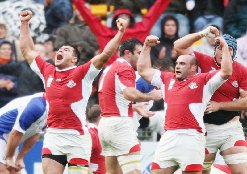
Fiji laid down the challenge before the game even kicked off with their traditional haka led by captain Mosese Rauluni.

Canada certainly started off well enough by securing the majority of possession by keeping the ball amongst their bigger forwards.  But the backline had a tough time against the classier Fijians and failed to get the ball moving through the hands when it counted.

The boot of Pyke didn't help the Canucks' cause much either with endless up-and-unders kicked too far, and in the end just giving possession away to the Fijians in their own 22.

Fiji were their brilliant selves in loose play, with their locks acting like wings as they side-stepped past hapless defenders and the wings acted like locks as they bashed their way towards the Canada tryline.

The tight exchanges were more of a concern to the Fijians -- as it was always going to be -- with the Islanders struggling in the line-outs, losing five altogether off their own throw.  The scrums also took a knock with Canada securing two feeds after pushing their opposition backwards.

Referee Spreadbury -- at times far too whistle-happy -- was forced to blow the game to a stand still after mistakes from both sides started to take their toll, with the small crowd begging for continuity.

However, the mistakes led to penalties and the penalties led to three-pointers as Canada wing James Pritchard opened the scoring with a well-taken shot at goal from the touchline.

Nicky Little got Fiji on the board with a monstrous 40-metre kick to level the scores in the seventh minute of the game after Canada flank Dave Biddle was adjudged off-side.

A wonderful try-saving tackle by skipper and scrum-half Morgan Williams on Fiji full-back Kameli Ratuvou inches from the line prevented the Islanders from taking the lead.

Pyke couldn't do the same for his team-mates though after lock Kele Leawere charged ten metres before trampling over the Canadian full-back for Fiji's first try of the afternoon by the posts.  Little converted the simple conversion and Fiji held a deserved 10-3 lead.

Pritchard kept Canada in tune with a 40-metre penalty kick of his own that just managed to creep over.

Fiji replied after lock Ifereimi Rawaqa showed off some sevens skills and danced his way just short of the tryline.  Ratuvou was on hand to take the quick ball from the ensuing ruck to crash over for his first try of the match.  Little missed the tricky conversion, but the Islanders now had a handy 15-6 lead that they took with them into half-time.

Canada would have been kicking themselves after two missed try-scoring opportunities before the half-time hooter because of fumbling hands.

Fiji made them pay even more after dangerous right wing Vilimoni Delasau showed his incredible pace and strength when he went over for try number three for the Islanders two minutes into the second half.

Flanker Akapusi Qera made the initial burst, galloping a good 30 metres with the tryline in sight.  Last week's man-of-the-match against Japan was too greedy though and went for glory with several team-mates in support.  After another desperate tackle from Williams, the ball was recycled well by the Fijians and flung right to Delasau who made a tough try look easy.

Little converted to take the score to 22-6 and it looked like that was the ball game.

Instead, Fiji switched off their engine and Canada went into fifth gear as attack after attack took the Canucks into the Fijians 22, after yet another gliding run from Pritchard.  The forwards got the charge on and mauled their way towards the Islanders' line.  Nine phases later, fly-half Ryan Smith brushed off a soft tackle from Little and dived over under the sticks.

Pritchard added the extras and just like that, Canada were back in the game with the scoreboard reading 22-13 and 60 minutes gone on the clock.

Again, it was ill-discipline from Canada that halted any threatening attacks they had on their opponents, but Fiji didn't do themselves any favours by turning over far too much ball.

This would often lead to a counter-attack from the Canucks and in the 70th minute replacement hooker Aaron Carpenter made a burst into open space.  The Canada backline was lined up with the biggest overlap the World Cup has seen.  But Pyke went on his own and the rest was TMO history.

Canada turned their next attack into points thanks to another penalty from Pritchard -- who only missed two kicks all afternoon.  That score took the Canucks within a converted try to win the game and they came so close in doing so.

With time up on the clock, the Canada forwards pushed and shoved and pushed again.  The crowd really got behind the Canucks and a match-winning try looked on the cards, but the Fijians held out long enough for Canada to make an error by spilling the ball.

If the Canadian supporters' hearts weighed anchor at that moment, they would have sunk completely after the ball was slapped to Ratuvou, who turned on the gas and raced the entire length of the field to score the clincher, and the bonus point try.

Man of the match:  Fiji let themselves down in this category in the second half after completely losing their flow and control of the game.  A solid performance from full-back Kameli Ratuvou kept Canada looking at the Saracens playmaker's back every time he got the ball.  And lets not forget his brace of tries, the second winning the game for his team.  Centre Seru Rabeni was impressive before he taken off in the second half, while skipper Mosese Rauluni was everywhere as usual.  It's not often though that the losing team gets the nod, but James Pritchard did everything right and would be gutted that his flawless performance on attack, defence and with the boot could only lead to a loss.

Moment of the match:  The dying seconds of the game must have had Canadians' hearts in their throats with an upset just inches away.  That, together with Ratuvou's match-winning sprint towards the line take the accolade.

Villain of the match:  You know who you are ...  the interesting call by Craig Joubert does it for us.  Though our law discussions may clear a few things up later this week.  Until now, all daggers point in the direction of the game's TMO.

The scorers:

For Canada:
Tries:  Smith
Con:  Pritchard
Pens:  Pritchard 3

For Fiji:
Tries:  Leawere, Ratuvou 2, Delasau
Cons:  Little 3
Pen:  Little

Canada:  15 Mike Pyke, 14 DTH van der Merwe, 13 Craig Culpan, 12 Dave Spicer, 11 James Pritchard, 10 Ryan Smith, 9 Morgan Williams (c), 8 Sean-Michael Stephen, 7 Dave Biddle, 6 Jamie Cudmore, 5 Mike James, 4 Mike Burak, 3 Jon Thiel, 2 Pat Riordan, 1 Rod Snow
Replacements:  16 Aaron Carpenter, 17 Dan Pletch, 18 Mike Pletch, 19 Luke Tait, 20 Colin Yukes, 21 Ed Fairhurst, 22 Ander Monro

Fiji:  15 Kameli Ratuvou, 14 Vilimoni Delasau, 13 Seru Rabeni, 12 Seremaia Bai, 11 Isoa Neivua, 10 Nicky Little, 9 Mosese Rauluni (c), 8 Sisa Koyamaibole, 7 Akapusi Qera, 6 Semisi Naevo, 5 Ifereimi Rawaqa, 4 Kele Leawere, 3 Jone Railomo, 2 Sunia Koto, 1 Graham Dewes
Replacements:  16 Vereniki Sauturaga, 17 Henry Qiodravu, 18 Netani Talei, 19 Jone Qovu, 20 Jone Daunivucu, 21 Maleli Kunavore, 22 Norman Ligairi

Referee:  Tony Spreadbury
Touch judges:  Christophe Berdos, Mark Lawrence
Television match official:  Craig Joubert
Assessor:  Steve Hilditch

Thirteen-man Tonga triumph

Tonga, despite being reduced to 13 men, ended a seven-year losing streak against Samoa by causing one of the biggest upsets of the World Cup, winning 19-15 in their Pool A match at Stade de la Mosson, Montpellier, on Sunday.

The Tongans, who played with 14 men for 20 minutes of the game and 13 men for the last five minutes, sent a strong message to pool rivals South Africa and England with a performance that showed plenty of heart.

They may not have the structure of their more illustrious rivals and talk of a quarter-final place may be premature, but they showed they can never be written off.

As one of the poorest nations at the World Cup, they showed that they can grind out victories.

As captain Nili Latu said:  "We came from Tonga [to the World Cup] with empty pockets, but determined to make a point.  We have got two big games coming up [against South Africa on September 22 and England six days later] and that is going to test us."

However, the Tongans passed a big Test in Montpellier on Sunday.

Despite being underdogs they played a tactically more astute game, especially in the second half.

As could be expected, the set pieces of both teams were not of a standard that will suggest they can be World Cup winners.  They are simply not clinical enough and can be disrupted far too easily.  That is why they struggle against the bigger teams.

Normally both sides do bring something special to the game, which includes a willingness to play the game a great pace and take the ball wide as often as possible.

Unfortunately the Sevens skills which these teams are so famous for seemed to have deserted them for large parts of the game.

As a result the first half lacked any real structure or the entertainment value you would have expected of an encounter between these two rivals.

The other disappointing aspect of the game was the extraordinary amount of kicking, as both teams looked flat and very lethargic in a game with a very high error count.

Added to that the option taking and execution of both teams also left a lot to be desired for teams

It was only in the final quarter that there was life to be found in this clash.

Tonga wasted no time in opening their account -- a sweetly struck Pierre Hola penalty, coming after a number of strong driving plays by the Tongans that put the Samoan defenders under pressure.

However, the Samoans hit back almost straight away -- with fullback Gavin Williams levelling matters with a penalty of his own.

Samoa showed their willingness to up the pace of the game, despite the intense heat, when they took a quick line-out and came within a TMO's call of scoring.  As is often the case with calls going to the TMO it wasn't very clear if the ball had been grounded and the doubt resulted in a five metre scrum.  It gave the Tongans a chance to ward off the immediate threat.

It took the Samoans another 15 minutes to get points on the board, another Williams penalty, when Tonga were penalised for not releasing the ball on the ground with the Samoans on attack just metres out from the Tongan tryline.

The Samoans now started to assert themselves on the game and the Tongans conceded a couple of quick penalties, the second of which Williams slotted to take his team's lead to 9-3 after just 23 minutes.

Tonga's prospects were dealt a further blow when centre Epeli Taione was yellow carded for repeated infringements in the 28th minute and Williams slotted a fourth penalty to give the Samoans an even bigger lead.

Ironically this finally sparked the Tongans into action and after a lack of concentration saw some of their earlier efforts come to nothing, Hola slotted his second penalty with just two minutes to go to narrow the gap.

Hola had another shot at goal right on the half-time hooter, but this one he dragged wide.

The penalty count continued to mount and Tonga were the first beneficiaries of this early in the second half when Hola slotted his third penalty to narrow the gap to just three points (12-9).

Samoa's frustration with the harrassing nature of the Tongan game started to show as they conceded some unnecessary penalties and lost any momentum they would have hoped to have build up.

The Tongans, thriving in the stop-start nature of the game looked the more assured of the two sides as the final quarter approached.

And the Tongans were soon rewarded as they not only lifted the tempo, but also the effectiveness of their game.

The reward came in the form of a try to previously yellow-carded centre Epeli Taione -- who was driven over in a heap of bodies, after a a maul and a series of forward-orientated drives.

Hola added the conversion and a penalty a few minutes later as the Tongans looked to pull clear.  At 19-12 ahead, they looked in control.

However, poor discipline cost them dearly as Williams slotted his fifth penalty of the afternoon for Samoa in the 69th minute -- following a cheap, high shot -- and the gap had narrowed to just four points again -- 19-15 to Tonga.

And it went from bad to worse when fiery flanker Hale T-Pole -- the man who was warned earlier for his cheap shot on an opponent -- was red carded for another act of foul play -- this time an elbow to someone's chops.

The Tongans simply did not learn and replacement forward Toma Toke was yellow carded two minutes later for another cheap, high shot on an opponent.

Yet, the Samoans failed to cash in on their numerical advantage -- with some really sloppy play resulting in every scoring chance going to waste.

But the 13-man Tongan team deserves credit for some ferocious tackling -- which, of course, was not always legal.

However, they hung on desperately and earned a valuable win -- their first against Samoa since 2000.

Man of the match:  It wasn't a game of many highlights and many heroes.  The standard of play was far too poor.  However, Tongan number eight Finau Maka certainly put his hand up all afternoon -- both on defence and attack.

Moment of the match:  It is simple.The only try of the match and the defining moment -- with centre Epeli Taione being driven over the line under a pile of bodies in the 59th minute.  It came from a maul and a series of drives, a typical forward try, but the centre was there to add his weight to the Tongan cause and it paid dividends.

Villain of the match:  They were by no means the only culprits in a series of transgressions, but Tongan centre Epeli Taione and replacement forward Toma Toke are both in the book for this award with their yellow cards.  However, the outright winner is Tongan flank Hale T-Pole, who was red carded for an injudicious elbow three minutes after he had been warned for a similar dig on an opponent.

The scorers:

For Samoa:
Pens:  Williams 5

For Tonga:
Try:  Taione
Con:  Hola
Pens:  Hola 4

Yellow cards:  Epeli Taione (Tonga, 28 -- repeated infringements), Toma Toke (Tonga, 75 -- foul play)
Red card:  Hale T Pole (Tonga, 72 -- foul play)

Teams:

Samoa:  15 Gavin Williams, 14 Sailosi Tagicakibau, 13 Elvis Seveali'i, 12 Seilala Mapusua, 11 Alesana Tuilagi, 10 Loki Crichton, 9 Steve So'oialo, 8 Semo Sititi (captain), 7 Ulia Ulia, 6 Daniel Leo, 5 Kane Thompson, 4 Joe Tekori, 3 Census Johnston, 2 Mahonri Schwalger, 1 Justin Va'a.
Replacements:  16 Tanielu Fuga, 17 Muliufi Salanoa, 18 Leo Lafaiali'i, 19 Justin Purdie, 20 Junior Polu, 21 Lolo Lui, 22 David Lemi.

Tonga:  15 Vungakoto Lilo, 14 Tevita Tu'ifua, 13 Sukanaivalu Hufanga, 12 Epeli Taione, 11 Joseph Vaka, 10 Pierre Hola, 9 Enele Taufa, 8 Finau Maka, 7 Nili Latu (c), 6 Hale T Pole, 5 Paino Hehea, 4 Inoke Afeaki, 3 Kisi Pulu, 2 Ephraim Taukafa, 1 Soane Tonga'uiha.
Replacements:  16 Aleki Lutui, 17 Toma Toke, 18 Viliami Vaki, 19 'Emosi Kauhenga, 20 Sione Tu'ipulotu, 21 Isileli Tupou, 22 Hudson Tonga'uiha.

Referee:  Jonathan Kaplan
Touch judges:  Alan Lewis, Bryce Lawrence
Television match official:  Lyndon Bray
Assessor:  Ian Scotney

France fire at last

France are back on song in the World Cup, making amends for their opening night loss with a 87-10 demolition of Namibia on Sunday.

What a turn up for the books!  Here, finally, was an established side making mince meat out of a school of minnows -- and how the French needed this fillip.

It seems like a year since last Friday, but not for France.  Les Bleus had been accused of "betraying" the nation following the loss to Argentina on the opening night of the World Cup.

They duly removed themselves from the spotlight and went into hiding to brood and plot revenge on all comers, and Namibia bore the brunt of their pent-up aggression.

This was a very different French side to the one that froze in Paris last week.  Gone were the nerves, replaced by confidence, hunger, steel and straight running.

France's forwards, relentless in attack and defence, built a solid platform on which the likes of Vincent Clerc, David Marty and Cédric Heymans danced a merry jig.

The Toulouse connection worked well:  pulling the strings were local heroes Frédéric Michalak, sporting an odd shaven corn-row hairdo, and Jean-Baptiste Elissalde.

The big win will serve to exorcise the Argentine demons, but one question remains:  did Bernard Laporte pick the right team for that opening game? France's future minister for sport might yet need the help of a spin doctor or two.

France exploded out of the blocks, attacking the Namibians on the hoof, eager to expunge their sins through speed of thought and limb.  Running away from their problems, if you will.

Heymans, back in his familiar position on the wing and clearly loving life, soon opened the scoring by dotting down in the corner after a rapier-like raid opened a narrow gap on the short side.

A rare foray into French territory then allowed Namibia fly-half Emile Wessels the time and inclination to drop a goal.

But France answered back brilliantly by scoring their second try after cutting Namibia's threadbare defence to smithereens in a break from their deep in their own half.  It was Marty who finished off the move by choosing a sublime angle and fending off a top-heavy tackle before diving over the line.

Things then went bad to worse for the Namibians with Jacques Nieuwenhuis receiving a red card for a high tackle on Sébastien Chabal.  It seemed that l'anesthésiste would need a hit of his own medicine, but the sight of his assailant leaving the field appeared to perk him up.

Critics of the World Cup's slight skew-wiff disciplinary policies might like to question the decision to permanently reduce Namibia to 14 men, but referee Alain Rolland had already had stern words with the hot-headed loose forward.

France took immediate advantage of their numerical advantage by releasing the brake on an unstoppable rolling maul, and Thierry Dusautoir was on hand to collect France's third try.

The hosts collected their bonus-point moments later via a fabulous break down the middle of the paddock.  There was more than a hint of a forward pass, but the speed of the move blurred the infringement, and Lionel Nallet showed good speed in arriving to take the final pass.

Clerc then added his name by scoresheet by skirting round a very ragged defensive line after collected a deft mis-pass from Heymans.

With Michalak now able to feed his runners at will and according to his own preferences, Nallet was soon celebrating his second in the last move of the half.

What a difference a week makes!  With the game all but won and with six tries under their belts, the French trooped off for the break to a standing ovation and with the stirring chimes of La Marseillaise ringing in their ears.  The Namibians were out for the count and the Irish, France's next opponents, surely quivering behind the sofa at their hotel.

France kept their foot on the pedal in the second half, but some courageous defence from the men from south-west Africa kept the hosts almost honest.

The French were clearly wanting to flex each of their muscles for all the world to see, and the next score came from Julien Bonnaire on the tail of a push-over scrum.

The following ploy out of the bag was the cross-field kick, and Jean-Baptiste Elissalde's pin-point punt found Chabal, of all people, lurking in the corner, and Bratley Langenhoven was powerless to stop France's brand new folk hero.

The score only seemed to enrage the man with a thousand nicknames, and l'homme des cavernes was soon over the whitewash for his second after running in a try from his own half, using his pace and immense strength to power over the line.

Elissalde then chose to edge into the limelight, opting to open his try account by using slight of hand rather than monsterism.

Namibia were now in tatters and another flowing move was punctuated by another try from Clerc.

A 75-3 lead would prompt most teams to easy off in deference of battles to come.  But France didn't want to just make their point, they were desperate to ram it down the optical nerves of the watching world.

And so the tries kept coming.  Clerc completed his hat-trick before being denied his fourth by a questionable decision by Simon McDowell in the video suite.

Raphaël Ibañez came off the bench to claim France's 13th and final try and the massacre was complete.

But it was Namibia who had the last word after Langenhoven intercepted to score in the last move of the game; the sporting French public greeting the consolation prize with a hearty cheer.

So all eyes now turn to Friday's crunch encounter between the hosts and Ireland in Paris.

Ireland coach Eddie O'Sullivan said witnessing his side's ugly win over Georgia was akin to watching a "horror movie".  He might be moved to compare this video nasty to being buried alive in a casket of rabid cockerels.  Allez les Bleus -- on this evidence they might yet go all the way.

Man of the match:  There are so many contenders that we feel compelled to award a collective gone.  If individuals must be name, we'll point to the contributions of Sébastien Chabal, Thierry Dusautoir, Frédéric Michalak, Jean-Baptiste Elissalde and Vincent Clerc.  But just pipping the post is Cédric Heymans, who sent a message to his boss that simply read:  "I'm not a fullback, I'm a wing"!

Moment of the match:  The standing ovation at the stoke of half-time told a story in itself, but how can we ignore Sébastien Chabal's 55-metre rampage that lead to his second try?

Villian of the match:  We've seen worse tackles in the last week, but Jacques Nieuwenhuis deserves this hideous gong for failing to heed the warnings that preceded his red card.

The scorers:

For France:
Tries:  Heymans, Marty, Dusautoir, Nallet 2, Clerc 3, Bonnaire, Chabal 2, Elissalde, Ibanez
Cons:  Elissalde 11

For Namibia:
Try:  Langenhoven
Con:  Losper
Drop goal:  Wessels

France:  15 Clément Poitrenaud, 14 Vincent Clerc, 13 David Marty, 12 Damien Traille, 11 Cédric Heymans, 10 Frédéric Michalak, 9 Jean-Baptiste Elissalde (c), 8 Julien Bonnaire, 7 Thierry Dusautoir, 6 Yannick Nyanga, 5 Lionel Nallet, 4 Sébastien Chabal, 3 Pieter de Villiers, 2 Dimitri Szarzewski, 1 Jean-Baptiste Poux.
Replacements:  16 Raphaël Ibañez, 17 Nicolas Mas, 18 Fabien Pelous, 19 Imanol Harinordoquy, 20 Lionel Beauxis, 21 Yannick Jauzion, 22 Aurélien Rougerie.

Namibia:  15 Tertius Losper, 14 Ryan Witbooi, 13 Bratley Langenhoven, 12 Piet van Zyl, 11 Heini Bock, 10 Emile Wessels, 9 Jurie van Tonder, 8 Jacques Nieuwenhuis, 7 Michael MacKenzie, 6 Jacques Burger, 5 Nico Esterhuize, 4 Wacca Kazombiaze, 3 Jane du Toit, 2 Hugo Horn, 1 Kees Lensing (c).
Replacements:  16 Johannes Meyer, 17 Johnny Redelinghuys, 18 Herman Lindvelt, 19 Tinus du Plessis, 20 Eugene Jantjies, 21 Lu-Wayne Botes, 22 Melrick Africa.

Referee:  Alain Rolland
Touch judges:  Carlo Damasco, Kelvin Deaker
Television match official:  Simon McDowell
Assessor:  Tappe Henning